
Dried Iris Root Grinding Machine: From Coarse Crushing to 300 Mesh Fine Powder
A staged grinding route for fibrous dried iris or orris root, from pre-crushing to fine powder production.
YDCS Series Coarse Crusher for large fibrous roots
YDWS Pin Mill reference direction: 40-100 mesh
YDWF ACM Mill reference direction: 100-300 mesh
Material testing required for fineness and capacity
Quick Answer: What Machine Is Suitable for Grinding Dried Iris Root?
For dried iris root, also commonly referred to as orris root, the grinding process should normally be selected according to the original root size, fibrous structure, required powder fineness, and final application.
Because dried roots can be relatively large and fibrous, directly feeding whole roots into a fine grinding machine is usually not the most practical process.
A more reasonable solution is:
Dried Iris Root → YDCS Series Coarse Crusher → Fine Grinding → Powder Collection
For the fine grinding stage:
| Target Particle Size | Recommended Machine | Typical Application Direction |
|---|---|---|
| Coarse particles / pre-crushing | YDCS Series Coarse Crusher | Preparation before fine grinding |
| 40–100 mesh | YDWS Series Pin Mill | General root powder production |
| 100–300 mesh | YDWF Series ACM Mill | Fine and superfine root powder |
| Strict particle size distribution | YDWF Series ACM Mill | Pharmaceutical, functional ingredient, or other higher-specification applications |
These particle-size ranges should be regarded as process selection references rather than guaranteed results. Actual grinding performance depends on the root variety, moisture content, fiber structure, feed condition, target particle size, and machine configuration.
Reference video link:
Watch the equipment or material test video
1. Why Is Dried Iris Root More Difficult to Grind?
When selecting a grinding machine for botanical roots, it is not enough to consider only the required mesh size.
The physical structure of the raw material is equally important.
Dried iris root used commercially as orris material is derived from dried iris rhizomes. Orris materials are also used in fragrance and related botanical applications.
From a grinding perspective, several characteristics need to be considered.
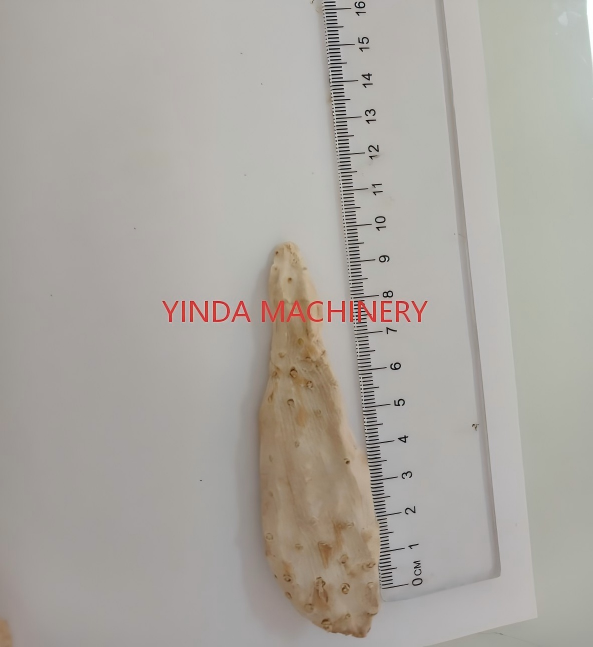
Large and Irregular Feed Size
Unlike powder, grain, or small spice seeds, dried roots are usually supplied as irregular pieces.
Some pieces can be relatively long and wide, which makes direct and stable feeding into a pin mill or ACM mill more difficult.
Large roots may also create:
unstable feeding;
temporary blockage at the inlet;
uneven grinding load;
higher impact on the fine grinding chamber.
Therefore, size reduction before fine grinding is important.
Fibrous Structure
Another important factor is the fiber contained in dried root materials.
Fibrous materials behave differently from brittle crystals such as sugar or salt.
During grinding, fibers may:
bend instead of breaking immediately;
form elongated particles;
affect screen passing efficiency;
reduce grinding efficiency when the feed size is too large.
This is one of the main reasons why a coarse crusher + fine grinder process is usually more practical for dried roots.
Moisture Condition
The root should also be sufficiently dried before grinding.
If moisture is too high, the material may become tougher and more flexible rather than brittle, which can increase the risk of:
fiber entanglement;
material accumulation;
screen blockage;
reduced grinding efficiency.
However, there is no single moisture limit that can be applied to every botanical root.
The suitable moisture condition should be evaluated according to the actual material and confirmed by a grinding test when necessary.
2. Recommended Dried Iris Root Grinding Process
For relatively large dried iris roots, our YINDA recommends separating the process into pre-crushing and fine grinding stages.
Recommended Process Flow
Dried Iris Root
↓
YDCS Series Coarse Crusher
↓
Coarse Root Pieces
↓
YDWS Pin Mill or YDWF ACM Mill
↓
Powder Collection
↓
Optional Sieving / Packaging
The main advantage of this arrangement is that each machine performs a specific size-reduction function instead of forcing one machine to process the material from whole root directly into fine powder.
3. Step One: YDCS Series Coarse Crusher for Root Pre-Crushing
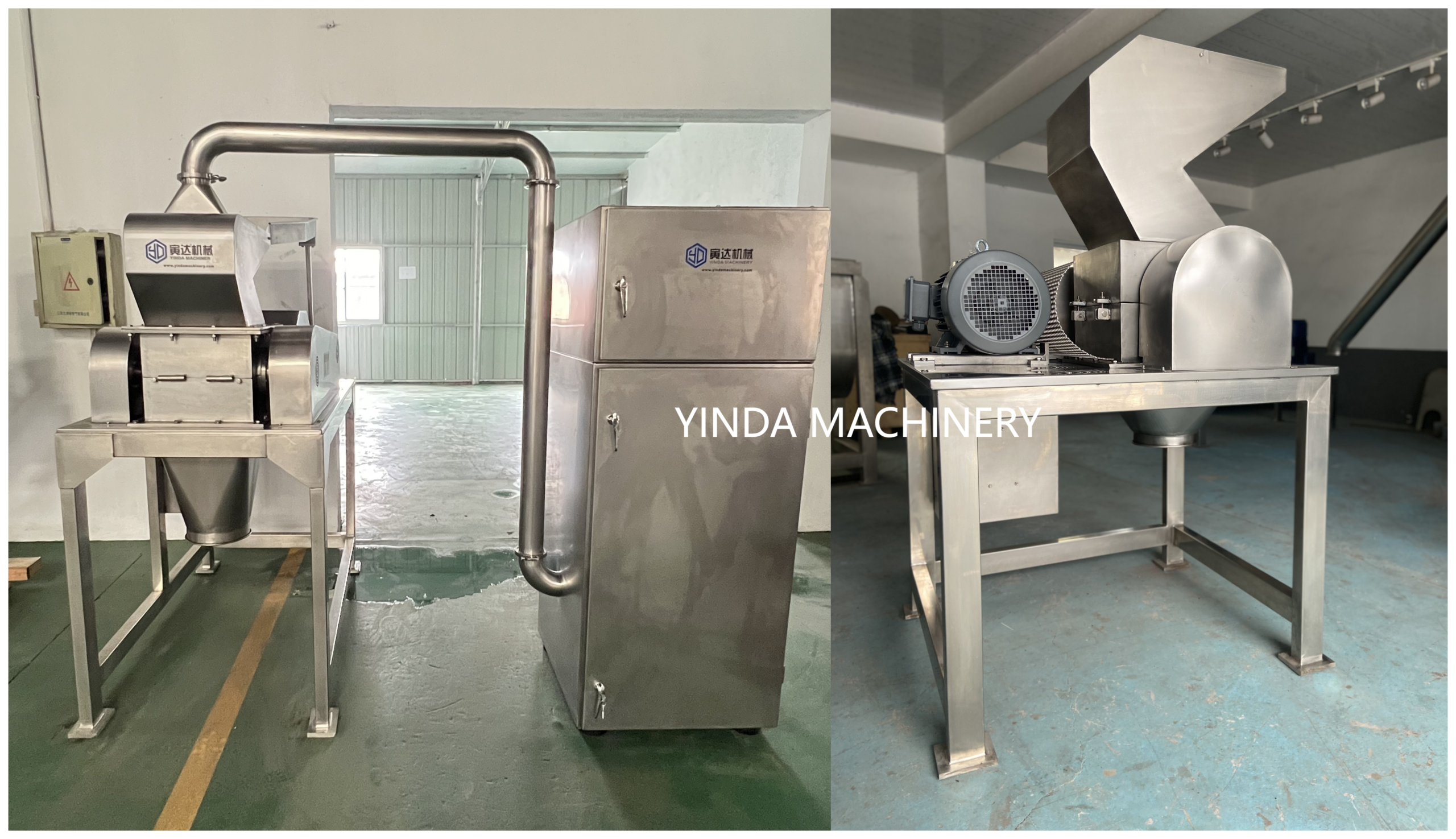
For dried iris roots with relatively large dimensions, our YDCS Series Coarse Crusher is recommended as the first grinding stage.
Its main function is not to produce the final powder.
Instead, it reduces large and irregular roots into smaller pieces that can be fed more smoothly into the downstream fine grinding equipment.
Why Is Pre-Crushing Important?
Pre-crushing provides several practical benefits:
reduces the original root dimensions;
cuts long fibrous materials into shorter pieces;
improves downstream feeding stability;
reduces instantaneous load on the fine grinder;
provides a more uniform feed condition;
makes the complete grinding process easier to control.
For fibrous roots, this process design is generally more appropriate than directly feeding large root pieces into a pin mill or ACM mill.

Working Principle
The YDCS coarse crusher uses mechanical cutting and impact to reduce large pieces of material.
For dried root applications, the objective is to obtain a manageable intermediate particle size rather than a fine powder.
The actual discharge size should be selected according to the requirements of the downstream grinding machine.
4. Option One: 40–100 Mesh Dried Iris Root Powder – YDWS Series Pin Mill
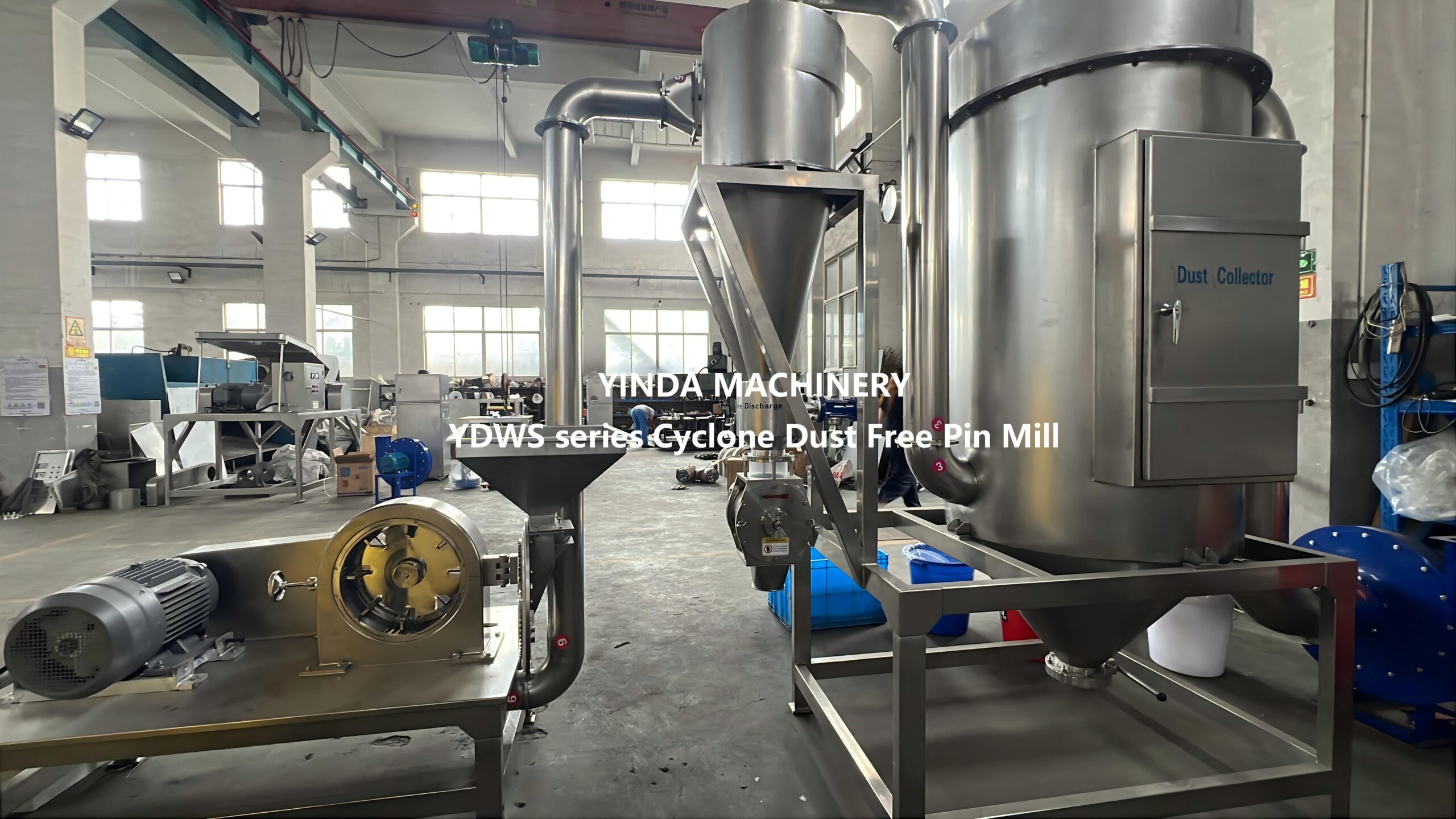
If the required final powder is approximately 40–100 mesh, our YINDA YDWS Series Pin Mill can be considered after coarse crushing.
Recommended Process
Dried Iris Root → YDCS Coarse Crusher → YDWS Pin Mill → 40–100 Mesh Root Powder
The pin mill is particularly suitable when the application requires a relatively fine powder but does not require extremely narrow particle size distribution.
How Does the Pin Mill Grind Root Material?
The YDWS pin mill uses high-speed rotating pins and fixed pins to generate:
impact;
collision;
repeated particle-to-particle interaction.
After the coarse-crushed root enters the grinding chamber, the particles pass through several high-speed impact zones and are gradually reduced in size.
Compared with using the coarse crusher alone, the pin mill provides much finer powder.
When Should You Choose a Pin Mill?
A pin mill can be considered when:
the target powder is approximately 40–100 mesh;
the material has already been properly pre-crushed;
extremely narrow particle size distribution is not required;
the production objective is conventional dried root powder;
the customer prefers a relatively simple grinding system.
For many general botanical root powder applications, this is a practical balance between grinding fineness, system complexity, and investment.
5. Option Two: 100–300 Mesh Fine Powder – YDWF Series ACM Mill
When the required powder becomes finer, especially around 100–300 mesh, an ACM grinding system becomes more suitable.
Recommended process:
Dried Iris Root → YDCS Coarse Crusher → YDWF Series ACM Mill → Fine Root Powder
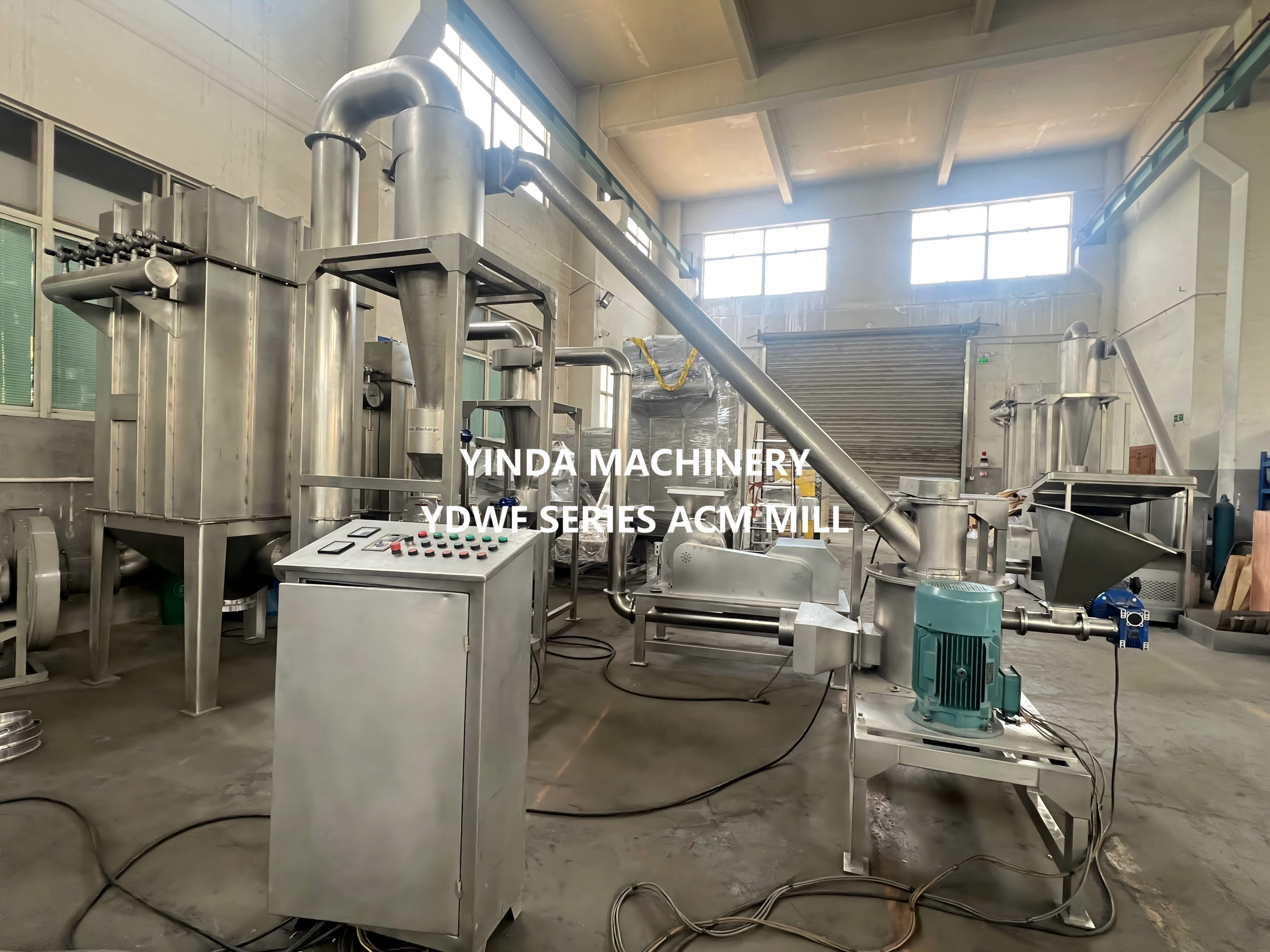
The main difference between an ACM mill and a conventional pin mill is that the ACM system combines grinding and dynamic air classification.
This provides much greater control over fine particles.
6. Why Use an ACM Mill for Fine Root Powder?
Inside the YDWF ACM mill, the material is subjected to high-speed grinding while an integrated classifier controls which particles can leave the grinding chamber.
Fine particles that meet the classification condition are carried out by the airflow.
Particles that remain too coarse are returned to the grinding zone for further size reduction.
This creates a continuous:
Grinding → Classification → Regrinding → Final Collection
Compared with simply controlling particle size through a fixed screen, dynamic classification provides more flexibility when producing fine powder.
7. Pharmaceutical or High-Specification Applications: Why Particle Size Distribution Matters
For some applications, simply saying that the powder is “100 mesh” or “200 mesh” is not enough.
For example, customers in:
pharmaceutical processing;
botanical active ingredient preparation;
functional ingredients;
high-value plant powder processing;
formulation applications;
may have more specific particle-size requirements.
They may evaluate:
D50;
D90;
D97;
maximum particle size;
particle size distribution width;
batch-to-batch consistency.
In these applications, the YDWF Series ACM Mill should be considered directly for the fine grinding stage, even if the required nominal mesh size could theoretically overlap with the capability of another grinder.
The reason is not simply that ACM can produce finer powder.
The more important advantage is its dynamic particle classification capability.
Recommended Process for Higher-Specification Applications
Dried Iris Root
↓
YDCS Coarse Crusher
↓
YDWF ACM Mill with Dynamic Classification
↓
Cyclone / Dust Collection System
↓
Controlled Fine Powder
For pharmaceutical applications, additional requirements such as:
SS304 or SS316L product-contact parts;
surface polishing;
hygienic construction;
easy-cleaning design;
dust containment;
material certificates;
documentation requirements;
should be confirmed separately according to the customer's actual project specification.
A machine should not be described as pharmaceutical-grade or GMP-compliant based only on the grinding principle.
8. Pin Mill vs. ACM Mill for Dried Iris Root
| Comparison | YDWS Pin Mill | YDWF ACM Mill |
|---|---|---|
| Typical selection direction | Medium-fine grinding | Fine / superfine grinding |
| Recommended reference range | 40–100 mesh | 100–300 mesh |
| Grinding principle | High-speed impact and shearing | Grinding + air classification |
| Particle size control | Relatively simple | More precise |
| Dynamic classifier | No | Yes |
| Particle size distribution control | Moderate | Better |
| System complexity | Lower | Higher |
| Suitable for strict PSD requirements | Limited | Recommended |
| Typical application | General root powder | Fine or high-specification powder |
The selection should not be based only on the statement:
“Which machine can reach a certain mesh?”
A better question is:
“What particle size, particle size distribution, production capacity, and final powder quality does the application actually require?”
9. Why Not Feed Whole Dried Roots Directly into the Fine Grinder?
This is an important question for root grinding projects.
Technically, some fine grinding machines may accept relatively large particles.
However, this does not necessarily mean that direct feeding of whole roots is the best industrial process.
For large fibrous root pieces, direct fine grinding may create:
unstable feeding;
excessive instantaneous load;
inefficient use of the fine grinding chamber;
inconsistent grinding;
higher possibility of material accumulation.
Using a coarse crusher as the first stage converts irregular roots into a more controlled feed material.
Therefore:
For large dried roots:
Coarse Crushing + Fine Grinding
is generally preferable to:
Whole Root + Fine Grinding Machine
10. How to Select a Root Grinding Machine
When selecting equipment for dried iris root or other dried botanical roots, YINDA recommends confirming the following information first.
1. Raw Material
What type of root or rhizome will be processed?
Different roots may have significantly different:
hardness;
fiber content;
oil content;
moisture;
density.
2. Maximum Feed Size
Provide the approximate:
Length × Width × Thickness
of the largest pieces.
Photos with a ruler are also useful for evaluating the required pre-crushing stage.
3. Moisture Content
The actual moisture condition affects:
brittleness;
cutting performance;
grinding efficiency;
powder flowability.
4. Target Particle Size
For example:
40 mesh;
60 mesh;
80 mesh;
100 mesh;
200 mesh;
300 mesh.
If particle size distribution is important, mesh alone is not sufficient.
The customer should also provide specifications such as:
D50 / D90 / D97
when available.
5. Required Capacity
Capacity should always be evaluated together with the target fineness.
Producing 60 mesh powder and producing 300 mesh powder from the same raw material can result in very different processing capacities.
Therefore, capacity should not be estimated independently of the particle-size requirement.
6. Final Application
The final use of the powder affects machine selection.
For example:
General botanical powder
→ Pin mill may be sufficient.
Very fine powder
→ ACM mill is more appropriate.
Pharmaceutical or high-specification product with strict particle size distribution
→ ACM mill should be prioritized.
11. Can This Process Be Used for Other Dried Roots?
Yes. The same process concept can also be evaluated for many other dried fibrous botanical materials.
The general logic is:
Large Fibrous Root → Coarse Cutting → Controlled Fine Grinding
rather than selecting the final grinder only according to mesh size.
However, different roots can vary significantly in:
hardness;
fiber structure;
residual oil;
sugar content;
moisture;
thermal sensitivity.
Therefore, equipment selection for one root material should not automatically be copied to another material without evaluation.
For uncertain materials, a grinding test is the most reliable way to confirm the final configuration.
12. Recommended Machine Selection Summary
For dried iris root grinding, the following selection logic can be used as a preliminary reference:
If the roots are large and fibrous:
YDCS Series Coarse Crusher
Use it for pre-crushing before fine grinding.
If the target powder is approximately 40–100 mesh:
YDCS Coarse Crusher + YDWS Pin Mill
Suitable for general dried root powder processing.
If the target powder is approximately 100–300 mesh:
YDCS Coarse Crusher + YDWF ACM Mill
Suitable for fine and superfine root powder.
If particle size distribution is strictly controlled:
YDCS Coarse Crusher + YDWF ACM Mill
The ACM system should be prioritized because its integrated air classifier provides better control of the final particle size distribution.
FAQ About Dried Iris Root Grinding
Can a pin mill grind dried iris root?
Yes, but large dried roots should normally be pre-crushed first.
For approximately 40–100 mesh powder, a YDCS coarse crusher followed by a YDWS pin mill can be considered.
Can dried iris root be ground directly to 200 mesh?
For relatively large fibrous roots, a two-stage process is more practical.
A typical configuration is:
YDCS Coarse Crusher → YDWF ACM Mill
The coarse crusher first reduces the root size, while the ACM mill performs fine grinding and classification.
What machine should I use for 300 mesh root powder?
For fine powder around 300 mesh, the YDWF Series ACM Mill is the recommended direction.
However, the actual achievable particle size and capacity should be verified according to the specific root material.
What is the difference between a pin mill and ACM mill for root grinding?
A pin mill mainly reduces particle size through high-speed impact and shearing.
An ACM mill combines high-speed grinding with dynamic air classification.
Therefore, the ACM mill is more suitable when the customer requires:
finer powder;
controlled top particle size;
tighter particle size distribution;
higher-specification final products.
Do dried roots need to be crushed before fine grinding?
If the original root pieces are relatively large or fibrous, pre-crushing is recommended.
This improves feeding stability and creates a more suitable feed size for the downstream pin mill or ACM mill.
Can YINDA confirm the final mesh and capacity without testing?
A preliminary machine selection can be made based on the material information and target specifications.
However, actual capacity, particle size distribution, powder condition, and grinding behavior are influenced by:
root variety;
feed size;
moisture content;
fiber content;
target fineness;
machine speed;
classifier setting;
feeding rate;
complete system configuration.
For projects with strict final particle-size requirements, material testing is recommended before final equipment confirmation.
Yinda supports global customers with material testing, customized machine selection, complete powder processing line design, and technical support for gum arabic powder production.
Contact YINDA
Email: dennie@yindamachinery.com
WhatsApp: +86-13914192807
Website: https://www.yindamachinery.com/
Need a Dried Root Grinding Solution?
If you are looking for a dried iris root grinding machine, orris root grinder, or grinding equipment for other fibrous botanical roots, the first step is not simply choosing a pin mill or pulverizer.
A suitable grinding system should be selected according to the actual characteristics of your material and the required final powder.
Please provide:
•Raw material name
•Photos of the dried roots
•Maximum feed size
•Moisture content
•Target particle size or particle size distribution
•Required capacity
•Final application
•Required machine material and sanitary standard
YINDA can then evaluate whether your application is better suited for:
YDCS Coarse Crusher + YDWS Pin Mill
or
YDCS Coarse Crusher + YDWF ACM Mill
and recommend a more practical dried root grinding process based on your actual production requirements.
IMAGE
VIDEO
Jiangyin Yinda Machinery Co., Ltd.
Professional Powder Grinding, Mixing and Processing Equipment Solutions
Get a Customized Powder Processing Solution
Please share your raw material, feeding size, target particle size, required capacity, moisture or oil content, heat sensitivity, voltage, cleaning requirements, and final application. Yinda Machinery will evaluate a suitable configuration.
Your Powder Processing Contact
Dennie Yuan | Powder Processing Solution Specialist
Email: dennie@yindamachinery.com
WhatsApp / WeChat: +86-13914192807
Website: www.yindamachinery.com