
Dehulled Mustard Seed Grinding Machine: Roller Mill or Colloid Mill for Mustard Paste?
Select roller milling for coarse mustard particles or wet colloid milling when the required product is a smooth mustard paste.
Roller mill for approximately 20-40 mesh particles
Soaking or formulation followed by colloid milling
High natural oil content and screen-blockage risk
A colloid mill does not produce dry mustard powder
Quick Answer
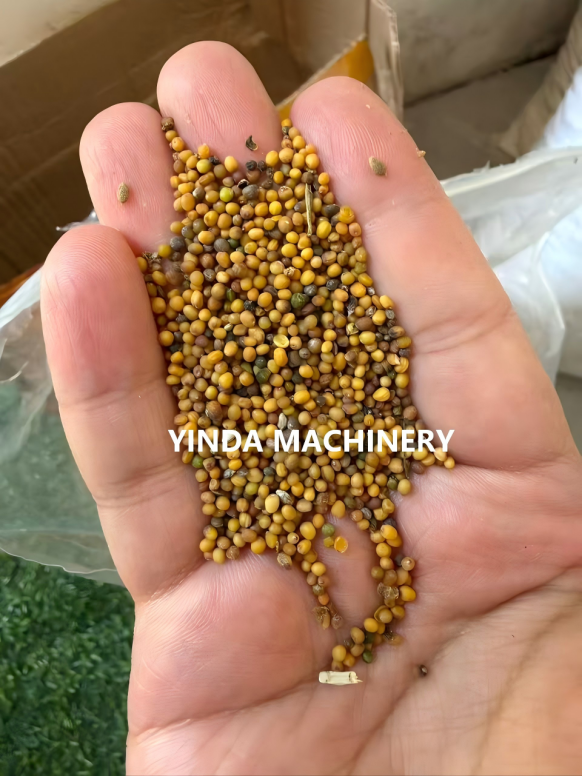
Dehulled mustard seeds contain a relatively high level of natural oil. Once the seed structure is broken, the released oil can cause the material to smear, agglomerate, stick to the grinding chamber, or block screens and classification components.
For this reason, conventional pin mills, hammer mills, and ACM mills are generally not the first recommendation for directly producing fine powder from dehulled mustard seeds.
The appropriate grinding method depends primarily on the final product:
- For a coarse mustard product with approximately 20–40 mesh particles, a roller mill can be considered.
- For a smooth or fine mustard paste, the seeds can be soaked in water, vinegar, brine, or another recipe liquid and then wet-ground using a colloid mill.
- When the required texture is finer than the practical coarse-grinding range, directly soaking and wet-grinding the seeds is normally more suitable than attempting increasingly fine dry grinding.
- A colloid mill produces a wet paste or suspension. It does not produce dry mustard powder.
Industrial mustard preparation commonly involves soaking or combining mustard seeds with water, vinegar, and other recipe ingredients before grinding the mixture to the required paste consistency.
Watch the equipment or material test video
Why Are Dehulled Mustard Seeds Difficult to Grind?
1. High Natural Oil Content
Mustard seeds are oil-rich raw materials. Removing the hull exposes more of the internal seed structure, making oil release more likely when the kernels are subjected to impact, friction, pressure, and temperature rise.
During dry grinding, the released oil may coat the newly generated particles. Instead of remaining as a free-flowing powder, the material may become:
- Sticky
- Greasy
- Agglomerated
- Difficult to discharge
- Difficult to classify
- Difficult to clean from internal machine surfaces
The actual behavior depends on the mustard variety, residual moisture, storage condition, temperature, feed size, required fineness, and grinding method.
2. Finer Dry Grinding Increases Processing Difficulty
Producing a finer powder requires more energy to be applied to the material. For high-oil mustard kernels, additional impact and friction may release more oil and generate more heat.
As a result, reducing the screen opening or increasing the classifier speed does not necessarily produce a stable fine powder. It may instead cause:
- Material buildup inside the grinding chamber
- Screen blockage
- Reduced airflow
- Unstable feeding
- Capacity reduction
- Increased cleaning frequency
- Uneven particle-size distribution
Therefore, machine selection should not be based only on the nominal mesh range of the mill.
3. Final Product Form Determines the Correct Process
Before selecting a mustard seed grinding machine, it is necessary to determine whether the required product is:
- A dry coarse mustard particle
- A coarse-grain mustard paste
- A smooth mustard paste
- A dry fine mustard powder
These products require different processing routes.
A colloid mill is suitable for wet mustard paste, but it cannot replace a dry powder mill when the final product must remain dry.
Recommended Processing Routes
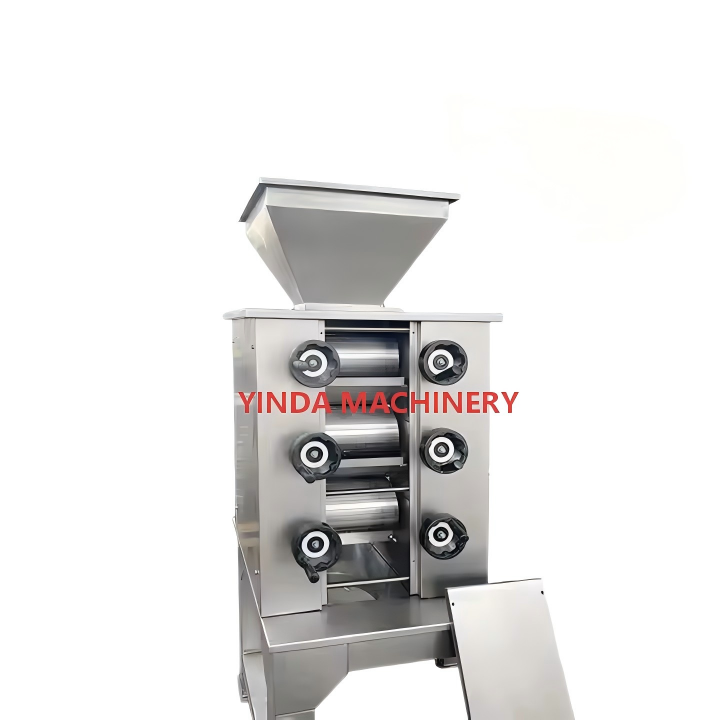
Route 1: Roller Milling for Coarse Mustard Particles
Recommended Process Flow
Dehulled Mustard Seeds→ Inspection and Foreign-Material Removal→ Controlled Feeding→ Roller Mill→ Approximately 20–40 Mesh Coarse Particles→ Soaking or Recipe-Liquid Addition→ Mixing→ Coarse Mustard Paste
This route is suitable when the customer accepts a coarse texture or wants visible mustard particles in the final product.
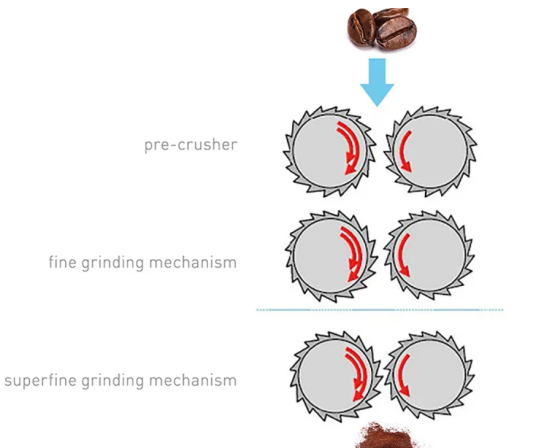
The roller mill reduces the seed size mainly through compression and controlled shearing between the rollers. Compared with high-speed impact grinding, this mechanism can reduce excessive impact on the oil-rich kernels.
Experience-Based Fineness Reference
For dehulled mustard seeds, approximately 20–40 mesh can be used as an initial equipment-selection reference for roller milling.
This range is not a guaranteed result.
The actual particle size and production stability depend on:
- Roller gap
- Roller surface design
- Roller-speed difference
- Feed uniformity
- Seed variety
- Seed temperature
- Residual moisture
- Oil content
- Required particle-size distribution
A material test is recommended before confirming the final roller specification and production capacity.
Suitable Final Products
The roller-milling route may be considered for:
- Whole-grain mustard
- Coarse mustard paste
- Mustard sauces with visible particles
- Semi-finished mustard granules
- Products where a rustic or coarse texture is preferred

Route 2: Soaking and Colloid Milling for Smooth Mustard Paste
Recommended Process Flow
Dehulled Mustard Seeds→ Inspection and Cleaning→ Soaking or Maceration→ Liquid-Solid Ratio Adjustment→ Colloid Mill Wet Grinding→ Mixing or Homogenization→ Holding or Maturation→ Filling
This route is recommended when the final product is a smooth mustard paste rather than dry powder.
Mustard seeds may be soaked in water, vinegar, brine, or another recipe liquid before grinding. Industrial mustard processes commonly use pre-soaking or liquid incorporation to soften the seeds and prepare them for paste grinding.
Why Soak the Mustard Seeds?
Soaking can help:
- Soften the seed structure
- Improve liquid penetration
- Make wet grinding more stable
- Reduce the need for aggressive dry impact
- Facilitate paste formation
- Adjust the final viscosity and consistency
- Support uniform incorporation of recipe ingredients
The soaking liquid, soaking time, liquid-to-seed ratio, and soaking temperature should be determined according to the product formulation.
These conditions should not be standardized without considering:
- Mustard variety
- Dehulling condition
- Desired pungency
- Desired acidity
- Required viscosity
- Final product texture
- Recipe ingredients
- Food-safety requirements
- Subsequent thermal processing
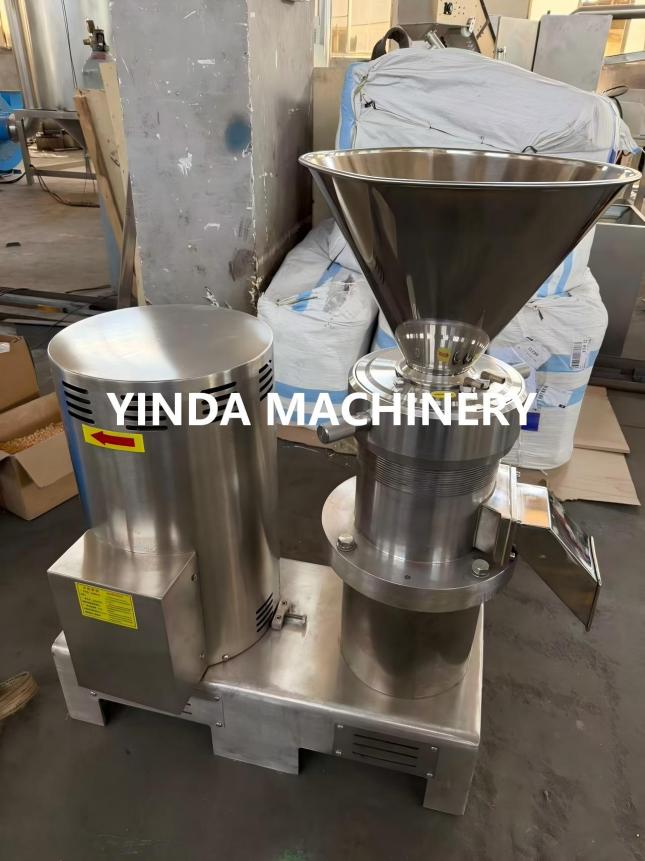
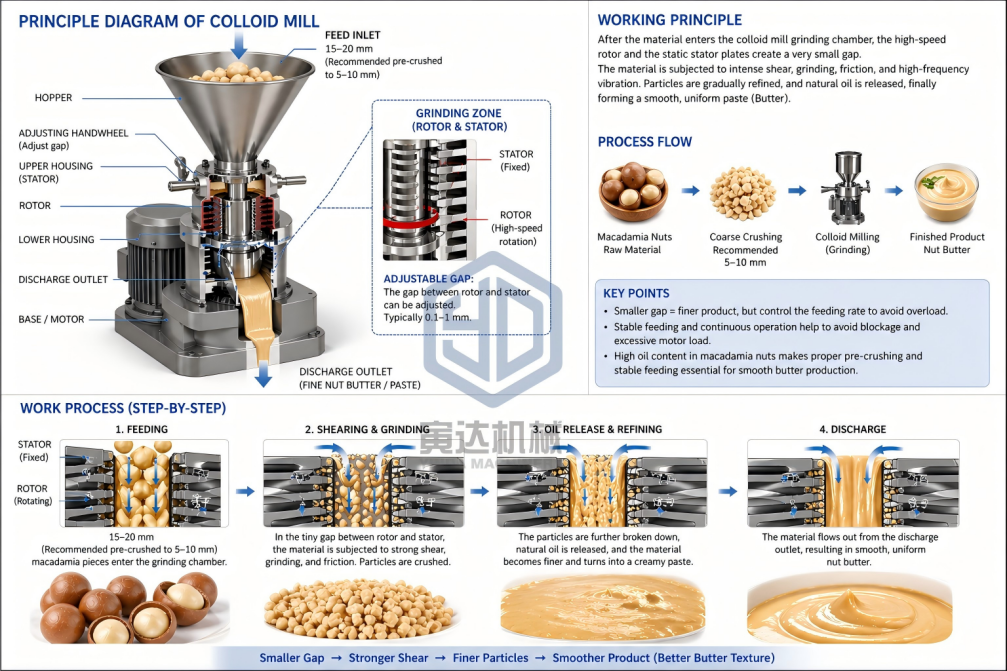
How Does a Colloid Mill Work?
A colloid mill normally uses a high-speed rotor and a stationary stator. The hydrated mustard mixture passes through the adjustable working gap, where it is subjected to:
- Shearing
- Friction
- Turbulence
- High-frequency mechanical action
- Particle dispersion
Colloid mills are specifically designed for wet milling, dispersion, homogenization, and particle-size reduction in liquid or semi-liquid materials. Industrial applications include mustard and other high-viscosity spice pastes.
Depending on the required texture, the material may be:
- Processed in one pass
- Recirculated through the mill
- Processed through progressively smaller working gaps
- Combined with a separate mixing or homogenization stage
The appropriate method must be confirmed through testing because excessive processing may increase product temperature or change viscosity.

Why Are Pin Mills, Hammer Mills, and ACM Mills Not the First Choice?
Pin Mill
A pin mill uses high-speed relative movement between rotating and stationary pins.
It is effective for many dry, brittle, and low-to-moderate-oil materials. However, dehulled mustard seeds may release oil during repeated high-speed impact.
Potential risks include:
- Material coating the pins
- Agglomeration inside the chamber
- Reduced free-flowing ability
- Unstable discharge
- Difficult cleaning
- Temperature rise
Therefore, the nominal fineness range of a pin mill should not be used as proof that it can continuously process high-oil mustard kernels.
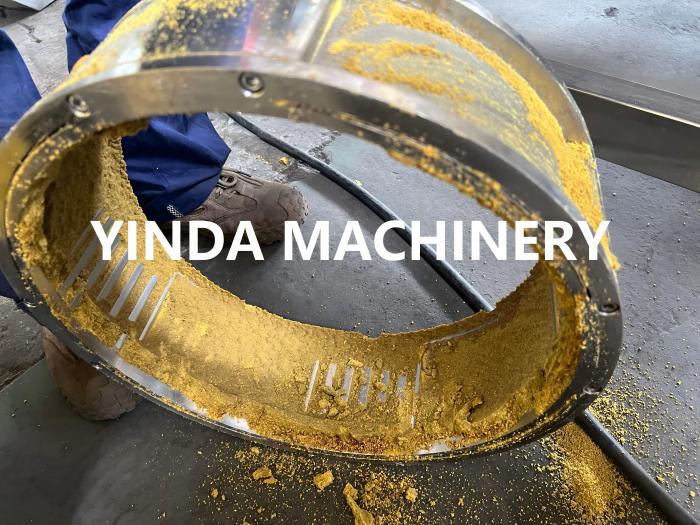
Here is the actual test result from our grinding test.
The powder blocked the screen because of the high rich oil.
Hammer Mill
A hammer mill reduces particle size through repeated impact between the hammers, material, liner, and screen.
For oil-rich mustard kernels, repeated impact may produce a mixture of particles and released oil. When a small screen opening is used, oily particles may accumulate around the screen holes.
A hammer mill may therefore face:
- Screen blockage
- Smearing
- High recirculation inside the chamber
- Reduced output
- Irregular particle size
- Frequent shutdown for cleaning
It is not recommended as the default fine-grinding solution for dehulled mustard seeds.
ACM Mill
An air-classifying mill combines impact grinding with dynamic air classification.
Although an ACM mill can produce fine powder from many food ingredients, the classifier wheel and internal airflow do not eliminate the fundamental problem of oil release.
Sticky mustard material may adhere to:
- Grinding components
- Internal chamber surfaces
- Classifier blades
- Discharge pipelines
- Cyclone surfaces
- Dust-collection components
An ACM mill should therefore not be recommended only because the requested particle size falls within its nominal equipment range.
For high-oil dehulled mustard seeds, an actual material test would be necessary before considering any dry ACM process.
Roller Mill Working Principle
A roller mill feeds the mustard seeds into the gap between rotating rollers.
Depending on the roller design and speed relationship, the material is reduced by:
- Compression
- Controlled crushing
- Shearing
- Flaking or cracking
The roller gap can be adjusted to control the degree of particle-size reduction.
Compared with high-speed impact mills, the roller mill applies a more controlled crushing action. It is therefore more appropriate when the objective is to obtain coarse mustard particles rather than very fine dry powder.
However, reducing the roller gap excessively does not automatically guarantee a finer, free-flowing mustard powder. Once excessive oil is released, the material may still become sticky or form compressed flakes.
Colloid Mill Working Principle
The soaked mustard seed mixture enters the colloid mill through the inlet.
A high-speed rotor moves relative to the stationary stator, creating strong mechanical forces within a narrow adjustable gap. The hydrated seed particles are broken down, dispersed, and incorporated into the liquid phase.
The resulting product is a mustard paste or suspension.
The final texture is influenced by:
- Initial seed particle size
- Soaking condition
- Liquid-to-solid ratio
- Rotor-stator gap
- Feed rate
- Product viscosity
- Number of grinding passes
- Product temperature
- Formula ingredients
For this reason, colloid mill performance should be evaluated by paste quality rather than only by a mesh number.
More useful evaluation indicators include:
- Particle-size distribution
- Maximum detectable particle size
- Paste smoothness
- Viscosity
- Flowability
- Temperature after grinding
- Oil separation
- Product uniformity
- Sensory texture
- Here is our website link for your quick model choosing:
- https://yindamachinery.com/colloid-mill/
Roller Mill vs. Colloid Mill
| Comparison Item | Roller Mill | Colloid Mill |
|---|---|---|
| Processing method | Mainly dry coarse crushing | Wet grinding |
| Suitable feed | Dry dehulled mustard seeds | Soaked seeds or mustard slurry |
| Typical product form | Coarse particles | Paste or suspension |
| Initial fineness reference | Approximately 20–40 mesh | Should be evaluated by wet particle size and paste texture |
| Final texture | Coarse or grainy | Fine and smooth |
| Liquid required during grinding | Normally no | Yes |
| Suitable for dry powder | Only for relatively coarse particles | No |
| Main mechanical action | Compression and controlled shearing | Rotor-stator shearing, friction, and dispersion |
| Oil-release risk | Lower than intensive impact grinding, but still requires control | Oil becomes incorporated into the liquid paste |
| Typical application | Coarse mustard or intermediate granules | Smooth mustard paste and sauce |
Recommended Configuration Options
Option A: Coarse Mustard Paste Line
- Raw-material inspection
- Magnetic separation or foreign-material removal
- Controlled feeder
- Roller mill
- Collection hopper
- Soaking or mixing tank
- Paste mixer
- Transfer pump
- Filling equipment
This configuration is suitable when approximately 20–40 mesh mustard particles are acceptable and the final product should retain a coarse texture.
Option B: Smooth Mustard Paste Line
- Raw-material inspection
- Soaking or maceration tank
- Agitated feeding tank
- Colloid mill
- Recirculation pipeline, if required
- Mixing or homogenization tank
- Holding tank
- Transfer pump
- Filling equipment
This configuration is suitable when the customer requires a smooth and uniform mustard paste.
Optional Components
Depending on the production process, optional equipment may include:
- Stainless-steel soaking tank
- Agitator
- Jacketed tank
- Sanitary transfer pump
- Recirculation pipeline
- Buffer tank
- Magnetic separator
- Inline filter
- Temperature monitoring
- Integrated electrical control system
The exact configuration must be selected according to the product viscosity, recipe, production capacity, cleaning method, and food-safety requirements.
Equipment Selection Guide
Choose a Roller Mill When:
- The mustard seeds are processed in a dry condition.
- The required particles are relatively coarse.
- Approximately 20–40 mesh is acceptable as an initial reference.
- The final mustard paste should retain visible particles.
- A coarse-grain texture is required.
- The customer wants to reduce the seed size before soaking or mixing.
Choose a Colloid Mill When:
- The final product is mustard paste.
- A smooth texture is required.
- The seeds can be soaked before grinding.
- Water, vinegar, brine, or another recipe liquid is part of the formula.
- Dry fine powder is not required.
- Particle dispersion and paste uniformity are more important than dry mesh size.
Do Not Select a Colloid Mill When:
- The final product must remain a dry powder.
- No liquid can be introduced.
- The downstream process cannot handle a paste or slurry.
- The product must be collected in powder bags immediately after grinding.
Require a Material Test When:
- A dry powder finer than 40 mesh is required.
- The mustard variety or oil content is unknown.
- The customer requires guaranteed continuous capacity.
- The material has been roasted or heat-treated.
- The product temperature is strictly limited.
- The customer requires a defined D90, D97, or D99 particle size.
- The required powder must remain free-flowing.
Important Technical Clarification: Mesh Is Not the Best Indicator for Mustard Paste
Mesh is primarily a screening term used for dry particles.
For wet-ground mustard paste, the product normally cannot be evaluated accurately by passing it through a conventional dry sieve. The liquid phase, viscosity, and particle adhesion affect the result.
Therefore, the following specifications are more appropriate for colloid-milled mustard paste:
- Target particle-size distribution in microns
- Maximum particle size
- Paste viscosity
- Product consistency
- Sensory smoothness
- Uniformity
- Oil separation after storage
- Product temperature after grinding
If you want “100 mesh mustard paste,” the requirement should be clarified.
The actual request may actually mean:
- No obvious graininess
- A smooth mouthfeel
- A maximum particle size below a certain value
- A paste that can pass through a specific filling nozzle
- A stable and uniform suspension
These requirements should be converted into measurable product indicators before equipment selection.
What Information Is Required Before Selecting the Machine?
To recommend a suitable mustard seed processing system, the following information should be confirmed:
- Is the mustard seed whole or dehulled?
- What type or variety of mustard seed is used?
- Is the raw material dry, roasted, or pre-treated?
- Is the final product a dry powder or a paste?
- Is a coarse or smooth texture required?
- What liquid will be used for soaking?
- What is the liquid-to-solid ratio?
- What is the required batch size or hourly capacity?
- What is the expected product viscosity?
- Is recirculation permitted?
- What is the maximum acceptable product temperature?
- What cleaning method is required?
- Are SS304 or SS316L product-contact parts required?
- Is an integrated soaking, grinding, mixing, and filling line required?
Without this information, selecting a machine only according to mesh and capacity may lead to an unsuitable process.
Frequently Asked Questions
Can a pin mill grind dehulled mustard seeds?
A pin mill can physically break mustard seeds, but it is not normally the first recommendation for high-oil dehulled mustard kernels.
As the material becomes finer, the released oil may cause sticking, agglomeration, internal buildup, and unstable discharge. A test would be necessary before confirming feasibility.
Can a hammer mill produce fine mustard powder?
A hammer mill may produce coarse particles from certain mustard materials, but using a small screen to obtain fine powder can increase the risk of screen blockage and oil-related buildup.
For dehulled high-oil mustard seeds, a roller mill is generally more suitable for controlled coarse reduction.
Can an ACM mill grind mustard seeds into fine powder?
An ACM mill is capable of fine grinding many dry materials, but its nominal fineness range does not guarantee suitability for high-oil mustard kernels.
Oil-rich particles may adhere to the grinding chamber, classifier, cyclone, pipeline, or filter. The process should not be recommended without a material test.
What machine is recommended for 20–40 mesh mustard particles?
A roller mill can be considered when approximately 20–40 mesh particles are acceptable.
This is an experience-based selection reference rather than a guaranteed result. The actual fineness and capacity must be confirmed according to the mustard seed condition and roller configuration.
What machine is recommended for smooth mustard paste?
A colloid mill is recommended for wet grinding soaked mustard seeds into a smooth paste.
The seeds should first be combined with the appropriate process liquid according to the product formulation.
Should mustard seeds be soaked before colloid milling?
Yes. A colloid mill requires a pumpable liquid, slurry, or semi-fluid feed.
The soaking stage softens the seed material and prepares it for stable wet grinding. The soaking medium may be water, vinegar, brine, or another recipe liquid. Commercial mustard processing commonly includes pre-soaking or liquid incorporation before grinding.
Can a colloid mill produce dry mustard powder?
No.
A colloid mill is a wet-grinding machine. Its output is a paste, suspension, dispersion, or emulsion rather than dry powder.
If dry fine mustard powder is required, a separate dry-grinding feasibility study is necessary.
Is finer dry grinding always better before making mustard paste?
Not necessarily.
If the final product is a smooth paste, attempting to produce increasingly fine dry mustard powder may create unnecessary oil-release and cleaning problems.
Direct soaking followed by wet grinding can simplify the process and avoid an unstable fine dry-grinding stage.
How should colloid-milled mustard paste fineness be measured?
It is better to use particle size in microns, particle-size distribution, viscosity, paste smoothness, and maximum detectable particle size.
A mesh number alone may not accurately represent the quality of a viscous wet paste.
Is material testing necessary?
Yes, especially when the customer requires:
- A guaranteed capacity
- A defined particle-size distribution
- A specific paste viscosity
- A strict product-temperature limit
- Continuous industrial operation
- Dry powder finer than 40 mesh
Testing should use the customer’s actual mustard seeds and recipe liquid whenever possible.
Conclusion
Dehulled mustard seeds should not be treated as ordinary dry spices.
Their high natural oil content makes conventional high-speed impact grinding difficult, especially when fine dry powder is required. Pin mills, hammer mills, and ACM mills should therefore not be selected only according to their nominal mesh ranges.
For coarse mustard particles or grainy mustard paste, a roller mill can be considered, with approximately 20–40 mesh used as an initial experience-based reference.
For smooth mustard paste, the more appropriate process is:
Soaking or maceration → colloid mill wet grinding → mixing or homogenization → filling
When the final product must remain dry and finer than the practical roller-milling range, the application requires separate testing. A colloid mill cannot produce dry powder.
YINDA can evaluate the raw material, final product form, required texture, viscosity, capacity, soaking process, and cleaning requirements before recommending a suitable mustard seed grinding and paste-processing system.
Contact YINDA
Email: dennie@yindamachinery.com
WhatsApp: +86-13914192807
Website: https://www.yindamachinery.com/
Please provide the following information for technical evaluation:
- Mustard seed photos or videos
- Whole or dehulled seed
- Raw-material moisture
- Required final product
- Required particle size or paste texture
- Hourly or batch capacity
- Soaking liquid and formulation
- Product-contact material requirement
- Voltage and frequency
- Required cleaning method
A material test is recommended before confirming the final machine model, working gap, capacity, and process configuration.
Get a Customized Powder Processing Solution
Please share your raw material, feeding size, target particle size, required capacity, moisture or oil content, heat sensitivity, voltage, cleaning requirements, and final application. Yinda Machinery will evaluate a suitable configuration.
Your Powder Processing Contact
Dennie Yuan | Powder Processing Solution Specialist
Email: dennie@yindamachinery.com
WhatsApp / WeChat: +86-13914192807
Website: www.yindamachinery.com