
Ribbon Blender with Liquid Spray System: How to Add Oil or Flavor Without Lumps
Use controlled spray nozzles, powder circulation, and metered liquid addition to distribute oil or flavor while reducing local wet lumps.
Recommended Machine
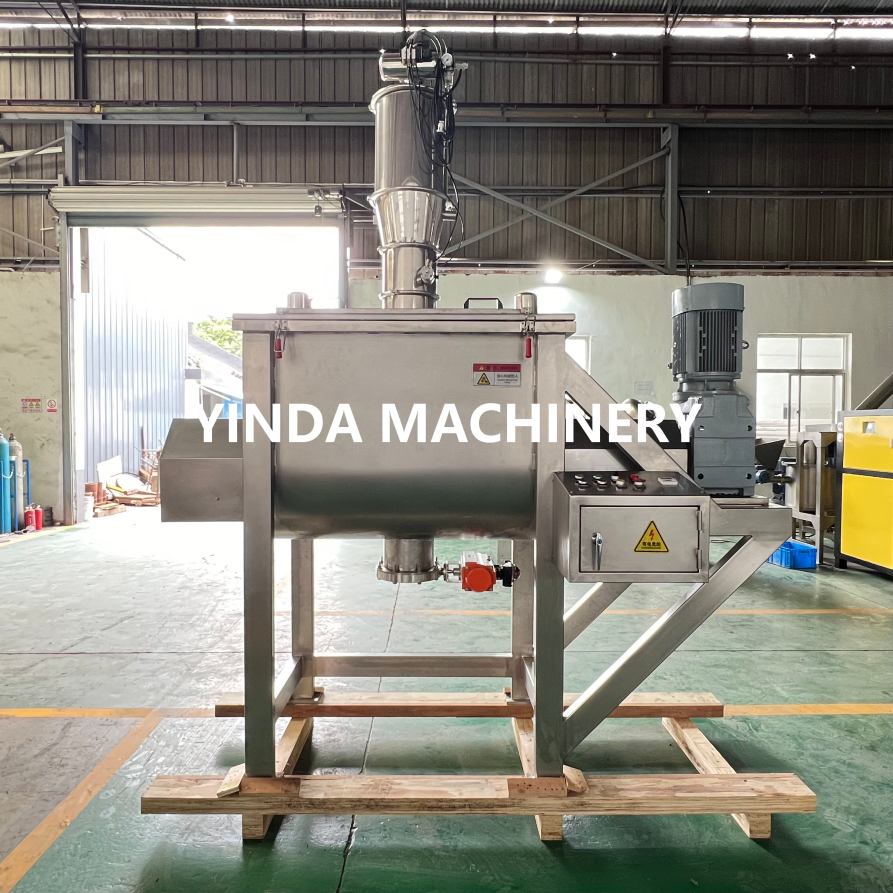
YDLH Series Ribbon Blender with Liquid Spray System
Suitable Addition
Minor quantities of oil, flavor, color, lecithin, or binder solution
Key Process Controls
Spray rate, droplet size, nozzle position, viscosity, and mixer loading
Alternative
YDSM Plough Shear Mixer for stickier or higher-liquid formulations
Quick Answer: Can a Ribbon Blender Mix Powder with Oil or Liquid Flavor?
Yes.
YINDA YDLH series ribbon blender equipped with a liquid spray system can be used to mix dry powders while adding minor quantities of liquid ingredients such as:
- Flavoring oil
- Liquid flavor
- Lecithin
- Liquid color
- Edible oil
- Binder solution
- Other low-viscosity liquid additives
The key is not simply adding the liquid into the mixer.
For better distribution, the liquid should normally be introduced through properly selected spray nozzles while the powder is already moving inside the mixing chamber. A metering pump or pressure feeding system can be used to control the liquid addition rate.
This helps distribute the liquid over a larger powder surface instead of allowing it to concentrate in one area and form wet lumps. Controlled spray rate, nozzle selection, mixer loading and powder characteristics all affect the final result.

Watch the equipment or material test video
Why Does Directly Pouring Oil into Powder Create Lumps?
This is one of the most common problems when liquid ingredients are added to dry powders.
Suppose a formula contains salt, sugar, starch, milk powder, protein powder, spices or other dry ingredients, together with a small amount of oil or liquid flavor.
If the liquid is poured directly into one position inside the mixer, several problems may occur.
1. Local Over-Wetting
A large amount of liquid contacts only a small volume of powder at the beginning.
These particles absorb or become coated with much more liquid than the surrounding material.
Instead of being distributed evenly, they may stick together and form wet agglomerates.
2. Uneven Liquid Distribution
Once a wet lump is formed, the liquid inside it becomes more difficult to redistribute to the rest of the batch.
The mixer then has to mechanically break and redistribute these agglomerates.
A conventional ribbon agitator can move material effectively, but it is not designed as a high-speed lump-breaking device.
3. Powder Properties Can Make the Problem Worse
Different powders respond very differently when exposed to liquid.
For example, some powders absorb liquid quickly, while others have poor wettability. Fine powders with large surface areas may behave differently from coarse granules.
Therefore, the same spray system cannot automatically guarantee the same result for every formulation.
This is why liquid addition should be considered as a powder + liquid process, rather than simply an accessory added to a standard dry powder mixer.
Recommended Mixing Process
For many powder formulations containing a relatively small liquid component, the following process is more appropriate:
Dry Powder Feeding
↓
Dry Pre-Mixing
↓
Start Continuous Powder Movement
↓
Controlled Liquid Spraying
↓
Powder + Liquid Mixing
↓
Post-Mixing After Liquid Addition
↓
Discharge
The principle is simple:
Do not allow a large quantity of liquid to contact a small quantity of stationary powder.
Instead, spread the liquid progressively across powder that is continuously circulating inside the mixer.
Step 1: Load the Main Dry Ingredients
The main powders are first loaded into the ribbon blender.
Depending on the production line, feeding can be manual or connected with equipment such as:
- Vacuum conveyor
- Screw conveyor
- Dump station
- Intermediate storage hopper
Minor dry ingredients can also be added according to the formulation.
Step 2: Pre-Mix the Dry Powder
Before spraying the liquid, it is normally preferable to allow the ribbon blender to mix the dry ingredients first.
This establishes stable powder circulation inside the mixing chamber.
It is particularly useful when the formulation contains ingredients with different:
- Particle sizes
- Bulk densities
- Concentrations
- Flowability
The objective is to create a reasonably distributed dry mixture before introducing another variable—the liquid.
Step 3: Spray the Liquid While the Powder Is Moving
After the powder is circulating, the liquid spray system starts.
Instead of discharging liquid from one large pipe directly into the powder bed, atomizing or dispersing nozzles can divide the liquid into smaller droplets and distribute them across a wider area.
Typical system components may include:
- Liquid storage tank
- Metering pump
- Pipeline
- Spray bar
- One or multiple spray nozzles
- Valve and flow-control components
- Optional heating or temperature-control arrangement for certain liquids
A controlled feeding rate is important. Excessive liquid flow can flood a localized section of the powder bed and cause wet agglomerates.
Step 4: Continue Mixing After Liquid Addition
The mixer should not necessarily be stopped immediately after all liquid has entered the chamber.
Additional mixing time allows the ribbon agitator to continue redistributing the coated powder throughout the batch.
The appropriate spraying time and post-mixing time depend on the actual formulation.
They should be confirmed according to the material rather than using one fixed mixing time for every product.
How Does a Ribbon Blender with Liquid Spray System Work?
A typical horizontal ribbon blender consists of:
- U-shaped mixing chamber
- Main shaft
- Inner ribbon
- Outer ribbon
- Drive system
- Discharge valve
- Feeding cover
- Optional liquid spray system
The inner and outer ribbons are arranged in opposite directions.
During operation, they generate axial and radial circulation of the powder, continuously exchanging material from different areas inside the mixing chamber.
When liquid is sprayed onto this moving powder bed, fresh powder surfaces are continuously exposed to the spray.
This is fundamentally more suitable for uniform liquid distribution than pouring the same quantity of liquid into one stationary area.

Five Key Factors for Preventing Lumps
Adding a spray nozzle alone does not solve every powder-liquid mixing problem.
The following parameters are more important.
1. Liquid Addition Rate
This is one of the first parameters to control.
If liquid enters faster than the powder can absorb and redistribute it, local wet zones can develop.
Therefore:
Faster spraying does not necessarily mean faster production.
A slower and more controlled addition can sometimes produce a much more uniform final mixture.
2. Spray Droplet Size
A concentrated stream of liquid has a very different effect from dispersed droplets.
When appropriate atomization is used, the same amount of liquid can contact a larger powder surface.
However, excessively fine atomization is not automatically better either.
The correct nozzle design depends on:
- Liquid viscosity
- Required flow rate
- Spray pressure
- Powder characteristics
- Available spray area
- Mixer size
Nozzle selection should therefore be based on the actual process.
3. Nozzle Position
The objective is to spray toward the active moving powder zone, not simply toward any open space inside the mixer.
Poor nozzle positioning may increase:
- Mixer wall wetting
- Shaft contamination
- Liquid accumulation
- Cleaning difficulty
- Local agglomeration
For this reason, nozzle quantity, spray angle and installation position should be reviewed according to mixer dimensions and powder loading.
4. Liquid Viscosity
Low-viscosity oil and flavor solutions are generally easier to pump and spray than highly viscous liquids.
As viscosity increases, the liquid may become more difficult to atomize.
Depending on the material, additional measures may need to be evaluated, such as:
- Different nozzle design
- Larger liquid passage
- Suitable pump selection
- Liquid temperature control
The configuration should be determined from the actual liquid properties.
5. Powder Wettability and Absorption
Two formulations with the same liquid percentage can behave completely differently.
For example, the result depends on whether the dry ingredients:
- Absorb oil rapidly
- Repel the liquid
- Become sticky after wetting
- Dissolve partially
- Form agglomerates easily
This is one reason why we do not recommend using a universal liquid percentage as the only criterion for mixer selection.
Material testing is more reliable for critical formulations.
Typical Applications
A ribbon blender with liquid spray can be considered for applications such as:
Seasoning Powder
Dry ingredients may include:
- Salt
- Sugar
- MSG
- Maltodextrin
- Cheese powder
- Spices
- Flavor powders
Small quantities of liquid flavor, edible oil or liquid color may be sprayed during mixing.
Nutritional and Food Powder
Possible formulations include:
- Protein powder
- Supplement powder
- Beverage premix
- Milk-based powder
- Cereal powder
Liquid flavor or other minor ingredients can be introduced through the spray system when required.
Spice and Flavor Blends
Oil can sometimes be used to carry flavors, colors or functional ingredients.
Controlled spraying can help reduce localized over-wetting compared with direct liquid pouring.
Chemical Powder
The same principle can also be used for certain chemical formulations requiring minor liquid additives, provided the material compatibility and relevant safety requirements are properly evaluated.
Recommended Ribbon Blender Configuration
For a powder formulation requiring liquid addition, a typical configuration can include:
| Component | Function |
|---|---|
| U-Type Mixing Chamber | Contains the batch |
| Double Ribbon Agitator | Provides powder circulation |
| Gear Motor | Drives the mixing shaft |
| Spray Nozzle / Spray Bar | Distributes liquid |
| Metering Pump | Controls liquid feed rate |
| Liquid Tank | Stores liquid additive |
| Discharge Valve | Controls product discharge |
| Control System | Controls mixing and liquid addition sequence |
Additional options may include:
- SUS304 construction
- SUS316L contact parts
- Variable-frequency speed control
- Vacuum powder feeding
- Load cells
- Pneumatic discharge valve
- Dust collection
- Customized liquid tank
- Heating system for suitable liquid ingredients
- Integrated PLC control
The final configuration should be selected according to the powder, liquid and production requirements.
Liquid Spray vs. Direct Pouring
| Item | Direct Liquid Pouring | Liquid Spray System |
|---|---|---|
| Liquid distribution | Concentrated | More dispersed |
| Local over-wetting risk | Higher | Lower when correctly designed |
| Flow-rate control | Limited | Can be controlled |
| Repeatability | More operator-dependent | Easier to standardize |
| Suitable for flavor/oil dosing | Limited | More suitable |
| Automation | Difficult | Easier to integrate |
For production requiring consistent batch-to-batch liquid addition, the spray system is normally the more controllable solution.
When Is a Ribbon Blender No Longer the Best Choice?
This point is important.
A ribbon blender with liquid spray is not automatically the best machine for every powder + liquid formulation.
As the liquid addition becomes more demanding, several problems may become increasingly important:
- More wet agglomerates
- Sticky powder
- Difficult liquid redistribution
- Stronger tendency to coat the mixer wall
- Higher requirement for lump breaking
- Need for faster powder-liquid dispersion
At this stage, simply installing more spray nozzles may not solve the fundamental mixing problem.
A mixer with stronger dispersing and deagglomerating capability should be evaluated.
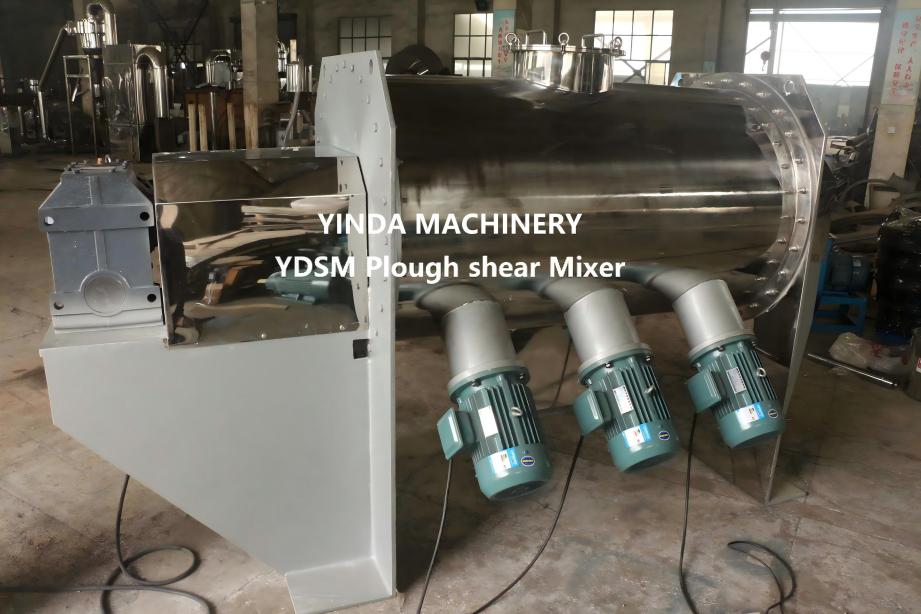
One possible solution is YINDA YDSM Plough shear Mixer.
Alternative for Higher Liquid Addition: Plough shear Mixer
YDSM series Plough Shear Mixer uses specially shaped mixing elements rotating inside a horizontal cylindrical chamber.
The movement of these mixing elements creates much more intensive particle motion than a conventional ribbon agitator.
This promotes rapid interaction between the liquid droplets and continuously moving powder particles.
For formulations where liquid addition causes agglomeration, the system can also be equipped with high-speed choppers.
The choppers provide additional localized shear to help break wet agglomerates and improve liquid distribution. This makes the ploughshare mixing principle particularly relevant when powder-liquid interaction and deagglomeration become more demanding.
YDSM Series Plough Shear Mixer Should Be Evaluated When:
- The liquid addition is relatively high for the formulation
- Powder becomes sticky after liquid addition
- Wet agglomerates are difficult to break
- Faster liquid dispersion is required
- Liquid must be distributed more intensively
- A ribbon blender cannot achieve the required product consistency
However, a Plough Shear Mixer is not automatically necessary whenever liquid is present.
For relatively simple dry blending with a minor liquid additive, a ribbon blender with a properly designed spray system is usually a more economical and straightforward solution.
Explore Our Ploughshare Mixer:https://yindamachinery.com/plough-shear-mixer/
Ribbon Blender vs. Plough Shear Mixer for Liquid Addition
| Mixing Requirement | Ribbon Blender + Spray | Plough Shear Mixer |
|---|---|---|
| Dry powder blending | Excellent application | Suitable |
| Minor liquid addition | Recommended | Suitable |
| Oil/flavor coating | Suitable | Suitable |
| Mixing intensity | Moderate | Higher |
| Wet lump breaking | Limited | Better with chopper |
| Sticky formulation | Application-dependent | Generally more capable |
| Higher liquid loading | Requires evaluation | More suitable for evaluation |
| Equipment investment | Lower | Higher |
| Process complexity | Relatively simple | Higher |
Therefore, machine selection should follow the mixing mechanism required by the formulation, rather than simply comparing mixer capacity or price.
How to Choose the Right Mixer
Before selecting a ribbon blender with liquid spray, we recommend confirming the following information.
Dry Powder Information
- What materials need to be mixed?
- What is the bulk density?
- What is the particle size?
- Is the powder free-flowing or cohesive?
- Does the powder absorb oil easily?
Liquid Information
- What liquid needs to be added?
- What is the liquid viscosity?
- How much liquid is added per batch?
- Does the liquid need heating before spraying?
- Does the liquid make the powder sticky?
Production Information
- What is the batch size?
- What is the required production capacity?
- What mixing uniformity is required?
- What material is required: SUS304 or SUS316L?
- Is automatic liquid dosing required?
These questions allow us to determine whether the project is a standard dry mixing application with minor liquid addition or a more intensive powder-liquid mixing process.
FAQ
Can I Pour Oil Directly into a Ribbon Blender?
Technically, liquid can be introduced through an opening, but direct pouring is generally less controllable when uniform liquid distribution is important.
For minor oil or flavor addition, spraying the liquid onto moving powder is normally a better process because it reduces localized liquid concentration.
Can a Ribbon Blender Mix Oil and Powder?
Yes, provided the formulation is suitable.
Ribbon blenders are commonly used for dry powder mixing and can also be configured for adding minor liquid ingredients through a spray system.
Why Does My Powder Form Lumps After Adding Liquid?
Possible reasons include:
- Liquid addition is too fast
- Droplets are too concentrated
- Liquid is poured into one area
- Powder absorbs liquid rapidly
- Liquid viscosity is too high
- Powder becomes sticky when wet
- Insufficient powder circulation
- The mixer does not provide enough deagglomeration
The cause should be identified before simply increasing mixing time.
How Many Spray Nozzles Does a Ribbon Blender Need?
There is no universal number.
It depends on mixer size, effective powder surface area, spray pattern, liquid flow rate, nozzle coverage and material behavior.
A small mixer may require a very different spray arrangement from a large industrial mixer.
Can the Spray System Be Automatically Controlled?
Yes.
The liquid pump, mixer and spraying sequence can be integrated into a control system.
Depending on the project, the process can be designed as:
Dry mixing → automatic spray start → controlled liquid dosing → spray stop → post-mixing → discharge
This can improve process repeatability compared with completely manual liquid addition.
What If the Liquid Is Very Viscous?
High viscosity can make pumping and atomization more difficult.
The pump, pipeline, nozzle and potentially the liquid temperature-control method should be evaluated according to the actual liquid.
A sample or technical data sheet is useful when selecting the system.
What Liquid Percentage Can a Ribbon Blender Handle?
There is no reliable universal percentage.
The acceptable amount depends strongly on:
- Powder absorption
- Powder wettability
- Liquid viscosity
- Particle size
- Spray quality
- Mixing intensity
- Final product requirements
For this reason, the liquid percentage should be treated as one selection parameter rather than a fixed dividing line.
When the material becomes sticky, forms persistent wet agglomerates, or requires stronger liquid dispersion, a Ploughshare Mixer should also be evaluated.
Is a Plough Shear Mixer Better Than a Ribbon Blender?
Not in every application.
For ordinary dry powder blending with minor liquid addition, a ribbon blender is usually simpler and more economical.
For more demanding powder-liquid mixing, particularly where wet agglomerates require additional dispersion, a Ploughshare Mixer with high-speed choppers may provide a more appropriate mixing mechanism.
The correct choice depends on the formulation.
Conclusion
Adding oil or liquid flavor to powder is not simply a matter of installing a liquid inlet on a mixer.
The real objective is to control where, how fast and in what form the liquid contacts the powder.
For many dry powder formulations containing a relatively small liquid component, a Ribbon Blender with Liquid Spray System provides a practical solution:
Stable powder circulation + controlled liquid dosing + distributed spraying + sufficient post-mixing
can significantly reduce the risk of localized over-wetting and wet lump formation.
However, when increasing liquid addition changes the powder from a primarily dry mixture into a sticky or strongly agglomerating system, the mixer selection should be reconsidered.
In these applications, a Plough Shear Mixer with liquid spray and optional high-speed choppers can provide stronger powder-liquid dispersion and deagglomeration.
The correct solution should therefore be selected according to the actual material behavior—not simply according to mixer volume.
Need to Mix Powder with Oil, Flavor or Other Liquid Ingredients?
Send us the following information:
- Powder name and composition
- Bulk density
- Particle size
- Batch size
- Required capacity
- Liquid type
- Liquid quantity per batch
- Liquid viscosity, if available
- Final product requirement
Yinda can evaluate whether a YDLH Ribbon Blender with Liquid Spray System is sufficient or whether YDSM Ploughshare Mixer is more appropriate for your formulation.
Email: dennie@yindamachinery.com
WhatsApp: +86-13914192807
Website: https://www.yindamachinery.com/
Get a Customized Powder Processing Solution
Please share your raw material, feeding size, target particle size, required capacity, moisture or oil content, heat sensitivity, voltage, cleaning requirements, and final application. Yinda Machinery will evaluate a suitable configuration.
Your Powder Processing Contact
Dennie Yuan | Powder Processing Solution Specialist
Email: dennie@yindamachinery.com
WhatsApp / WeChat: +86-13914192807
Website: www.yindamachinery.com