
How to Mix Powders with Different Bulk Densities Without Segregation
Mixer selection, feeding sequence, working volume, and controlled discharge must work together to reduce segregation.
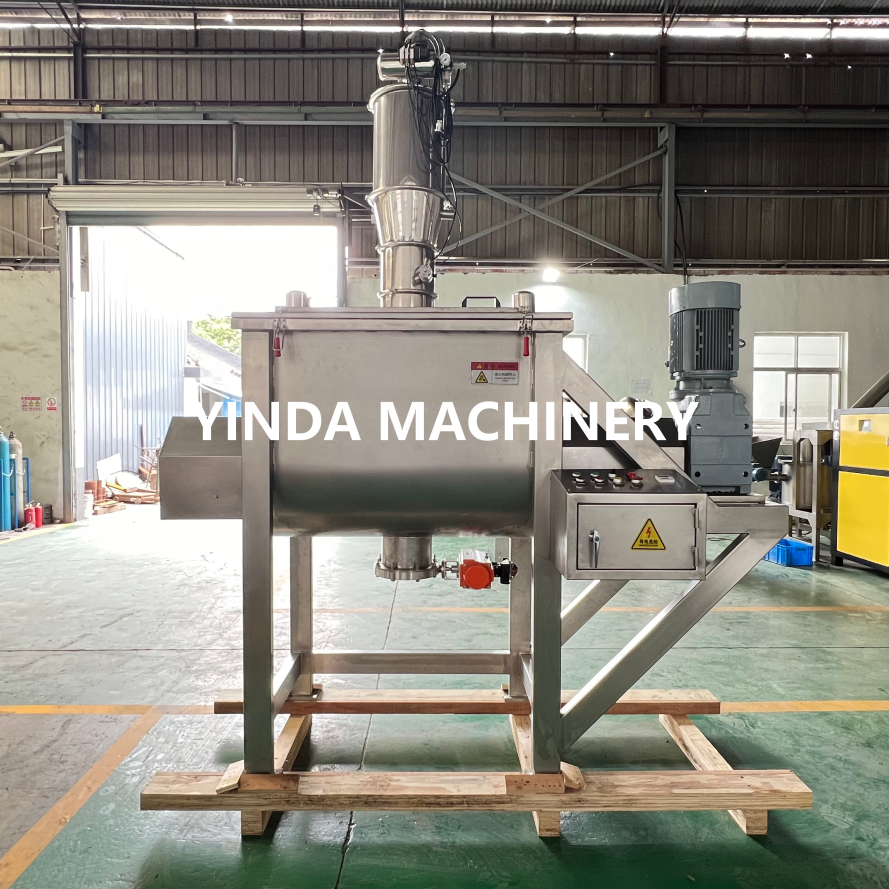
YDLH Ribbon Blender for forced-convection mixing
V Blender, Double Cone Blender, or 3D Mixer
Density, particle size, flowability, and ingredient ratio
Control discharge, conveying, storage, and packaging
Quick Answer
Mixing powders with different bulk densities is possible, but bulk density alone should not determine the mixer selection.
A stable powder blend depends on several material characteristics, including:
- Bulk density
- Particle size and particle size distribution
- Particle shape
- Flowability
- Moisture and cohesiveness
- Ingredient ratio
- Sensitivity to shear
- Mixing time
- Discharge and conveying method
For formulations containing powders with noticeably different densities or particle characteristics, a forced-convection mixer such as YINDA YDLH Series ribbon blender is often worth evaluating because the agitator actively moves material throughout the mixing chamber.
However, a YDV series V blender, YDW series double cone blender, or YDSW series 3D mixer can still be suitable when the ingredients are relatively free-flowing, the formulation is compatible with tumble mixing, and gentle mixing is preferred.
The most important point is:
For formulations with large differences in density, particle size, or ingredient proportion, a material test is strongly recommended before final equipment selection.
Why Do Powders with Different Bulk Densities Segregate?
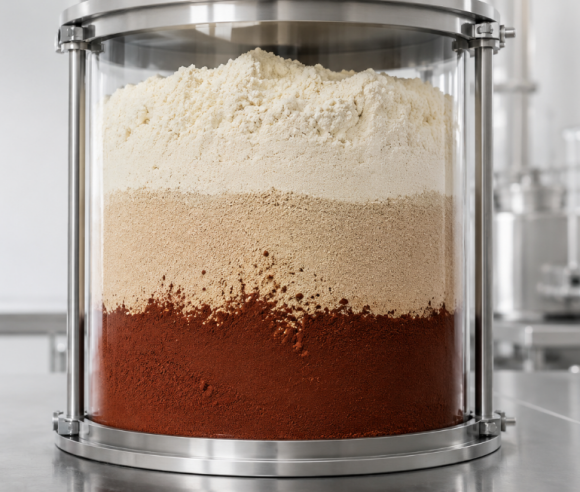
Powder segregation occurs when different particles move differently during mixing or handling.
Bulk density can contribute to this behavior, but it is rarely the only factor.
For example, consider a formulation containing:
- A light fine powder
- A heavier granular ingredient
- A small amount of flavor, vitamin, pigment, or active ingredient
Even when all three components are initially distributed uniformly, they may separate again when the blend is dropped into a hopper, vibrated, pneumatically conveyed, or stored before packaging.
1. Difference in Particle Size
Particle size difference is one of the major causes of powder segregation.
When fine particles and coarse particles are mixed together, smaller particles may move downward through the spaces between larger particles.
This is often referred to as percolation or sifting segregation.
As a result:
- Fines may concentrate toward the lower section.
- Larger particles may gradually migrate upward.
- Different packages from the same batch may contain different ingredient ratios.
Therefore, when evaluating a density difference, particle size distribution must also be considered.
2. Difference in Bulk Density
When particles have significantly different densities, they respond differently to:
- Gravity
- Acceleration
- Vibration
- Air movement
- Mixer agitation
- Free fall during discharge
A heavier component may behave differently from a very light powder even when their particle sizes are similar.
However, there is no universal density ratio at which a particular mixer automatically becomes suitable or unsuitable.
The actual behavior depends on the complete powder formulation.
3. Difference in Particle Shape
Spherical granules, irregular powders, flakes, fibers, and needle-shaped particles have different flow characteristics.
For example:
- Spherical particles normally flow relatively easily.
- Fine irregular powders may be more cohesive.
- Fibrous materials may interlock.
- Flakes may have very low apparent bulk density.
These differences can influence both mixing efficiency and segregation tendency.
4. Difference in Flowability
Two ingredients with similar bulk densities can still behave very differently.
A free-flowing granule may move rapidly through a mixer, while a cohesive fine powder may remain attached to the mixer wall or form agglomerates.
This means that bulk density data alone is not sufficient for mixer selection.
5. Large Difference in Ingredient Ratio
The formulation ratio is another critical factor.
Mixing:
50 kg Powder A + 50 kg Powder B
is fundamentally different from mixing:
99 kg Base Powder + 1 kg Minor Ingredient
Even when the bulk densities are similar, distributing a very small amount of one ingredient uniformly throughout a large batch can be difficult.
For low-percentage ingredients, staged addition or pre-mixing may be required.
Recommended Process for Mixing Powders with Different Densities
A good powder mixing system should be designed around the complete process rather than only the mixer.
A typical approach is:
Raw Material Preparation → Screening / Size Adjustment → Weighing → Staged Feeding → Mixing → Controlled Discharge → Screening if Required → Packaging
Each step can influence final blend uniformity.
Step 1: Check the Powder Properties Before Selecting a Mixer
Before choosing between a ribbon blender, V blender, double cone blender, or 3D mixer, we normally recommend checking the following information.
| Parameter | Why It Matters |
|---|---|
| Bulk density of each ingredient | Helps determine batch volume and indicates possible density differences |
| Particle size | Large size differences can increase segregation risk |
| Particle size distribution | A wide distribution may encourage percolation |
| Ingredient percentage | Important for minor or trace ingredients |
| Flowability | Determines how easily material circulates and discharges |
| Moisture content | Higher moisture may increase adhesion or agglomeration |
| Cohesiveness | Influences dead zones and mixing behavior |
| Oil content | May cause sticking or lump formation |
| Shear sensitivity | Determines whether aggressive mixing is acceptable |
| Required batch size | Determines mixer working volume |
| Required uniformity | Particularly important for food, nutraceutical, chemical, and pharmaceutical formulations |
For complicated formulations, laboratory or pilot mixing tests provide more reliable information than theoretical density comparison alone.
Step 2: Reduce Unnecessary Particle Size Differences
If one ingredient is extremely coarse while another is very fine, simply increasing mixing time may not solve the problem.
In some applications, it may be better to first adjust the particle size distribution by:
- Milling
- Crushing
- Screening
- Deagglomeration
For example, mixing a very fine powder directly with large granules can create significantly more segregation risk than mixing ingredients with reasonably compatible particle sizes.
This does not mean every ingredient must have exactly the same particle size.
The objective is to avoid unnecessarily extreme differences where the process allows adjustment.
Step 3: Use the Correct Feeding Sequence
Charging order becomes especially important when one ingredient represents only a small percentage of the formulation.
Instead of adding a small quantity directly into a large amount of base powder, pre-blending or geometric dilution may be considered.
A simplified method is:
Minor Ingredient + Small Portion of Base Powder → Pre-Mix → Add Additional Base Powder → Final Mixing
This gradually distributes the low-percentage component through the batch.
This approach can be particularly useful for:
- Vitamins
- Minerals
- Flavor powders
- Pigments
- Food additives
- Pharmaceutical excipients
- Nutritional premixes
- Functional ingredients
The appropriate procedure should still be validated according to the actual formulation and required uniformity.
Step 4: Select the Correct Mixer
Option 1: YDLH Series Ribbon Blender
For many industrial formulations containing powders with different densities, particle sizes, or ingredient proportions, a ribbon blender is one of the first mixer types worth evaluating.
How a Ribbon Blender Works
A ribbon blender normally uses inner and outer helical ribbons mounted on a horizontal shaft.
During operation, the ribbons create axial and radial material movement inside the mixing chamber.
Instead of relying primarily on gravity, the agitator actively circulates the powder.
This is generally classified as convective mixing.
Why Consider a Ribbon Blender?
A ribbon blender can be useful when:
- Multiple powders must be mixed.
- Material properties are not identical.
- Different bulk densities are involved.
- Minor ingredients need to be distributed through a larger batch.
- The formulation requires relatively active material circulation.
- Additional process integration is required.
Possible applications include:
- Seasoning powder
- Nutritional powder
- Protein powder
- Food additives
- Chemical powder
- Detergent powder
- Premixes
- Beverage powder
- Flour blends
- Functional food ingredients
However, using a ribbon blender does not automatically eliminate segregation.
Correct loading, mixing time, feeding sequence, discharge method, and downstream transfer design remain important.
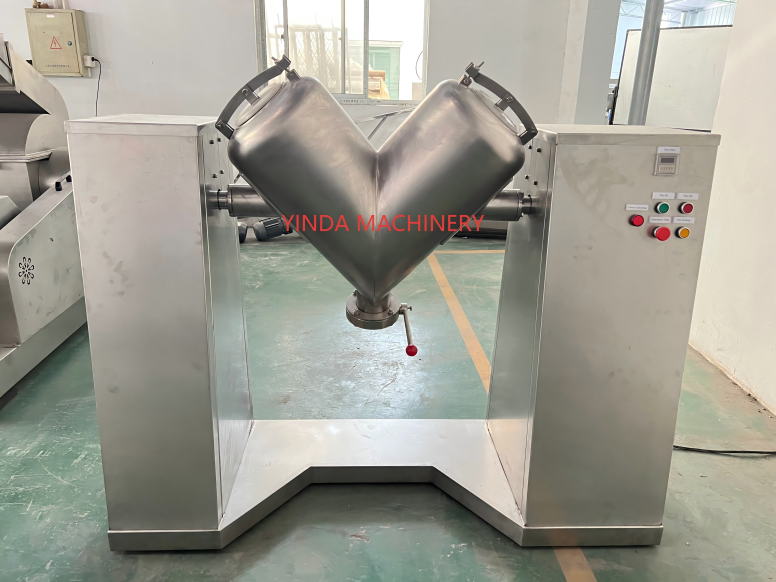
Option 2: YDV Series V Blender
A V blender is a tumble-type mixer.
As the V-shaped vessel rotates, the material repeatedly divides and recombines.
This provides relatively gentle mixing with limited mechanical shear.
When Is a V Blender Suitable?
A V blender is normally worth considering when:
- Powders are relatively free-flowing.
- Ingredients have reasonably compatible physical properties.
- Gentle mixing is required.
- Product degradation due to mechanical shear should be minimized.
- The formulation does not require aggressive deagglomeration.
For free-flowing dry powders, V blenders can achieve good mixing results.
However, if the formulation contains major differences in:
- Particle size
- Density
- Flowability
- Ingredient percentage
the material should be tested carefully.
Because a V blender relies mainly on gravity-driven tumbling, it should not automatically be assumed to be the best solution for severe density differences.
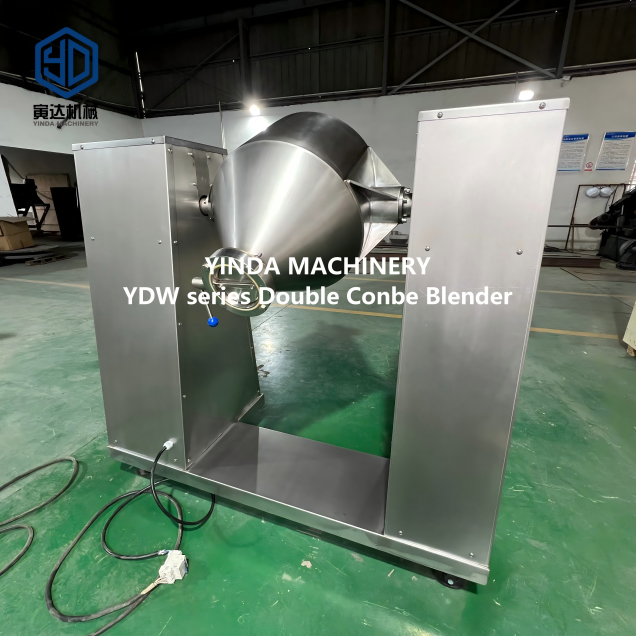
Option 3: Double Cone Blender
A double cone blender also uses tumble mixing.
The rotating vessel repeatedly changes the position of the powder bed, allowing particles to redistribute through gravitational movement.
Typical Advantages
A double cone blender can be considered for:
- Free-flowing powders
- Granules
- Gentle mixing
- Shear-sensitive materials
- Relatively compatible ingredients
Its simple mixing chamber can also be attractive where straightforward cleaning is important.
However, similar to a V blender, it is primarily a gravity-driven mixing method.
Therefore, when ingredients have strongly different densities, particle sizes, or flow characteristics, actual test results are more important than simply selecting the mixer based on its name or vessel shape.
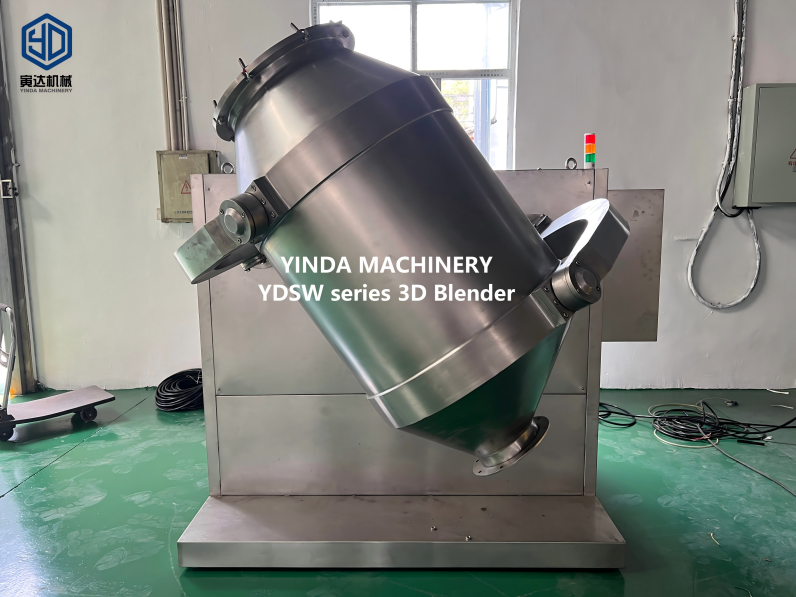
Option 4: YDSW Series 3D Mixer
A 3D mixer moves the mixing vessel in multiple directions rather than simply rotating around a single fixed axis.
This produces continuously changing powder movement inside the vessel.
When Can a 3D Mixer Be Considered?
It may be useful for:
- High-value powder formulations
- Gentle powder handling
- Small to medium batch processing
- Applications requiring multi-directional tumbling
- Powders where low mechanical shear is preferred
The multi-directional motion can improve particle redistribution compared with simple single-axis tumbling.
However, a 3D mixer is still essentially a low-shear tumble mixing system.
It should therefore not be treated as a universal solution for powders with extremely different densities or particle sizes.
Material testing remains necessary for challenging formulations.
Ribbon Blender vs V Blender vs Double Cone Blender vs 3D Mixer
The following table provides a practical comparison.
| Factor | Ribbon Blender | V Blender | Double Cone Blender | 3D Mixer |
|---|---|---|---|---|
| Mixing mechanism | Forced convection | Gravity tumbling | Gravity tumbling | Multi-directional tumbling |
| Mixing intensity | Moderate | Gentle | Gentle | Gentle |
| Free-flowing powders | Suitable | Suitable | Suitable | Suitable |
| Powders with different densities | Often worth evaluating first | Requires evaluation | Requires evaluation | Requires evaluation |
| Very different particle sizes | Testing recommended | Higher segregation concern | Higher segregation concern | Testing recommended |
| Minor ingredient distribution | Can be suitable with correct feeding strategy | Pre-blending may be required | Pre-blending may be required | Pre-blending may be required |
| Shear-sensitive materials | Evaluate agitator effect | Good candidate | Good candidate | Good candidate |
| Liquid addition | Possible with suitable configuration | Generally not the primary choice | Generally not the primary choice | Generally not the primary choice |
| Industrial line integration | High flexibility | Moderate | Moderate | Moderate |
| Selection basis | Material + process | Material + process | Material + process | Material + process |
Important: This table is a selection reference rather than a guaranteed mixing result.
The final selection should be based on actual powder characteristics and process requirements.
Is Ribbon Blender Always Better for Powders with Different Densities?
No.
This is an important distinction.
A ribbon blender provides active convective mixing, which is often useful when ingredients have different physical characteristics.
But mixer selection should not be reduced to:
Different density = Ribbon Blender
For example, a V blender or double cone blender may perform very well if:
- Both ingredients are free-flowing.
- Their particle sizes are reasonably compatible.
- The density difference is moderate.
- The formulation ratio is not extreme.
- Gentle mixing is desirable.
Conversely, even a ribbon blender may struggle if:
- One ingredient forms severe agglomerates.
- Particle sizes differ dramatically.
- A trace ingredient is added incorrectly.
- The mixer is underfilled or overloaded.
- Mixing continues beyond the optimum point.
- The finished blend is re-segregated during discharge.
The correct solution must therefore consider the entire process.
Do Not Overmix the Powder
A common assumption is:
This is not necessarily correct.
Once a suitable mixing state has been achieved, excessive mixing can provide additional opportunities for particles with different properties to separate again.
The optimum mixing time depends on:
- Mixer design
- Rotational speed
- Agitator design
- Batch loading
- Powder characteristics
- Ingredient ratio
- Required uniformity
Therefore, industrial mixing time should preferably be established through testing rather than arbitrary extension.
Working Volume and Fill Ratio Also Matter
Mixer capacity should not be selected only according to kilogram batch weight.
For example:
Formula A
Bulk density = 0.3 kg/L
A 300 kg batch occupies approximately:
1,000 L
Formula B
Bulk density = 0.8 kg/L
A 300 kg batch occupies approximately:
375 L
Although both batches weigh 300 kg, their required mixer volume is completely different.
Therefore:
Batch Volume = Batch Weight ÷ Bulk Density
The selected mixer must then provide an appropriate working volume for its specific mixing mechanism.
This is particularly important when a formulation contains several ingredients with significantly different bulk densities.
Mixing Is Only Half of the Problem
This is one of the most overlooked issues in powder processing.
A powder can leave the mixer with good uniformity and still become segregated before reaching the package.
Potential segregation points include:
Mixer → Discharge Chute → Buffer Hopper → Conveyor → Sifter → Storage Hopper → Packaging Machine
How Can Discharge Cause Segregation?
1. Excessive Free-Fall Height
When powder falls through a long distance, particles respond differently to gravity and air resistance.
Fine and lightweight particles can behave differently from larger or denser particles.
Reducing unnecessary free fall can therefore help protect blend uniformity.
2. Vibration
Vibration can encourage smaller particles to move through gaps between larger particles.
This can gradually separate a previously uniform mixture.
Therefore, unnecessary vibration during storage and transfer should be minimized.
3. Funnel Flow in a Hopper
If only the material directly above the outlet flows while powder near the hopper wall remains stationary, different sections of the powder bed may discharge at different times.
For segregation-sensitive formulations, hopper geometry and discharge behavior should therefore be evaluated carefully.
4. Pneumatic Conveying
Pneumatic conveying is convenient for:
- Dust control
- Closed transfer
- Automation
- Reducing manual handling
However, it should not automatically be assumed to preserve every finished powder blend.
Air velocity can cause particles with different sizes and densities to behave differently.
For highly segregation-sensitive finished blends, conveying trials and system design should therefore be considered carefully.
Where possible, minimizing unnecessary transfer steps between mixing and packaging can reduce re-segregation opportunities.
Recommended Mixing Line Design
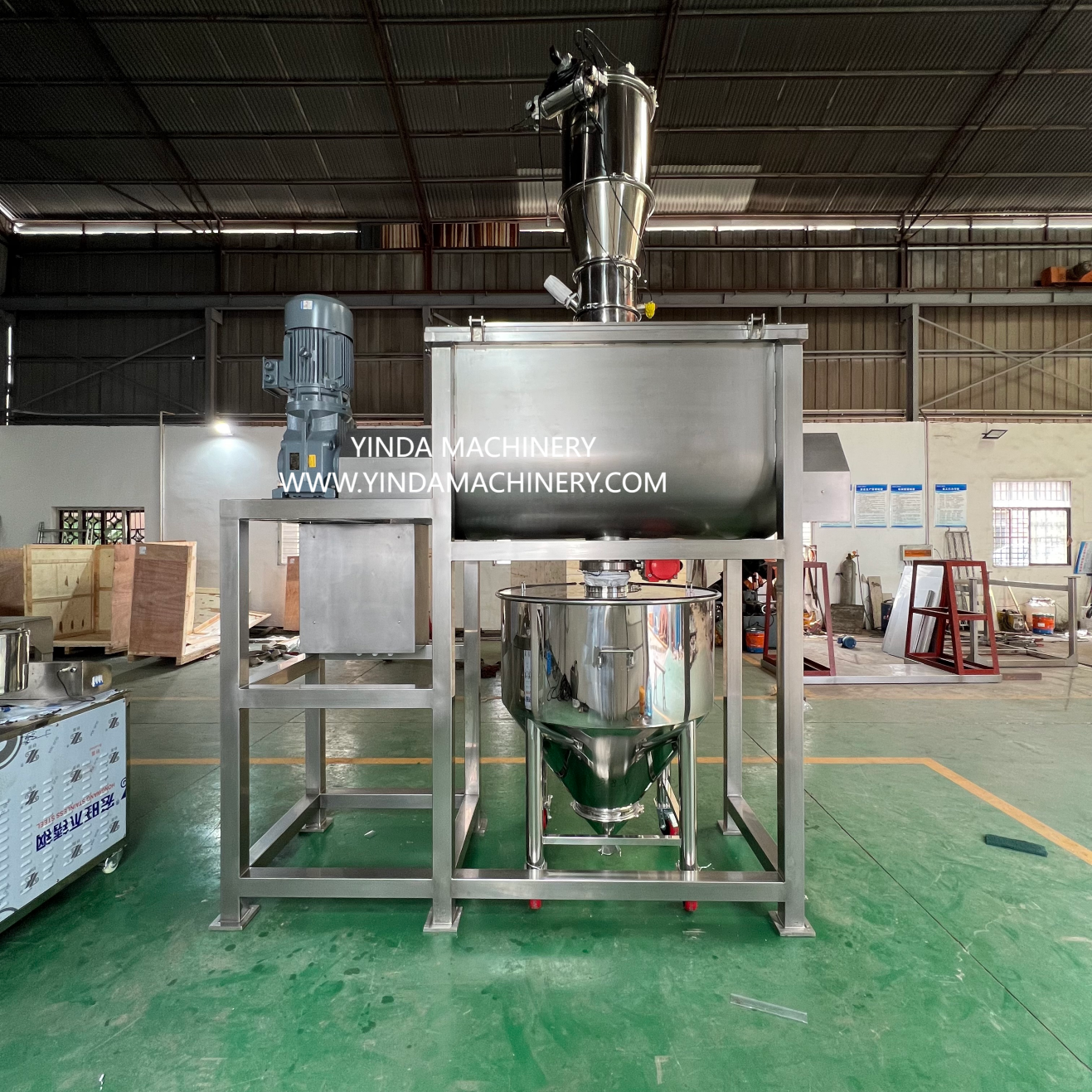
For a typical food or nutritional powder formulation, a possible process may be:
Raw Material Feeding
↓
Screening / Deagglomeration
↓
Weighing and Dosing
↓
Ribbon Blender
↓
Controlled Discharge
↓
Vibrating Sifter if Required
↓
Direct Packaging or Controlled Transfer
Watch the equipment or material test video
Depending on the process, optional equipment may include:
- Vacuum conveyor
- Screw conveyor
- Vibrating sifter
- Buffer hopper
- Dust collector
- Magnetic separator
- Metal detector
- Packaging machine
- Integrated electrical control system
The suitability of each component should be evaluated according to the powder characteristics and the required final product quality.
Example: Mixing Light Flavor Powder with a Heavy Base Powder
Assume a formulation contains:
- Main carrier powder
- Heavier mineral ingredient
- Small amount of flavor powder
The wrong approach would be to select a blender only according to the average batch density.
Instead, the following questions should be checked:
1. What is the bulk density of each component?
The difference between individual ingredients is more useful than only knowing the final mixed density.
2. What are their particle sizes?
A large particle size difference can be as important as density difference.
3. What percentage is the flavor ingredient?
A 1% flavor addition requires a different feeding strategy from a 30% ingredient.
4. Is the flavor cohesive?
If it tends to form lumps, simple tumble mixing may be insufficient.
5. How will the finished powder be discharged?
Even a successful blend can separate again during long free fall or unsuitable conveying.
For this type of application, a ribbon blender may be evaluated first because of its active convective mixing mechanism, possibly combined with staged feeding or pre-mixing.
However, final suitability should still be verified through material testing.
Configuration Options for Food and Nutritional Powder Mixing
For food, nutritional supplement, and similar hygienic applications, customers may also consider the following equipment configurations.
Stainless Steel Construction
Product-contact parts can be manufactured from:
- SUS304 stainless steel
- SUS316L stainless steel where required
The correct material should be selected according to:
- Product corrosiveness
- Hygiene requirements
- Cleaning procedures
- Industry standards
- Customer URS
Internal Surface Treatment
Smooth product-contact surfaces can help:
- Reduce powder retention
- Simplify cleaning
- Reduce cross-contamination risk
- Improve discharge
The required polishing level should be specified according to the application rather than assumed.
Dust-Controlled Feeding
For fine powders, a dust-free feeding station or enclosed conveying system can reduce airborne dust and improve working conditions.
Liquid Spray System
If a small amount of:
- Oil
- Flavor
- Liquid additive
must be added to the powder, a suitable spray system can be considered with a ribbon blender.
The liquid addition rate and spray distribution must be controlled to avoid local overwetting and lump formation.
Integrated Control
For a complete powder mixing line, feeding, mixing, screening, conveying, and discharge can be integrated into a centralized control system depending on the required level of automation.
How to Select the Right Powder Mixer
A practical selection sequence is:
Choose a Ribbon Blender First for Evaluation If:
- Several powders have noticeably different physical properties.
- Active material circulation is required.
- Minor ingredients must be distributed.
- The mixer will be integrated into an automated production line.
- Liquid addition may be required.
- Moderate mechanical mixing is acceptable.
Consider a V Blender If:
- Powders are dry and free-flowing.
- Gentle mixing is preferred.
- Material properties are relatively compatible.
- The formulation is not highly prone to segregation.
Consider a Double Cone Blender If:
- Free-flowing powders or granules are being processed.
- Low-shear mixing is required.
- Simple vessel geometry is desirable.
- Material characteristics are suitable for gravity tumbling.
Consider a 3D Mixer If:
- Multi-directional gentle mixing is required.
- Batch size is suitable for this equipment type.
- The product has a relatively high value.
- Mechanical shear should be minimized.
- Actual formulation trials confirm acceptable uniformity.
Material Testing Is Important
For simple formulations, previous application experience can provide a useful selection reference.
However, testing is strongly recommended when the formulation contains:
- Large bulk-density differences
- Large particle-size differences
- Very fine powder
- Very low-percentage ingredients
- Cohesive powder
- High oil content
- Hygroscopic ingredients
- Easily agglomerated material
- Strict blend-uniformity requirements
- Pharmaceutical or high-value nutritional applications
During testing, customers should not only check whether the mixer can physically mix the material.
The more important question is:
This may require sampling from multiple locations or different stages of discharge according to the customer’s quality-control procedure.
Frequently Asked Questions
Can powders with different bulk densities be mixed uniformly?
Yes, in many applications they can.
However, the result depends on more than bulk density. Particle size, flowability, ingredient ratio, cohesiveness, mixer type, mixing time, and downstream handling all influence final uniformity.
For challenging formulations, material testing is recommended.
What mixer is best for powders with different densities?
There is no universal best mixer.
A ribbon blender is often worth evaluating when active convective mixing is needed, while V blenders, double cone blenders, and 3D mixers can be suitable for compatible free-flowing formulations requiring gentler mixing.
The selection should be based on actual powder properties.
Is a ribbon blender better than a V blender for different-density powders?
Not in every application.
A ribbon blender provides active mechanical circulation, whereas a V blender relies mainly on gravity-driven tumbling.
For materials with significant differences in physical characteristics, the ribbon blender may provide more active redistribution.
For compatible free-flowing powders where gentle mixing is important, a V blender may still be suitable.
Testing provides the most reliable comparison.
Can longer mixing prevent segregation?
Not necessarily.
Longer mixing does not always mean better mixing.
After suitable uniformity has been achieved, unnecessary additional movement may create opportunities for certain formulations to demix again.
The optimum mixing time should therefore be determined experimentally.
Does the powder need to have the same particle size before mixing?
Not exactly.
Industrial formulations commonly contain different particle sizes.
However, extremely large particle size differences can increase segregation risk.
Where practical, milling, screening, or deagglomeration can be used to make the ingredients more compatible before mixing.
How do you mix a very small amount of powder into a large batch?
Pre-blending or staged addition can be considered.
The minor ingredient is first mixed with a smaller portion of the main powder and then gradually incorporated into the remaining batch.
This approach is commonly known as geometric dilution.
The final procedure should be validated according to the required product uniformity.
Can vacuum conveying be used after powder mixing?
Yes, but the formulation should be evaluated.
Vacuum conveying provides enclosed and dust-controlled transfer, but powders with significantly different particle sizes or densities can respond differently to pneumatic movement.
For segregation-sensitive finished blends, conveying distance, air velocity, transfer method, and number of transfer points should be considered carefully.
What information should I provide before selecting a powder mixer?
For a more accurate recommendation, provide:
- Material names
- Bulk density of each material
- Particle size of each material
- Mixing ratio
- Batch weight
- Moisture content
- Flowability
- Whether the powders are sticky or cohesive
- Required mixing uniformity
- Final application
- Required material of construction
- Electrical standard
- Feeding and discharge method
- Cleaning requirements
If available, sending representative samples for testing can further improve equipment selection.
Conclusion
Mixing powders with different bulk densities is not simply a question of choosing the strongest mixer.
A reliable process requires control of four areas:
Powder Characteristics
↓
Mixer Selection
↓
Mixing Method
↓
Discharge and Transfer
Bulk density is important, but particle size, particle shape, flowability, ingredient ratio, and downstream handling can be equally important or even more critical to final blend stability.
For formulations with relatively large differences in powder characteristics, a ribbon blender can be a strong candidate because of its forced-convection mixing mechanism.
For compatible, free-flowing materials requiring gentle handling, V blenders, double cone blenders, and 3D mixers may also provide suitable solutions.
The final decision should be based on the formulation itself rather than the equipment name.
For difficult powder formulations, a material mixing test is the most practical way to confirm:
- Mixer type
- Batch loading
- Feeding sequence
- Mixing time
- Discharge behavior
- Final powder uniformity
Need Help Selecting a Powder Mixer?
Yinda Machinery provides powder mixing equipment and integrated powder handling solutions for food, nutritional, chemical, pharmaceutical, and other industrial applications.
Available mixer types include:
- YDLH Series Ribbon Blender
- YDV Series V-Type Powder Mixer
- YDW Series Double Cone Blender
- YDSW Series 3D Powder Mixer
Send us your powder names, bulk densities, particle sizes, mixing ratio, batch capacity, and final application, and we can evaluate the appropriate mixing process for your material.
Email: dennie@yindamachinery.com
WhatsApp: +86-13914192807
Website: https://www.yindamachinery.com/
Get a Customized Powder Processing Solution
Please share your raw material, feeding size, target particle size, required capacity, moisture or oil content, heat sensitivity, voltage, cleaning requirements, and final application. Yinda Machinery will evaluate a suitable configuration.
Your Powder Processing Contact
Dennie Yuan | Powder Processing Solution Specialist
Email: dennie@yindamachinery.com
WhatsApp / WeChat: +86-13914192807
Website: www.yindamachinery.com