
V Cone Blender vs. Double Cone Blender: Which Powder Mixing Solution Is Right for Your Production?
Discover the differences between a v cone blender and a double cone blender, including their working principles, advantages, applications, and how to select the right powder handling equipment for pharmaceutical, food, chemical, and nutraceutical manufacturing.
Selecting the right powder mixing equipment plays a major role in maintaining product quality, improving production efficiency, and achieving consistent blending results. Both the v cone blender and the double cone blender are trusted solutions for blending dry powders and granules, but each machine offers unique advantages depending on your production requirements. As a leading manufacturer of powder handling equipment, Yinda Machinery provides reliable blending solutions engineered for high mixing uniformity, hygienic production, and long-term operational performance.
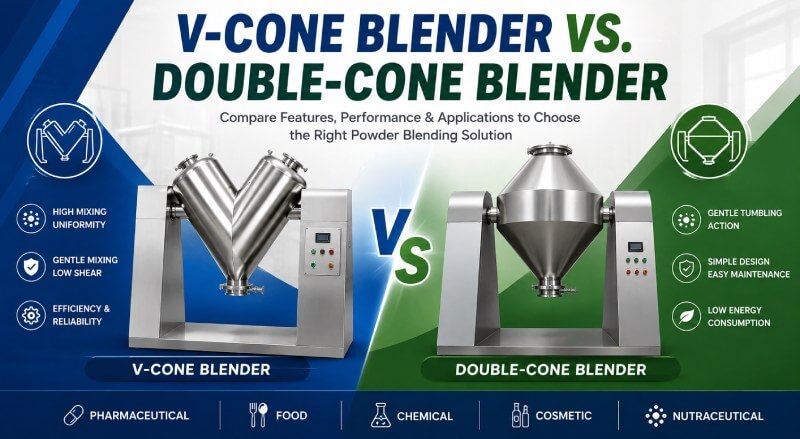
1. What Is a V Cone Blender?
A v cone blender is a tumble mixing machine featuring two cylindrical chambers joined together to form a “V” shape. As the vessel rotates, powders continuously divide and merge between both chambers, creating a highly efficient blending action without the need for internal paddles or high-speed agitators.
Instead of relying on mechanical force, the blender uses gravity and controlled tumbling to achieve excellent mixing uniformity. This gentle process minimizes heat generation, reduces friction, and helps preserve the physical characteristics of sensitive materials.
Because there are no internal blades, fragile particles remain intact throughout the mixing cycle, making the machine ideal for pharmaceutical powders, food ingredients, nutraceuticals, and specialty chemicals.
Recommended Image: Industrial stainless steel V Cone Blender installed in a powder processing production line.
2. How Does a V Cone Blender Work?
The mixing process begins after the required ingredients are loaded into the V-shaped vessel. As the blender rotates at a controlled speed, materials continuously move between the two chambers, repeatedly separating and recombining to create a homogeneous mixture.
Mixing Process
- Powder flows from one chamber to the other.
- Materials repeatedly split into two streams.
- Gravity causes particles to tumble naturally.
- Continuous dividing and recombining improve blend uniformity.
- A consistent mixture is produced with minimal energy consumption.
Industry Insight: Unlike ribbon or paddle mixers, a V Cone Blender relies primarily on gravity instead of mechanical agitation, helping protect fragile ingredients while reducing operating costs.
3. Main Components of a V Cone Blender
Although its design appears simple, every component contributes to stable operation, efficient blending, and long service life.
V-Shaped Mixing Chamber
Creates continuous powder movement while minimizing dead zones.
Drive System
Motor and gearbox rotate the vessel at an optimized mixing speed.
Supporting Frame
Provides excellent stability during continuous production.
Charging Port
Allows convenient loading while ensuring secure sealing.
Discharge Valve
Enables fast product unloading with minimal material residue.
4. Key Advantages of a V Cone Blender
- Excellent mixing uniformity for dry powders and granules.
- Gentle gravity-based mixing protects fragile ingredients.
- Low energy consumption compared to high-shear mixers.
- Easy cleaning with polished stainless steel construction.
- Minimal particle degradation during blending.
- Suitable for hygienic pharmaceutical and food production.
5. Common Applications of V Cone Blenders
The versatility of the v cone blender makes it one of the most widely used machines in modern powder handling equipment systems.
Pharmaceutical Industry
Mixing APIs and excipients while maintaining formulation consistency.
Food Processing
Blending spices, protein powders, milk powder, beverage mixes, and seasonings.
Chemical Manufacturing
Processing pigments, additives, specialty chemicals, and industrial powders.
Nutraceutical Production
Mixing herbal extracts, dietary supplements, vitamin powders, and protein formulations.
Yinda Solution: Integrated with grinding, sieving, conveying, and packaging systems, Yinda Machinery’s V Cone Blender helps manufacturers build complete powder handling equipment production lines for efficient and consistent manufacturing.
6. What Is a Double Cone Blender?
A double cone blender is a gravity-based tumble mixer designed for blending dry powders and free-flowing granules. Instead of using a V-shaped vessel, it features two symmetrical cone sections connected at their wider ends to create a streamlined mixing chamber.
As the vessel rotates around a horizontal axis, materials are continuously lifted, tumbled, and redistributed by gravity. This gentle mixing process minimizes shear forces while producing highly consistent blends for a wide range of industrial applications.
Like the v cone blender, the double cone blender contains no internal mixing blades, making it an excellent choice for products that require careful handling and minimal particle degradation.
Recommended Image: Stainless steel Double Cone Blender installed in a pharmaceutical or food processing facility.
7. How Does a Double Cone Blender Work?
The blending process starts by loading powders or granules into the conical vessel through the charging port. Once sealed, the machine rotates at a controlled speed, allowing gravity to create a continuous tumbling action that distributes materials evenly throughout the chamber.
Mixing Process
- Powders are lifted by the rotating vessel.
- Gravity causes materials to cascade naturally.
- Particles continuously change position.
- Repeated tumbling promotes uniform ingredient distribution.
- A homogeneous blend is achieved with low energy consumption.
Industry Insight: The Double Cone Blender is particularly effective for free-flowing powders with similar particle sizes and bulk densities, providing reliable mixing while maintaining product quality.
8. Main Components of a Double Cone Blender
Its simple yet efficient design allows the machine to deliver stable mixing performance while requiring minimal maintenance.
Double Cone Vessel
Provides smooth powder movement while reducing material accumulation.
Drive Assembly
Motor and gearbox rotate the chamber at the ideal speed for efficient blending.
Machine Frame
Supports the rotating vessel and maintains operational stability.
Material Inlet
Allows convenient loading with secure sealing during operation.
Discharge Valve
Enables efficient unloading while minimizing product residue.
9. Key Advantages of a Double Cone Blender
- Gentle mixing protects delicate powders and granules.
- Excellent batch-to-batch consistency.
- Simple machine construction for easier maintenance.
- Hygienic stainless steel design suitable for sanitary production.
- Low power consumption and reduced operating costs.
- Long service life with minimal maintenance requirements.
10. Common Applications of Double Cone Blenders
The double cone blender is widely used across industries that require gentle and efficient powder blending.
Pharmaceutical Manufacturing
Blending APIs, excipients, capsules, and tablet formulations.
Food Production
Processing flour blends, cocoa powder, coffee, soup mixes, and baking ingredients.
Chemical Industry
Mixing pigments, detergents, fertilizers, resins, and specialty chemicals.
Cosmetic Manufacturing
Blending face powders, mineral powders, and cosmetic ingredients.
Yinda Solution: Yinda Machinery integrates Double Cone Blenders with complete powder handling equipment systems, including conveying, feeding, screening, and packaging solutions for fully automated production.
11. V Cone Blender vs. Double Cone Blender
Although both machines are designed for blending dry powders using gravity-based tumbling, their vessel designs create noticeable differences in powder movement, mixing efficiency, production flexibility, and application suitability.
Key Difference: A V Cone Blender continuously divides and recombines materials between two angled chambers, while a Double Cone Blender relies on smooth lifting and cascading inside a symmetrical conical vessel.
Mixing Mechanism
The V Cone Blender generates more frequent particle movement through repeated separation and recombination, often producing faster and more uniform blending. The Double Cone Blender creates a gentle tumbling action that is highly effective for standard powder mixing applications.
Vessel Design
The V-shaped chamber encourages continuous powder division and recombination, whereas the Double Cone vessel promotes smooth material flow through a symmetrical mixing chamber.
Mixing Efficiency
Both machines provide excellent blending performance. However, the V Cone Blender generally reaches mixing uniformity more quickly for powders with similar particle characteristics.
Material Handling
Both systems provide low-shear mixing that minimizes particle damage. The V Cone Blender is commonly selected for sensitive formulations requiring exceptional blending precision.
Cleaning & Maintenance
Since neither machine contains internal paddles or blades, both are easy to clean and maintain. Optional mirror polishing and CIP systems further improve sanitation for pharmaceutical and food manufacturing.
Production Flexibility
The V Cone Blender is frequently preferred for high-value pharmaceutical, nutraceutical, and specialty chemical production, while the Double Cone Blender remains an economical solution for general powder processing across many industries.
12. Side-by-Side Comparison
| Feature | V Cone Blender | Double Cone Blender |
|---|---|---|
| Vessel Shape | V-Shaped Chamber | Double Cone Chamber |
| Mixing Method | Continuous splitting & recombining | Gentle tumbling & cascading |
| Mixing Uniformity | Excellent | Very Good |
| Mixing Speed | Generally Faster | Moderate |
| Particle Protection | Excellent | Excellent |
| Energy Consumption | Low | Low |
| Best Application | Sensitive powders & high uniformity | Free-flowing powders & economical production |
Performance Summary: Manufacturers seeking maximum blending uniformity typically choose the V Cone Blender, while businesses prioritizing cost-effective, gentle batch mixing often prefer the Double Cone Blender.
13. Which Blender Should You Choose?
There is no one-size-fits-all solution when selecting industrial blending equipment. The ideal choice depends on your raw materials, production objectives, quality standards, and future manufacturing plans.
If your production requires exceptional blend uniformity while preserving delicate particles, the V Cone Blender is typically the preferred option. Its continuous dividing and recombining action produces highly consistent mixtures for demanding applications.
If your process focuses on routine batch blending of free-flowing powders with an emphasis on simple operation, easy maintenance, and economical production, the Double Cone Blender offers an excellent solution.
Expert Recommendation: Before investing in a powder blender, evaluate your material characteristics, required mixing accuracy, production capacity, hygiene standards, and future automation requirements to ensure long-term production efficiency.
14. Five Factors to Consider Before Choosing a Blender
Selecting the right powder handling equipment involves more than comparing machine designs. Manufacturers should consider how the equipment integrates into the complete production process.
1. Powder Characteristics
Evaluate particle size, density, moisture content, and flowability to determine the most suitable mixing method.
2. Product Quality
Applications requiring highly uniform blends generally benefit from the mixing precision of a V Cone Blender.
3. Batch Capacity
Select equipment that supports both your current production volume and future expansion plans.
4. Cleaning & Hygiene
Food and pharmaceutical manufacturers should prioritize stainless steel construction, sanitary finishes, and CIP compatibility.
5. Production Automation
Consider integrating the blender with vacuum conveyors, screw feeders, weighing systems, storage silos, and packaging equipment.
Production Tip: Integrating your blender into a complete powder handling system helps improve productivity, reduce manual handling, and maintain consistent product quality.
Frequently Asked Questions
What is the main difference between a V Cone Blender and a Double Cone Blender?
The primary difference is the vessel design. A V Cone Blender uses two intersecting chambers that repeatedly divide and recombine powders, while a Double Cone Blender relies on smooth tumbling inside two connected conical sections.
Which blender is better for pharmaceutical manufacturing?
Both machines are widely used, but manufacturers requiring exceptional blending uniformity often choose a V Cone Blender because of its efficient low-shear mixing action.
Can these blenders handle fragile powders?
Yes. Both machines rely on gravity-based tumbling rather than aggressive mechanical agitation, making them ideal for fragile powders and granules.
Are V Cone Blenders suitable for food processing?
Absolutely. They are commonly used for spices, baking ingredients, beverage mixes, protein powders, milk powder, and seasoning blends.
Can Yinda Machinery customize powder handling equipment?
Yes. Yinda Machinery provides customized blending systems designed around production capacity, automation requirements, material characteristics, and industry-specific standards.
Why Choose Yinda Machinery?
Choosing industrial mixing equipment is a long-term investment. Beyond supplying reliable machines, Yinda Machinery provides complete powder handling solutions engineered to improve production efficiency, blending accuracy, and operational reliability across food, pharmaceutical, nutraceutical, and chemical industries.
- Premium SS304 and SS316L stainless steel construction
- Excellent mixing uniformity for powders and granules
- Custom machine capacities for different production requirements
- Food-grade hygienic designs with optional CIP systems
- Low maintenance and energy-efficient operation
- Complete powder processing line integration
- Professional engineering consultation
- Worldwide installation support and after-sales service
Conclusion
Both the V Cone Blender and the Double Cone Blender are proven solutions for blending dry powders and granules with high consistency and minimal particle damage. While they share the same gravity-based mixing principle, their different vessel designs influence mixing efficiency, powder movement, and application suitability.
Manufacturers seeking exceptional blending precision for sensitive materials often benefit from the advanced mixing action of a V Cone Blender. For routine batch blending of free-flowing powders, the Double Cone Blender offers dependable performance with low operating costs.
By understanding your material characteristics, production goals, and quality requirements, you can confidently select the blending solution that best supports your manufacturing process. Yinda Machinery offers both standalone mixers and complete powder handling equipment systems tailored to your production needs.
Looking for the Right Powder Mixing Solution?
Whether you need a high-performance V Cone Blender, a reliable Double Cone Blender, or a fully integrated powder handling equipment production line, Yinda Machinery has the expertise and engineering capabilities to deliver a customized solution that matches your manufacturing requirements.