
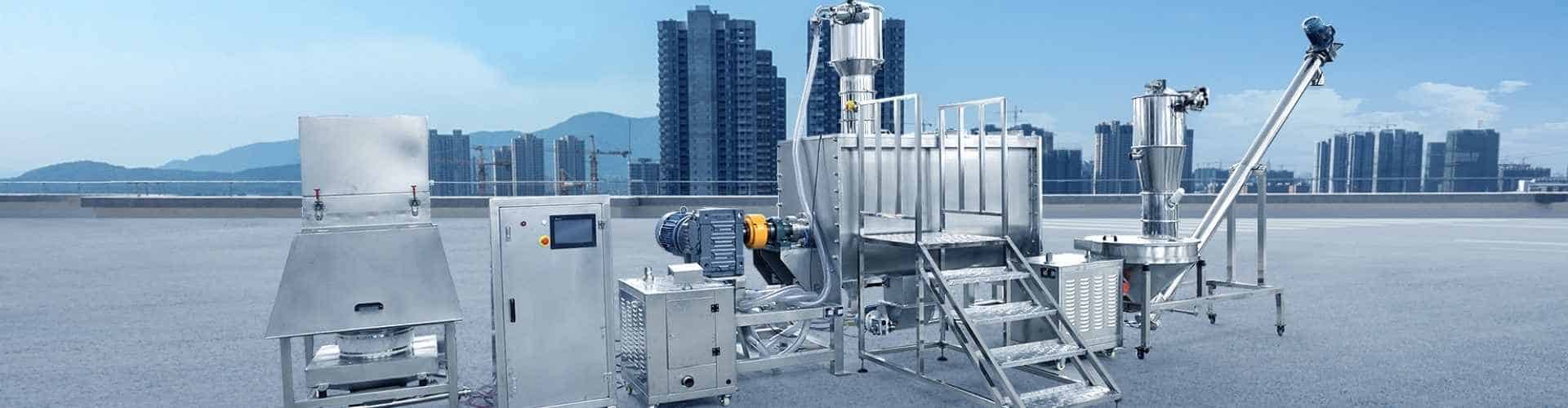
Cost-effective Ribbon Blender Machine Factory
As a professional Ribbon Blender Machine manufacturer and factory in China, we manufacture and supply all types of Ribbon Blender Machine with qualitative grades of raw materials and is designed in accordance with various quality standards.
Get in touch with us and let us know how we can assist with the Ribbon Blender Machine, we are always here to help you.

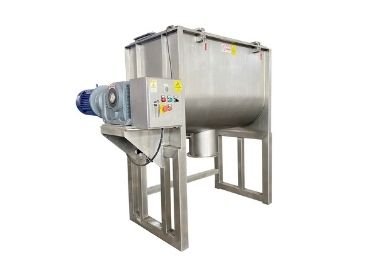

Yinda: Your Reliable Ribbon Blender Machine Supplier In China
1)if your project on powder processing needs to import a Ribbon Blender Machine, then Yinda will be your best choice to manufacture your Ribbon Blender Machine orders.
2)Yinda is one of the leading Ribbon Blender Machine suppliers and all of our Ribbon Blender Machine can meet ISO/CE/GMP standards, and we will provide a competitive price based on your project.
3)Yinda will give you the best Ribbon Blender Machine solution based on your project’s requirements with our professional technical team, and know more about powder and particle processing that we enjoy sharing with customers.
- Specifications
- Features
- Industrial Applications
- Ultimate service
| Model | YDLH-100 | YDLH-200 |
YDLH-500 |
YDLH-1000 | YDLH-1500 | YDLH-2000 |
| Full volume(m3) | 0.1m3/100L | 0.2m3/200L | 0.5m3/500L | 1m3/1000L | 1.5m3/1500L | 2m3/2000L |
| Working volume(L) | 60 | 120 | 300 | 800 | 1200 | 1600 |
| Mixing speed(rpm) | 53 | 53 | 53 | 42 | 42 | 42 |
| Mixing motor(kw) | 3 | 4 | 7.5 | 11 | 11 | 15 |
| Overall dimension(mm) | 1190*740*770 | 1550*1005*935 | 1972*1142*1300 | 2340*1437*1500 | 3180×1020×1550 | 3310×1120×1640 |
| Weight(kg) | 330 | 720 | 980 | 1700 | 1800 | 2100 |
The ribbon blender machine has a U-shaped trough in the horizontal direction. A double helical ribbon agitator in the machine keeps rotating inside. There are inner and outer helical ribbons in the ribbon agitator; that’s why it is known as a double helical ribbon agitator. The position of the shaft is at the centre of the trough.
Features:
- The working capacity range is from 50L to 50000L
- Various industries use ribbon blender machines for their processes
- The cover on the top is totally dependent on the length of the blender
- The mounting of the blender is on the supports that help in clearing all the discharge
- The location of the blender machine is at the centre of the flush bottom of the discharge valve
- Materials of all the contact parts are SS304 or SS316
- The exterior surface of the machine is matt finished
- The ribbon blender machine is the most economical and effective among all the blenders for mixing the solids in the dry state
Just get to know more about the ribbon blender machine from our representatives. Even, you can stay in touch from our official email address. Availability of fast delivery service so what are you waiting for? Place your order now without any delay.


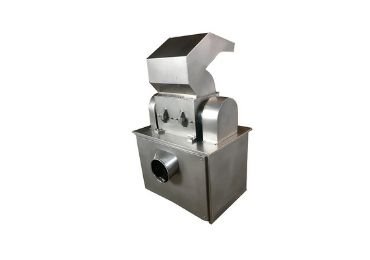
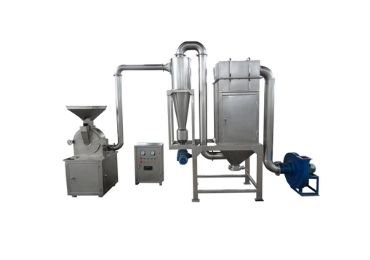
Hot-selling Equipments For Your Powder Processing
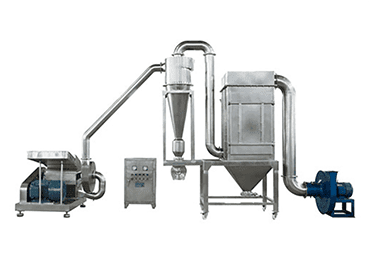
Ribbon Blender Machine: The Ultimate FAQ Guide
This guide will answer all your questions on Ribbon Blender Machine.
Whether you want to learn about the specifications, parts, working principle, or features – you will find everything right here.
So keep reading to learn more.
- What Is A Ribbon Blender Machine?
- What Are The Applications Of A Ribbon Blender Machine?
- What Are The Main Parts Of A Ribbon Blender Machine?
- What Is The Working Principle Of A Ribbon Blender Machine?
- Which Features Should You Consider In Ribbon Blender Machine?
- Which Are The Various Types Of Ribbon Blender Machines?
- What Is The Difference Between Ribbon Blender Machine And A Paddle Mixer?
- Which Products Are Processed By A Ribbon Blender Machine?
- Are There Add-On Equipment For A Ribbon Blender Machine?
- What Does A Ribbon Blender Machine Warranty Cover?
- How Do An IBC Bin Blender And Ribbon Blender Machine Compare?
- What Are The Benefits Of A Ribbon Mixing Machine?
- What Is The Difference Between Double Mixer And Ribbon Blender?
- How Can You Calculate The Ribbon Blender Machine Capacity?
- What Is The Capacity Range For A Ribbon Blender Machine?
- How Do You Maintain Ribbon Blender Machine?
- What Quality Standards And Certifications Does Ribbon Blender Machine Need?
- Which Industries Use Ribbon Blender Machine?
- How Can I Ensure My Ribbon Blender Machine Is Working Efficiently?
- What Materials Are Used To Make The Ribbon Mixer?
What Is A Ribbon Blender Machine?

Ribbon blender machine
A ribbon blender is a high-tech machine that consisting of a horizontally u-shaped trough. It also has a revolving specially engineered double-helical manufactured ribbon agitator.
Ribbon blenders use a tried-and-true agitator design that ensures a triple blending action for quick and effective blending.
The ribbons’ measurements and arrangement are carefully calibrated to ensure that material moves freely within the containers. This helps avoid dead spots and allowing for quick product outflow.
The ribbon blender’s designs might include;
- Tensile strength
- Corrosion-resistance
- Vacuum input
- Outflow arrangements
- Customized shaft sealing
- Thermal jackets
Ribbon blenders are produced in stainless steel 304, stainless steel 316, and mild steel fabrication in sizes ranging from 100 to 8000 liters.
What Are The Applications Of A Ribbon Blender Machine?
Ribbon blenders are among the highly adaptable, cost-effective, and widely used solids content blenders in a wide range of industries.
Examples of industries that use Ribbon Blender Machines include:
- Food
- Pharmaceuticals
- Agricultural products
- Polymer blends
Most materials and light extracts can be mixed using ribbon blenders. The anterior and posterior ribbons work together to deliver efficient and cost-effective mixing.
Ribbon blenders are commonly used to mix dry grains and powders uniformly. A “U” tank and a shaft containing two sets of spiral ribbons, one inside another, make up the blender.
The proximal and distal ribbons are exactly aligned. The material contacts each corner of the trough during spinning and transmits radial and linear movement to the entire content to be blended.
What Are The Main Parts Of A Ribbon Blender Machine?
A ribbon blender, like all other tech equipment, is a multifunctional machine with multiple functional parts. These components work together to guarantee a productive working system and consistent mix output.
These parts include;

Parts of ribbon blender machine
Mixing Vessel
The mixing and combining of the components take place in this compartment of the Ribbon blender.
A U-shaped cylinder is the most common shape for this chamber.
This compartment is where the mixing occurs. You can blend solid or granular ingredients according to the complexity of your operation.
Top-flat Cover
According to the diameter of the troughs, a tight-fitting upper flat cover is provided to enclose the container while working.
The top cover is a completely open tray, allowing for easy maintenance and reloading of the materials.
Usually, the cover is composed of robust stainless steel that does not bend even when subjected to moderate stress.
Discharge Division
The discharge section is properly equipped with effective valves that regulate the discharge promptly.
Normally, the valves offer a tight seal to prevent spillage and material waste.
They also keep the operator’s workplace conditions cleaner and safer.
The valves’ operating methods might be mechanical, electrical, or pneumatic.
This type of operation allows for more accurate regulation of the discharge processes.
You can choose from several different valve types.
Rounded valves, knife gated valves, rotational ball valves, butterfly nozzles, and plum-blossom displacement valves are all options based on the source materials.
Rotating Shaft
The rotating shaft is the transverse passageway that revolves at high speed to keep the agitator moving efficiently and quickly.
The agitator rotation then causes the materials to be toppled over and outwardly conveyed inside the blender.
The shaft’s speed is usually variable. The outer Ribbon’s length determines it. The shaft normally rotates at a speed of 80–100 m/min.
This high speed is necessary for producing thorough and consistent blends in a short amount of time.
Agitator Element
Commonly, ribbon blender machines have two spiral agitators containing anterior and posterior ribbons.
These are suitable for solid and liquid operations, such as solidified and diluted slurry.
Control System
The control unit is critical to the mixer’s general functionality.
The primary power controller, safety restriction switches, a fuse specifically for the rotors, and an emergency halt switch are all included in the control system.
Drive Mechanism
This component is in charge of guaranteeing the machine’s efficient functioning.
However, the drive mechanism can be changed depending on; the type of materials, the starting technique, processes, power efficiency, and output speed.
The drive unit is made up of motors, and you can choose from various types.
Standard motors, adjustable speed motors, superior energy efficiency, renewable motors, as well as explosion resistance motors, are just but a few examples.
What Is The Working Principle Of A Ribbon Blender Machine?
Convection and dispersion are the two blending principles used by ribbon blenders.
The macro displacement of substantial sections of the material is known as convective blending.
When the materials are flipped over across the horizontal plane of the agitation system, convection blending ensues.
Diffusion blending, which happens when isolated particles are displaced relative to the adjacent particles, is the other form of Ribbon blending.
Diffusion happens in the ribbon blender whenever materials in front of the Ribbon are pushed in one orientation while neighboring partials remain stationary or lag.
Solids are mixed and blended when these two types of motion are combined.

Ribbon blending system
Which Features Should You Consider In Ribbon Blender Machine?
The selection of mixers you use for your operation will greatly impact how quickly and successfully your recipe comes together.
Here are a few aspects to consider when selecting a ribbon blender for your materials and method.
Size And Volume
When choosing a ribbon mixer, the capacity and appearance of the blender are by far the most significant factors to consider. They would vary depending on how much material you’re mixing and how quickly it needs to be blended.
The Ribbon And Agitator Type
Some components may perform much better in a blender with blades rather than ribbons as the agitator.
A good example are substances that contain a lot of fluids or are vulnerable to shearing.
When configuring a ribbon mixer or any form of a blender, choosing the proper Ribbon or agitator type is critical.
The type of agitator you’ll need will be determined by the components you’re using. Also the amount of time and the mixer profile you’ll use for mixing will determine agitator you choose.
Mixer Construction Materials And Finish
Most ribbon blenders are made from stainless steel.
The building materials will be determined by the blended components and how those substances will be utilized.
When working with food-grade substances, the blender should be made of stainless steel with special coatings that make it easy to clean and disinfect.
If the contents are corrosive, stainless steel might be a better option, as milder steel would be dissolved over time by the substances.
Your ingredients or procedure may require other metals or finishes. These finishes may not be required if your products are not vulnerable to foodborne diseases.
Discharge Gate
When configuring your Ribbon Blender Machine, consider how your contents leave the blender. The best ribbon mixer will be determined in part by the processing duration and subsequent procedures.
Some operations may need a complete and quick shutdown. A full-length dropping underside delivery gate would be appropriate in this situation.
Other procedures may require a slower outflow or a firmer seal, in which case a slide-gate may be preferable.
Which Are The Various Types Of Ribbon Blender Machines?
There are several distinct types of blenders, the most common of which are:
Vertical Ribbon Blenders

Vertical ribbon blender
These are employed in small operations and comprise of a vertical rotor that lifts materials to the top and then drops back down.
It repeats the procedure to blend the components.
Horizontal Ribbon blender
Such blenders are generally mixers that comprise whips or blades connected to a lateral rotor.
Horizontal ribbon benders can typically have greater constant uniformity and short blending durations.

Horizontal ribbon blender
What Is The Difference Between Ribbon Blender Machine And A Paddle Mixer?
Compared to a paddle mixer, the mass output of blending duration is short in the ribbon mixer. It displays an excellent overall homogenization procedure with a short time and high efficiency.
The circular forces produced by the paddle blender are transverse, while the axial forces produced by the angled paddle mixer are longitudinal. Low viscosity fluids, mixtures, and dissolving solutions are suited for the paddle stirrer.
The ribbon mixer is a high-efficiency mixer commonly used to mix fluid or viscous ingredients with powdered and granular materials in applications such as;
- Food
- Livestock feed sectors/industries
- Pharmaceuticals
- Beauty products
Which Products Are Processed By A Ribbon Blender Machine?
Ribbon mixers are employed in the pharmacological industry to make polymer mixes, medicinal powders, and compound fillings.
Ribbon mixers are employed to make baby food, flavors, spices, dried food items, breakfast cereal products, cake mixtures, nutritional supplements, instant beverage mixes, and other goods in the foodservice processing sectors.
Other industrial products that are commonly combined in the Ribbon blender include:
- Animal Supplements
- Pet food
- Seeds for birds
- Beauty products
- Abrasives
- Herbicides as well as pesticides
- Powdered plastics
- Detergents for laundry
- Fertilizers
- Anti-inflammatories
- Gypsum
- Chemicals for cleaning
Are There Add-On Equipment For A Ribbon Blender Machine?

Ribbon Blender Machine
Yes. Additional equipment may be required for the ribbon blender, depending on the operation type.
The most typical access mechanisms for ribbon mixers are hatches on the roof of the blender, with the option to release the blender’s covering completely (tilting or slanting lid).
Some companies provide a ribbon extraction method that enables the entire Ribbon to be removed.
This is conceivable, increasing the expense and operational sophistication.
What Does A Ribbon Blender Machine Warranty Cover?
Warranty coverage for most Ribbon Blender Machines ranges from 1 year to 5 years, depending on the materials used in the machine’s construction.
Most manufacturers offer warranties covering any parts of the machine naturally damaged within the stipulated warranty period.
Ensuring high maintenance of the ribbon blender and regular servicing would guarantee maximum warranty coverage for the client.
How Do An IBC Bin Blender And Ribbon Blender Machine Compare?

IBC blender system

Ribbon blender machine
In the food handling sector, a Ribbon Mixer is a common application. Ribbon-shaped rotors and a U-shaped trough appear in a variety of models.
On the other hand, an Intermediate Bulk Container (IBC) bin blender is a blender fixed with a container to make its operation more effective.
Although both of them are used for various blending applications, the IBC bin blender is mostly used for granules and powders.
In terms of support mechanism, the Ribbon Blender Machine has firm and rigid support. Conversely, the IBC bin blender is clamped to provide support to the machine.
Both machines, in their own respect offer sufficient blending.
Ribbon Blender Machine provides a triple mixing action while the IBC bin blending offers a 360 degree symmetrical mixing.
Also, the thorough blending can be attributed to the unique attributes of both machines.
For ribbon blending the countercurrent ribbon movement results to the thorough mixing. Conversely, the vigorous blending in the IBC bin blending machine is as a result of its irregular shape.
Notably, both type of blenders achieve homogenous blending within a short/limited time.
Lastly, we have a wide range of customization options for both our IBC bin blenders and ribbon blenders.
What Are The Benefits Of A Ribbon Mixing Machine?
Some advantages of the ribbon blenders include:
- Most ribbon blenders have an outside shell made of steel. It is deserving due to the high quality of the blade and cover.
The stability of the material is critical.
- Also, our ribbon blenders have a service life of over 20 years.
- Additionally, ribbon blender’s dual ribbon blender blades spin faster, resulting in more effective and homogeneous results after the operation.
- The blending operation is made faster and more efficient with triple mixing. Ribbon mixers with good sealing do not allow material to leak out.
As a result, the ribbon mixer is a low-cost item.
- Moreover, with the assistance of the one-sided installation, you can effortlessly maintain the ribbon mixer. You can get in touch with us if you have any questions about how to maintain a ribbon mixer.
- Nonetheless, the autonomous control center of the ribbon blender supports the machine’s functionality. Its system has comparatively minimal mixing time, and the control device can redo the process. There is a possibility of recombination.
- Lastly, the ribbon blender’s discharge is straightforward, and the mixer can be used in various ways. Ribbon mixer designs and sizes range from 5-25000 liters.
What Is The Difference Between Double Mixer And Ribbon Blender?
A double mixer needs less headspace than a Ribbon mixer because it is a moderate blender. Also, the Double Mixer has only one opening cover, which makes maintenance and servicing simple.
This mixer works on the free-flow principle, which is often used to gently mix free-flowing grains and particles.
A double mixer is preferable for combining 2 to 5 items.
Ribbon mixers, which are U-shaped, have a quick mixing duration and are very efficient.
Two interconnected cylinders are combined that continuously split and intermesh granular movements, resulting in 1 to 2 percent mix fluctuations.
Each of the cylinder legs does have its entry lid for reloading materials, maintenance, and inspections.
The pharmaceuticals, nutritional, culinary, and skincare products sectors find this mixer preferable because it can blend 2 to 10 substances.
How Can You Calculate The Ribbon Blender Machine Capacity?
Mixers are volumetric; this implies their dimensions are usually expressed in cubic feet. If the mixer is too packed or too empty, particles will not mix well (flow).
Thirty-five percent to 65 percent of total capacity is a reasonable range of efficacy.
The material’s flow properties will best determine the capacity limit of each substance combined in the mixer.
The operational capacity is commonly calculated as 50% of the entire volume of the mixer as a thumb rule.
For instance, if a mixer has a two ft3 real volume, the operational capacity is one ft3.
What Is The Capacity Range For A Ribbon Blender Machine?
Ribbon blender vessels come in various sizes. From 8 ounces for a portable or miniature mixer to 10 to 64 ounces for a regular mixer to 80 ounces for a heavy-performance mixer.
The determination of the capacity best suited for your application is at your convenience.

Ribbon blender capacity
How Do You Maintain Ribbon Blender Machine?
The following management tasks, which would be incorporated into your regular maintenance list, are detailed in the guide:
- Lubricate the bearings regularly
- Inspect the gear reducer’s oil quantity
- Check the alignment and wear of the drive belt and suspension components
- Inspect the discharge components to ensure they are in good working order and do not leak
- Check for leaks around the seals
- Examine the ribbon system parts for deposited particles. Clean such accumulations regularly
When you want to change the parts, keep in mind that most of the mixer’s electrical transmission parts are common products.
You can order from us or get them locally.
However, it’s usually advisable to obtain the blender’s other spare components from the actual company or commercial agent, particularly those on the ribbon system.
The producer or distributor has a comprehensive list of your blender setup and can thus offer you the relevant parts promptly and conveniently.
What Quality Standards And Certifications Does Ribbon Blender Machine Need?
The ribbon blender’s hardware and accessories are all internationally recognized certified equipment of exceptional quality and durability.
All of these parts have been evaluated using Good Manufacturing Practice (GMP) standards.
The blender’s whole structure is designed to cope with and tolerate the atmospheric conditions imbalance that occurs during the performance.
Other standards and certifications include:
- CE certification for the electrical parts
- FDA certification for food grade steel
Which Industries Use Ribbon Blender Machine?
Ribbon mixers are one of the most adaptable, cost-effective, and widely used solids content blenders in a wide range of industries.
Ribbon blenders are employed in a variety of sectors, notably in industries that produce;
- Blends for baking
- Catalytic systems
- Porcelain
- Beauty products
- Fertilizers
- Simple Drink Mixture for Food
- Bodybuilding supplements
- Pharmaceutical products
- Dyes
- Powdered Plastics
- Powdered Protein
- Thermoplastics
- Seasonings
- Sugar Mixtures
- Supplements
How Can I Ensure My Ribbon Blender Machine Is Working Efficiently?
Only with regular servicing can your ribbon mixer deliver good blending once it is assembled. Inspect your blender’s parts and performance regularly to discover any faults earlier, when they’re less expensive to repair.
Frequent maintenance becomes even more critical for more complicated blenders (like those with a spray bar).
The blender’s operating and servicing handbook is the best source of information for establishing what management practices to perform.
What Materials Are Used To Make The Ribbon Mixer?
As a competent ribbon mixer supplier, our ribbon mixers can be constructed from an array of metals.
For example, carbon steel, 304 as well as 316L alloy steels, a weather-resistant steel, and so on.
The mixer is very durable thanks to its interoperable welded structure and dense, fully reinforced side panels.
When abrasive compounds are employed, wear and tear-resistant liner sheets can also be used. All exterior steel components, unlike the functional units, are coated with motor paints like enamel paints.
The ribbon mixer is a separate device that is riveted and welded together. The end panels have been reinforced completely.
All of these precautions make the tank exceedingly robust and stable, allowing the agitator oscillations and motion to be controlled.
The machine is supported by sturdy stands that maintain it in place, eliminating the possibility of the blender falling.
We also provide smaller ribbon mixers, such as this 50-100L, for laboratory experiments, pilot projects, and short production operations, in addition to the full-size equipment.
At Yinda, we have a range of powder handling equipments,such as air classifier mill, pin mill, hammer mill pulverizer, double cone blender and etc.
Contact us now for all your Ribbon Blender Machines.