
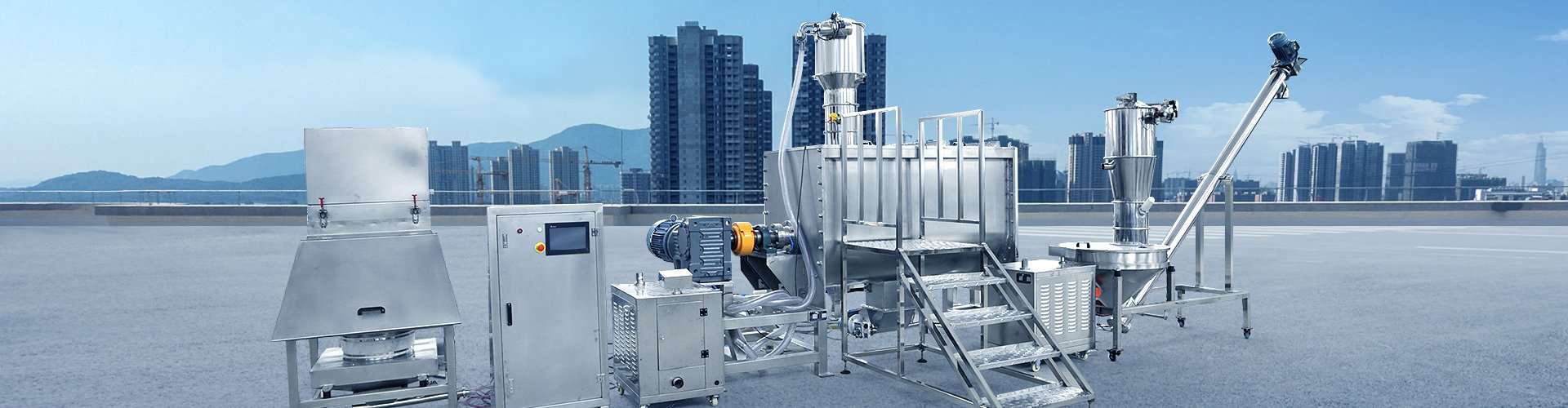
Cost-effective V Type Mixer Factory
Yinda Machinery is a leading manufacturer and factory of V Type Mixer in China and offers V Type Mixer in different sizes, capacities, and optional accessories.
We sell powder processing machines all over the world at factory prices. Our professional engineering team makes precisely designed V Type Mixer for laboratory and industrial production, and a diligent sales team can make communication efficient, equipment working stable, less trouble, and generate distinctive service.
The features of each machine in Yinda are compact design and increased productivity, help customer get desired result and performance.
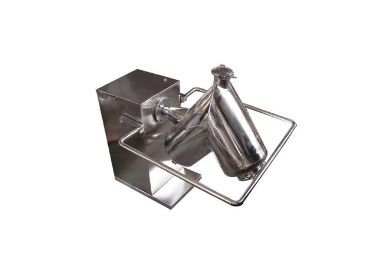
- Suitable for laboratory use or home use.
- Optimal filling range from 10 L-25 L.
- Stable operation and long use-life.

- Suitable for commercial or industrial use.
- Optimal filling range from 50L-150L.
- Manual valve for discharging.
- Button control system.

- The platform is recommended for safety protection.
- Vacuum feeding is recommended for large batches.
Yinda: Your Reliable V Type Mixer Supplier In China
1)If your project on powder processing needs to import a high performance V Type Mixer, then Yinda will be your best choice to manufacture your V Type Mixer orders.
2)Yinda is one of the leading V Type Mixer suppliers and all of our V Type Mixer can meet ISO/CE/GMP standards, and we can provide a competitive price based on your project.
3)Yinda will give you the best V Type Mixer solution based on your project’s requirements with our professional technical team, and know more about powder and particle processing that we enjoy sharing with customers,and glad to help you make well-known decision before purchase.
4) Drop us an email and send your detailed requirement now!
- Specifications
- Main Features
- Package And Shipment
- Industrial Applications
- Ultimate service
|
Model
|
YDV-100 |
YDV-200 |
YDV-300 |
YDV-500 |
YDV-1000 |
YDV-1500 |
YDV-2000 |
YDV-3000 |
YDV-4000 |
|
Volume (L) |
100 |
200 |
300 |
500 |
1000 |
1500 |
2000 |
3000 |
4000 |
| Load Coefficient |
0.3-0.4 |
||||||||
|
Motor power(kw) |
1.1 |
1.1
|
1.5
|
2.2
|
4
|
5.5
|
7.5
|
7.5 | 11 |
| Overall size(mm) | 1850×660×1500 | 2110*600*1675 | 2280*630*1780 | 2655*1040*2250 | 3070*1240*2490 | 3900*1440*3100 | 3900*1440*3100 | 4690*2200*4000 | 4950*2200*4230 |
| Weight (kg) | 230 | 290 | 400 | 550 | 860 | 1040 | 2040 | 2200 |
2800 |
V Type Mixer is also known as v blender, v cone blender, powder mixing machine and etc.
You will get a stainless steel GMP-grade v type mixer. Homogeneous mixing and complete discharge. Top quality components and spare parts. Yinda distribute v type mixer worldwide.


Hot-selling Equipments For Your Powder Processing



V-Type Mixer Machine –The Complete FAQ Guide
Are you looking for V type Mixer? You are at the right place.
Yinda machinery offers high-quality, guaranteed, mixing and blending services in China. We have been providing impeccable mixing services.
What is V-Type Mixer and its mechanism?
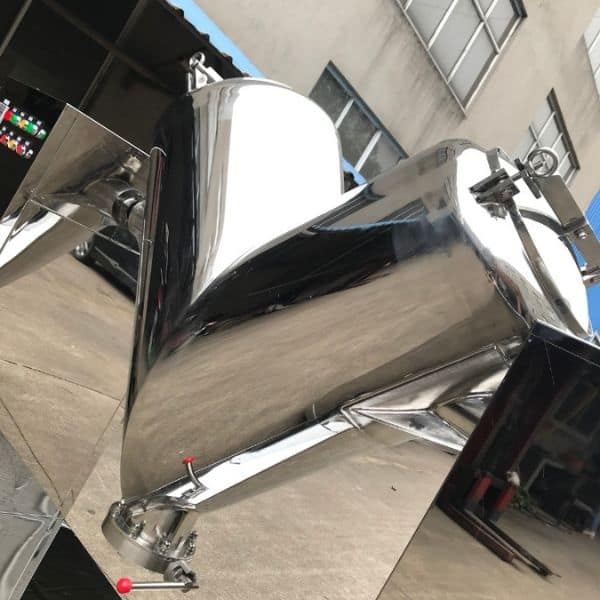
The V-Type Mixer consists of two cylindrical hollow covers which are linked at 75° to 90° angles. The container in the mixer can be mounted to tumble on trunnions.
While the V-Type Mixer drops, the material separates and recombines continually, and the mixing takes place randomly within the vessel when the material is free. The repeated conversion to the different sides of the material, together with increased friction, result in gentle, but even blending between the material and the long straight sides of the vessel.
Diffusion is the principal mechanism of mixing in a V Mixer. Mixing is defined by random, Small-scale solid particle movement, mixer movement supports diffuse mixing and increases particle mobility. Diffusion blending happens where a newly created interface distributes particles. In the absence of separation effects the dispersed blending leads to a high degree of homogeneity. Consequently, V-Mixers are utilized when precise blending formulas are required.
They are also ideal for situations in which some ingredients are less than 5% of the total mixing size. Typically, regular mixing periods are between 5 and 15 minutes according to the qualities of the substance to be mixed. It is loaded either by the two ends or by the V-apex Mixer’s port.
V-Type Mixer study has shown that there is no mechanism to transfer powder across the symmetry line of the blender for solid pumps of the same size and form. The required homogeneity of the mixes must be ensured for these materials that each side of the mixer is loaded equally.
How to measure the efficiency of V type Mixer?
The volume of the material fed into the mixer influences the mixing efficiency. The proposed V-Type Mixer volume of the total mixer capacity ranges from 50 per cent to 60 per cent. For example, if the material filling in a mixer is increased from 50% of the total volume to 70% of the total volume the time it takes for the homogenous mixing can be doubled.
Mixer speed can be a key to efficient mixing as well. The shear forces are modest at lower mixer speeds. Even if higher mixing speeds give more shear, more dusting can result in particles being separated.
That means that after the mixer has stopped the fines will be airborne and settled on the pulver bed. The critical speed is also available, which will significantly decrease the fusion efficiency if approached.
The centrifugal forces in the extreme ends of the mixer exceed the gravitational powers needed for mixing with increasing revolutions in minutes. The powder therefore tends to gravitate to the external walls of the shell of the blender.
As the blender size rises, the rotary speed normally lowers in accordance with the extreme mixer peripheral speed. V-Type Mixer are designed to work at crucial speeds between 50% and 80%.
What are the V-Type Mixer benefits and disadvantages?
The unique designs of the mixer make it impossible for other sets of combinations to achieve higher height.
All these advantages can be attributed to the mixer’s functions. Below you can find some of the advantages of working with V-Type Mixer.
V-Type Mixer usage advantages
- The reduction and attrition of particles is minimized due to the lack of moving blades.
- This allows it to be used for delicate things Material loading and unloading is simple.
- The mixer design produces an almost complete unload of product material and obviously an additional advantage in relation to horizontal mixers.
- The failure to project the shaft prevents contamination of the product.
- Easy to clean V-Type Mixer
V-Type Mixer Disadvantages
- For installation and operation, they require high headroom.
- They are not suitable for mixing densities and sizes of particles that may separate on discharge.
- It requires a broad and high overhead chamber especially during installation and operating process of the equipment.
- The machine does not have to be used to mix materials with different physical qualities that can separate them during unloading.
- Size and density are the characteristics here.
The machine is highly reliable for mixing except for these drawbacks. Not convinced yet of the V mixer requirement? Since we have some information on the V mixer, it is worth comparing it with other mixers on the market.
How V-Type Mixer Provide High-speed?
V-Type Mixer can be delivered with trunnions and fluid spray pipes with high-sped intensification bars (or lump breakers).
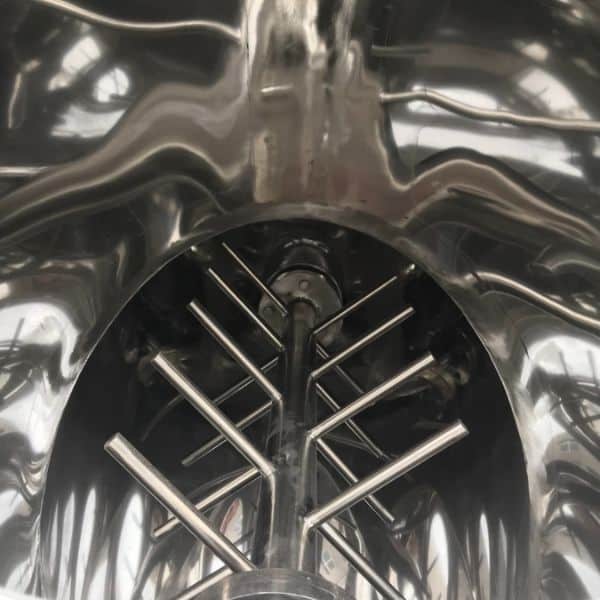
These intensifiers could be intended to disintegrate agglomerates into or created in the loading material during the wet mixing process. By offering intensifier bars, the V-Type Mixer may be adapted to more uses. This included:
- Capable of performing both dry and wet blends.
- Suitable for combining both fine and course compositions of particles.
- Convenience with cohesive powder mixing.
- The following drawbacks may be the provision of intensifier bars.
- Unwanted attrition of particles.
- Problems of intensifying shaft bar screening.
- Problems of cleaning.
What is difference between V-Type Mixer and other types of Blenders/ Mixers?
Most often, the pharmaceutical industry relies on the combination of medicines and chemicals to do a practical job with the mixers solely.
In addition, in this industry the technology required is different.
The integration of multiple mixers makes these requirements feasible. Why does that happen? Since they have various capacities and functions.
In this section, the V-Type Mixer is compared in detail with other renowned brands.
Note that we are based on four characteristics in our comparison:
- Design of structure
- The structural distinction between the machine
- Effectiveness
- In what conditions might a machine be chosen?
Everyone can see the difference between variable mixing equipment by evaluating them.
V-type and Ribbon Mixers:

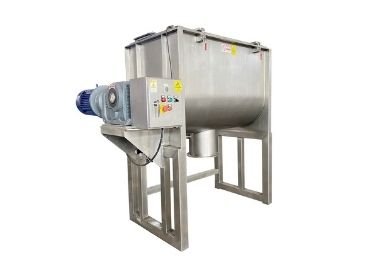
Ribbon Mixer for reference
Ribbon mixer is a machine with a ‘U’ shape on the side of the trough. The channel has an agitator consisting of helical ribbons inside and outside.
These bands contribute to a counter-direction of the content.
In addition, the movement is axially and radially frequent. So you notice clearly that the design of the mixer is somewhat different from the V-form design of the V-mixer.
The ribbons rotate impressively at speeds of around 300 fpm for dry powders to be mixed.
Depending on various conditions, the rate may vary. Besides that, in the processing of abrasive solids, the ribbon type is more efficient than the V-Type Mixer.
The V mixer makes powder and weak components. Why? In order to cope with the abrasive solids, the mixer construction can be changed. This is done by manufacturers by turning to a kind of agitator and trough with a special, abrasion resistant steel material. Steel must nonetheless be compatible with the product concerned. In addition, installation of a paddle stirrer allows the production of low shear needed for abrasive products even more reliable. The rubber mixer is versatile and cost-effective, unlike to the V-blender. This is why most operators choose to utilize it for frequent mixing operations. In short, you can choose the mixer if you work with abrasive components. On the other hand, V mixer is excellent if fragile.
Bin and V-Type Mixer:
It is a type of free fall. The bin blender/ mixer is unique.This type of mixer is important when using a certain type of container with a defined volume or capacity, and it can be little batches. The Intermediate Bulk Container (IBC) is otherwise referred to as a unique design. Blends, storages and feeds are all three functions.
The bin is in one. What is it like? Once the blending has been completed, the container can easily be removed from the drive mechanism and taken to the next operational phase. Of interest, you shift the container to another trough, e.g. hopper or barrel, without discharging its contents. That is why the designs of the containers are easy to be tailored to the customer’s preferences in many forms.
The bin forms could therefore be square, rectangular, spherical, cone, V or any other shape. You know that the bin blender does not have a particular shape. It can take any form, however. You fix and fasten it to make it your mixing bowl, no matter what shape you require. Thus you can preferably employ a bin blender with a certain capability application. Note that you can use a bin blender if your container volume is not appropriate for your batch. If this happens, you must locate a bin that is suitable for use and squeeze it.
Vertical and V-Type Mixer:
In contrast with the V-mixer, the vertical mixer has a vessel auger screw that rotates on the conical wall of the mixer.
This kind of motion upwards twists the material. The vertical mixer therefore often takes a vertical trajectory, but is cone-shaped. Furthermore, the mechanism has an auger screw. For the V-Type Mixer, all of these features are different. When materials reach the highest batch level the portions opposite the now moving screw are slowly reversed.
The mixing effect of the vertical mixer significantly results in minimal shear than a V mixer. In the process, the agitator and the wall surface are less frictional.
The vertical mixer is therefore, in contrast to the V mixer, appropriate for several abrasive applications.
Hard chromium plate is attached to components of the mixer which are in touch with and move, such as the auger and valves.
The tear and wear parts are coated using this placing process. All these aspects allow it to handle abrasive compounds more effectively. The vertical type handles the mix of pellets, powder and granules, aside from abrasive uses.
So when dealing with applications containing abrasive or pellet, the vertical mixer is a perfect match. Note that while the auger screw is completely supported at the top, it is empty of coils in the bottom. Again, this structural design allows the mixer to be completely emptied.
Double Cone Mixer and V-Type Mixer:
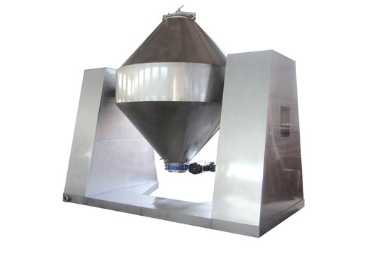
Ideally a machine with two cones on both ends, i.e. on top and below, is a double cone blender.
They connect a cylindrical element to the center segment, i.e. the bases of the cones. On either of the two supports of the blender/ mixer are the other auxiliary components, such as the driving motor. Mixing in the mixer also happens axially, as the powder material is moving in separate parts of the mixer.
Multi shear deflector plates are also available inside the cones in the mixer. The mixer has a variety of applications in the pharmaceutical business, including granulation and mixing of medicinal powders. In particular, dry powder could also be used for wet component mixing.
In the blending of very dense or abrasive goods, it is particularly useful to obtain most blenders.
The form allows a complete product withdrawal, without considerable retention, to improve its workability. In addition, the multi-shear plate’s technology increases light, compact powder and grains blending. So, in critical terms, if you are dealing with dense or abrasive components, this form of mixer design would suit you.
The conical shape is substantially different from that of the V blender at both ends of the mixer. However, compared to the V mixer, which requires more headroom, the double cone blender requires little overhead space for operation and installation.
What are the application of V-Type Mixer?
Mixer designs are used most often to mix free flowing solids in dry form. The mixer typically works on pharmaceutical products, although the slight shaving of the mixing action limits the use of the mixer for particularly soft powders or granules. For the following V-Type Mixer are usually used:
- Products for food
- Powdered milk
- Coffee
- Dry aromas
- Powdered ceramics
- Pigments
- Herbicides and plagues
- Plastic pulverization
- Food for animals
- Mixes of spice
- Engineering
- Food for children
- Cosmetic products
- Polyethylene
By examining your budget and requirements, we offer an individually designed v-type mixing and blending machine, also we can provide other relative handling systems such as pin mill, hammer mill, air classifier mil.
To safeguard the health and safety of clients, a proper mixing of pharmaceutical machine is needed. Pharmaceutical companies offer full validation and regulatory experience in Yinda with the newest mixing technology.
Yinda has been a trusted Chinese drug mixer for more than 20 years. Get us a robust, affordable and potent mixer of medicines. To purchase a free drug mixer offer, please contact us!