
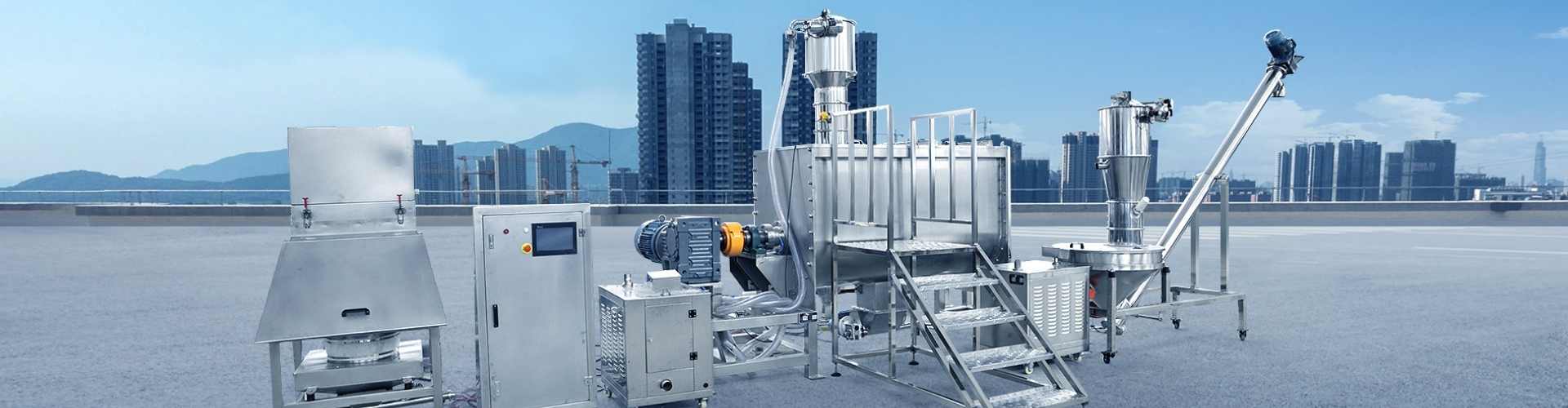
Cost-effective Ribbon Mixing Machine Factory
As a professional Ribbon Mixing Machine manufacturer and factory in China, we manufacture and supply all types of Ribbon Mixing Machine with qualitative grades of raw materials and is designed in accordance with various quality standards.
Get in touch with us and let us know how we can assist with the Ribbon Mixing Machine, we are always here to help you.

- Fit for dry or wet powder even mixing.

- Stainless steel material meets the GMP standards.

- Pneumatic valve for discharging.
- 100% loading rate possible.
Yinda: Your Reliable Ribbon Mixing Machine Supplier In China
1)if your project on powder processing needs to import a Ribbon Mixing Machine, then Yinda will be your best choice to manufacture your Ribbon Mixing Machine orders.
2)Yinda is one of the leading Ribbon Mixing Machine suppliers and all of our Ribbon Mixing Machine can meet ISO/CE/GMP standards, and we will provide a competitive price based on your project.
3)Yinda will give you the best Ribbon Mixing Machine solution based on your project’s requirements with our professional technical team, and know more about powder and particle processing that we enjoy sharing with customers.
- Specifications
- Main Features
- Package And Shipment
- Industrial Applications
- Ultimate service
| Model | YDLH-100 | YDLH-200 |
YDLH-500 |
YDLH-1000 | YDLH-1500 | YDLH-2000 |
| Full volume(m3) | 0.1m3/100L | 0.2m3/200L | 0.5m3/500L | 1m3/1000L | 1.5m3/1500L | 2m3/2000L |
| Working volume(L) | 60 | 120 | 300 | 800 | 1200 | 1600 |
| Mixing speed(rpm) | 53 | 53 | 53 | 42 | 42 | 42 |
| Mixing motor(kw) | 3 | 4 | 7.5 | 11 | 11 | 15 |
| Overall dimension(mm) | 1190*740*770 | 1550*1005*935 | 1972*1142*1300 | 2340*1437*1500 | 3180×1020×1550 | 3310×1120×1640 |
| Weight(kg) | 330 | 720 | 980 | 1700 | 1800 | 2100 |
The ribbon mixing machine is the light weighted helpful blender for mixing the powder components easily. These components are processed before, such as dry granules.
Features:
- The batch size dependent on the 65% volume of the ribbon mixing machine
- All the contact parts are consist of stainless steel.
- The feeding of the ingredients is from the charging port, whose position is on the top of the mixing machine
- The changes in the frequency are for fine-tuning the shear energy at the various levels of the blending
- The bearing mounting on the lanterns outside the mixing area to prevent the contamination
- The monoblock design helps in blocking the cross-contamination
- The purpose of designing the continuous ribbon is to discharge the final product completely.
- Availability of capacity is from 50kg to 2500kg
You can inquire more about the ribbon mixing machine from our customer care representatives. Fill in an online for the instant quotation. Our response time is just within 2-4 hours. Order your ribbon mixing machine without thinking more about it.


Hot-selling Equipments For Your Powder Processing


Ribbon Mixing Machine: The Ultimate FAQ Guide
- What Are The Ribbon Mixing Machine Uses?
- What Are The Primary Features Of Ribbon Mixing Machine?
- How Does A Ribbon Blender And A Vertical Cone Screw Blender Compare?
- Which Are The Various Types Of Ribbon Mixing Machine?
- When Should You Select U-shaped And W-shaped Ribbon Mixer Machine Design?
- What Are The Key Consideration To Select And Customize Ribbon Mixer Machine?
- What Are The Main Parts Of Ribbon Mixer Machine?
- How Does Ribbon Mixer Machine Work?
- What Is The Recommended Mixing Cycle of Ribbon Mixer?
- Which Are The Operating Parameters For Monitoring and Ensuring Desired Homogeneity With Ribbon Mixing Machine?
- What Is The Ideal Way To Add Raw Materials In Ribbon Mixing Machine?
- How Do You Ensure Clean Mixing In Ribbon Mixing Machine?
- Which Industries Use Ribbon Mixing Machine?
- What Are The Key Material Considerations For Efficient Operation Of Ribbon Mixing Machine?
- How Do You Determine The Appropriate Capacity Of The Ribbon Blender Mixer Machine?
- Which Factors Should You Consider To Determine The Type of Agitator For Ribbon Mixing Machine?
- Which Are The Types Of Mixer Seals Used In Ribbon Mixing Machine?
- How Many Types Of Discharge Gates For Ribbon Blender Mixers Are There?
- How Can You Optimize A Ribbon Mixing Machine?
- What Are The Advantages And Disadvantages Of Ribbon Mixer Machine?
- When Should You Replace The Ribbons of Ribbon Mixer?
- How Do You Determine The Right Motor Horsepower Of Ribbon Mixer Machine?
- What Is Swept Volume of Ribbon Mixing Machine?
- Which Are Some Of The Custom Ribbon Mixing Machine Options Available?
- How Do You Determine Mix Time Of Batch Horizontal Ribbon Mixer Machine?
- What Are The Ribbon Mixer Maintenance Tips?
- Are There Ribbon Blender Mixers For Products Bulk Densities Over 35 lbs/cu.ft.?
- What Are The Features Of Hygienic Ribbon Mixing Machine Design?
- How Do You Prevent Dust Explosions In Ribbon Mixer Machine?
- Which Are The Safety Systems In Ribbon Mixing Machine?
- Can You Use Ribbon Mixing Machine For Both Wet And Dry Applications?
- Which Material Do You Use To Construct Ribbon Mixing Machine?
- How Do You Troubleshoot Common Issues With Ribbon Mixing Machine?
- Which Is The Best Between Chain/Belt Driven And Direct Drive Ribbon Mixing Machine?
- What Is The Difference Between Standard Duty And Heavy-Duty Ribbon Mixing Machine?
If you have any question about ribbon mixing machine, you will find the answer right here.
Whether you want to learn about parts, features, operating parameters or working principle – this is a-must read guide for you.
Let’s dive right in.
What Are The Ribbon Mixing Machine Uses?

Ribbon mixer
A ribbon mixing machine or a ribbon blender is used to homogeneously mix powder or dry granules. Mostly, it is suited to mix solids with solids, but it can also be used to mix solids with liquids.
As such, the machine is used in manufacturing industries that make powder, pharmaceuticals, spices, cosmetics, and food.
What Are The Primary Features Of Ribbon Mixing Machine?
Some key features that most ribbon mixing machines possess include:
- The working capacity can range between 50L – 25,000L
- The contact parts of our machines are manufactured from stainless steel. However, we do also use special alloys steels and carbon steels.
- The steel parts undergo custom or set-standards polishing.
- Our machines can either have a single or double shaft. Double shaft machines are W-shaped with a mega volume capacity. On the other hand, single shaft machines are U-shaped with an average capacity.
- Instead of the regular ribbon, we incorporate the paddle-style agitator in our machines to ease the blending of fragile materials.
- Also, the side entry seals of our machines are fitted with air purge to better control cross-contamination.
- Moreover, the lanterns out of the mixing zone are mounted with bearings to aid in the control of cross-contamination.
- The flush bottom discharge valve is centrally located for efficiency.
- Atmospheric operation design.
- Easy to disassemble stuffing box with pure Teflon Gland Packing
- Worm reduction gearbox that creates a high versatility of the system.
- Operates using a Squirrel Cage 3 phase induction motor with an easy-to-change speed torque.
- The motor is suited for 50Hz, 415 volts.
- Non-steel exterior parts are coated with enamel paint.
How Does A Ribbon Blender And A Vertical Cone Screw Blender Compare?
Ribbon blenders and vertical cone screw blenders perform a similar function in material processing. However, the two differ in their design and advantages.
First and foremost, the design. The ribbon blender is horizontal while the vertical cone screw blender is vertical.
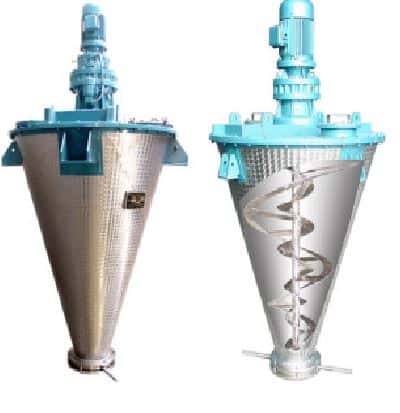
Vertical cone blender

Ribbon mixer
In terms of price, the vertical cone screw has a higher price tag compared to the ribbon blender.
Meaning, if you are operating under a tight budget, a ribbon blender will do.
Looking at power consumption, the vertical cone screw blender consumes less power. So, if you are looking to minimize power consumption, your guess is as good as mine.
Another important aspect to consider is the level of discharge. Unlike the vertical cone screw blender, the ribbon blender won’t give you 100 % discharge.
If you are operating under strict sanitary standards, you should face the direction of the vertical cone screw blender. The presence of a packing gland in the ribbon blender’s mixing zone makes it susceptible to contamination.
Also, a cone screw blender favors non-full capacity operation. It can operate with only 10 % of the blender capacity being full.
This is not possible with the ribbon blender due to its design.
Lastly, the ribbon blender offers a more vigorous blending compared to the vertical cone screw blender.
Which Are The Various Types Of Ribbon Mixing Machine?
Ribbon mixing machines vary in terms of their specifications such as design, sizes, and capacity.
Majorly, ribbon mixing machines fall under two main categories, which are:
- Vertical Ribbon Mixing Machines – These function by a repeated rising and falling of materials, with the aid of a vertical screw, to achieve a homogeneous mixture. However, the application of vertical ribbon blenders is majorly on small scale.
- Horizontal Ribbon Mixer Machine – They comprise blades or paddles fixed to a horizontal rotor.
This composition makes the machines mix the materials in short times and attain higher levels of consistent homogeneity.
When Should You Select U-shaped And W-shaped Ribbon Mixer Machine Design?
Your selection of a U-shaped or a W-shaped Ribbon mixer machine design will depend on your projected production capacity.
If you are aiming at large production, a W-shaped ribbon mixer machine will do.
Owing to its double shaft feature, it has a mega volume capacity.
On the other hand, the U-shaped ribbon mixer machine has a medium capacity hence it is suited for average production.
What Are The Key Consideration To Select And Customize Ribbon Mixer Machine?
Selection of the right ribbon mixer machine is crucial when making a purchase.
If you select a particular ribbon blender and it does not have some of the features you desire, the manufacturer can customize it.
Below are some crucial aspects that will guide your selection. Additionally, these features can be customized to your need.
Agitator Type
The agitator plays an important role in a ribbon mixing machine. There are two common types of agitators used in a ribbon blender, ribbon, and paddle.
A ribbon agitator operates by moving the materials in opposite directions using the outer and the inner helixes.
It offers a gentle but speedy mixing making it ideal for dry solids.
Paddle agitators, on the other hand, are a good alternative for solids with high liquid content.
When customizing your agitator, the below information will be of help;
- When working with viscous or dense material, choose an agitator with high shear.
- Conversely, a gentler agitator will do the trick if the materials are friable.
- Lastly, to save time your ribbon machine can have two agitators. Either both ribbons or a ribbon and a paddle.
Volume And Size
The volume and size of the ribbon mixer machine of your choice are dependent on your level of production.
Conclusively, a larger volume and size is ideal for large-level production, and vice versa.
However, it is important to note that opting for a large-capacity ribbon blender is not always the answer.
You can also choose to have multiple small ribbon mixers to optimize the mixing process.
When customizing the size, consider the swept volume. This is the area that the agitator occupies.
During the mixing process, filling the ribbon mixer to its swept volume will ensure efficient mixing.
Additionally, when customizing the length of the ribbon mixer, it should not surpass 2.5 times the agitator’s diameter.
Motor
Typically, a single agitator mixing medium-density material will require 10Hp per ton of the product being mixed.
Depending on the number of agitators your ribbon mixer may require a high or low power motor.
Consequently, you should select a motor that will efficiently run the machine. You can do this with the help of the manufacturer.
Notably, a high-power motor translates to high energy consumption.
In contrast, an extremely low-power motor will not operate the machine’s agitator.
Finishing And Construction Materials
The construction materials used in manufacturing a ribbon mixing machine vary depending on the products being mixed.
For example, a ribbon blender destined for the food industry has contact parts made of stainless steel, alongside special finishes.
Consequently, the machine is easy to clean and sanitize. Hence, contamination is prevented.
Unlike the interior or contact parts, the exterior or non-contact parts of a ribbon mixer can be made from mild steel then coated with paint.
Usually, food-grade stainless steel is always the standard construction material for the mixer’s contact parts.
For the non-contact parts, epoxy or enamel paints can be used as a coat.
The common finishes for the ribbon mixing machines are weld finishes that range from standard to sanitary welds.
Discharge Gates
How the products will exit the mixer after the mixing process is important to consider during selection and customization.
Discharge gates can either permit the partial or complete release of the final product.
You will have three main discharge gates to choose from;
- Pneumatic slide gate – It permits only a pre-determined amount of material to pass with the use of a tight seal. Consequently, making it useful in batching, measuring, or packaging.
- Drop bottom – It allows immediate complete discharge of the materials in the mixer. Their quick operation nature makes it difficult to get a tight seal when working with fine particles. Also, the ribbon mixer will need proper venting, to cater for the dust due to the quick discharge.
- Multiple slide gates – These offer a tight seal at the same time allowing for immediate discharge of the materials in the mixer.
What Are The Main Parts Of Ribbon Mixer Machine?
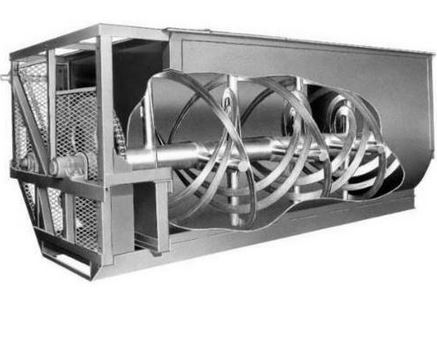
Ribbon mixer
Mixing Chamber/ Trough
This is the vessel where the mixing occurs. It can either be U or W-Shaped. It occupies the largest are of the ribbon mixer machine.
It also acts as the host of the main shaft agitator. Meaning, this is where the agitator blends and mixes the materials.
The mixing chamber can be used to mix solids with solids, liquids with liquids, or liquids with solids.
Lid Or Cover
It is used to cover the top of the mixing chamber during operation. It is manufactured from strong stainless steel making it durable.
The lid or cover can be fully opened to permit easy and thorough cleaning of the mixing chamber.
Also, you can easily add new materials to the mixing chamber.
Shaft
This piece rotates resulting in the subsequent motion of the agitator. Consequently, the agitator’s motion initiates the mixing action.
Optimally, a shaft moves at a speed of 80 -100 meters per minute.
However, this pace may vary depending on the type of ribbon mixer and the application.
The higher the speed the faster and more uniform the blending action.
Agitator
Mostly, ribbon mixer machines have helical agitators which have inner and outer ribbons. These types of agitators can be used for both wet and dry applications.
Discharge Division
The discharge division provides the exit of the already mixed materials.
To control the discharge, it is fitted with valves.
These valves offer a tight seal to eliminate any material wastage resulting from spillage.
The valves can either be controlled manually, pneumatically or electronically.
Also, there are different types of valves you can choose from;
- Rotatory ball valves – Are liquid-tight, ideal for wet applications.
- Knife gate valves – Are dust-tight, ideal for powder applications.
- Spherical valves
- Plum-blossom dislocation valves
- Butterfly valves
Control System
The ribbon mixer’s control panel comprises an emergency stop button, main power switch, fuse, and safety limit switch.
The control system can have a preinstalled program that will enable you to immediately start operating the machine after purchase.
Drive Unit
The drive mechanism of a ribbon mixing machine consists of motors.
These motors enable the rotation of the shafts.
There are various motor options including;
- Energy-saving and high-efficiency motors
- Variable-frequency motors
- Explosion resistant motors
- General motors
Notably, you can alter the driver unit’s speed and power consumption depending on the power-up method, materials, and type of processing.
How Does Ribbon Mixer Machine Work?
Once the materials enter the mixing chamber, the agitator and the shaft commence the mixing procedure.
As the shaft rotates the inner and outside helical move the materials in opposite direction.
The outer helical transmits the materials to the midsection from one end.
The inner helical carries the materials from the midsection to the other end.
The counter direction operation of the agitator consequently results in homogenous mixing.
Finally, the mixed product is discharged through the available discharge gate or mechanism.
What Is The Recommended Mixing Cycle of Ribbon Mixer?
A mixing cycle in a ribbon mixer is how many times your materials move from one end to another end.
For horizontal ribbon mixers, the typical mixing cycle is three times.
The importance of an accurate mixing cycle is to ensure that the products are thoroughly mixed.
You can adjust the mixing cycle depending on how fine your final product is.
Which Are The Operating Parameters For Monitoring and Ensuring Desired Homogeneity With Ribbon Mixing Machine?
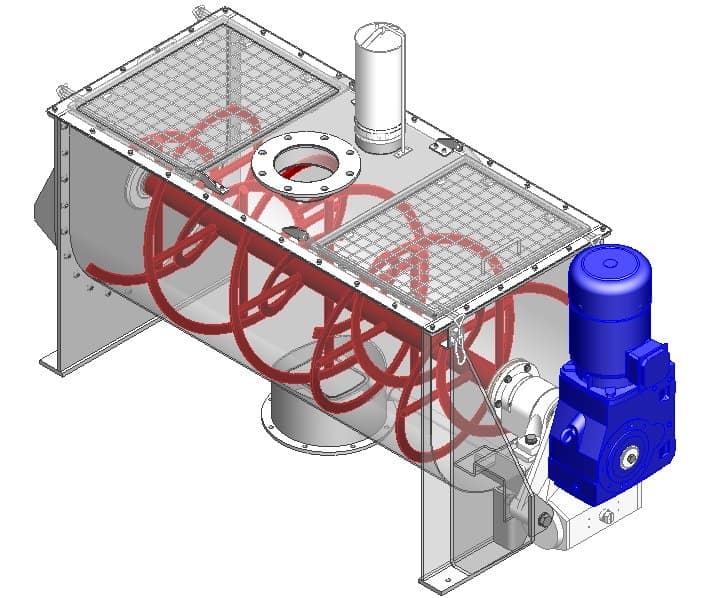
Ribbon mixer machine setup
There are some specific parameters you need to consider to ensure your ribbon mixing machine attains the desired homogeneity
Batch Size
The batch size should be between 70-80 percent of the mixer’s capacity.
Alternatively, check that the blades are slightly above the level of the material.
If you turn a blind eye to this parameter, you may end up overloading the machine. Consequently, resulting in the inefficiency of the machine.
Mixing Speed
The mixing speed will depend on the type of material and the time allocated for the mixing process.
The standard mixing speed for average mixers is 50 rpm.
You can adjust this to a higher value if you are aiming for a shorter mixing time. Also, a higher speed may permit more thorough mixing of the materials.
Additional Ingredients
If you plan to add minor ingredients to the mixture, you should introduce them in the mixer’s central area. This will ensure they are adequately blended into the mixture.
What Is The Ideal Way To Add Raw Materials In Ribbon Mixing Machine?
Ideally, you should add the raw materials in the trough before powering up the ribbon agitator.
This will allow you to first close the lid before initiating the blending process.
Carrying out the mixing with the lid closed will help prevent any contamination of the material. Also, the product will not jump out of the trough.
However, this does not apply when mixing liquids. Liquids are added while the agitator is in motion.
Consequently, you may need to have a metering pump to supply liquid to the mixing chamber at a controlled rate.
Ensure that the liquid is sprayed at the center, or at an equal amount in opposite ends (if multiple nozzles are used).
How Do You Ensure Clean Mixing In Ribbon Mixing Machine?
An important part of the ribbon mixing machine that functions to ensure clean mixing is the lid or cover. An air-tight lid/cover at the top of the trough is thus essential in ensuring clean mixing.
Additionally, you can install dust collection systems for powder mixing. Solvent recovery systems will also help in drying applications.
Which Industries Use Ribbon Mixing Machine?
Ribbon mixing machines are used by industries that deal in the below products:
- Salt
- Baby food
- Bakery premixes
- Dried food products
- Milk powder
- Plastic resins
- Carbon black
- Plastic powders
- Polymer additives
- Polyethylene
- PVC compounding
- Chemicals
- Laundry detergents
- Cleaning compounds
- Talcum powders
What Are The Key Material Considerations For Efficient Operation Of Ribbon Mixing Machine?
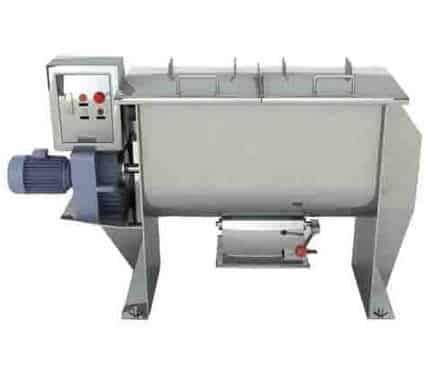
Ribbon mixer machine
Friability
Although a horizontal mixer offers minimal force on ingredients, it can still break friable materials.
As such, you will require paddle agitators for such materials since they offer a gentler mixing.
Heat and Shear
For heat and shear sensitive ingredients, the mixer’s contact surface must-have stainless steel or a non-sticking coating.
When such ingredients are subjected to heat or shear during the mixing process, they will melt, consequently sticking.
The sticking of such ingredients will affect the quality of the mixture and affect the mixer’s efficiency.
In the worst-case scenario, damaging the ribbon mixing machine in the long run.
Material Bulk Density
Low-density material like wheat middling tends to occupy more space than denser ingredients like soybean meal.
Having this in mind, you should accurately calculate the bulk density of ingredients you will use.
This way, you can ensure that you use the right amount, unlike when you visually do the measuring.
How Do You Determine The Appropriate Capacity Of The Ribbon Blender Mixer Machine?
To appropriately determine the capacity of a ribbon blender mixer machine, you will have to get the bulk density of the various ingredients you intend to use.
If you are using the mixer for different density materials, consider the highest and lowest densities.
The batch material also has to be between 30-40 % of the mixer’s volumetric capacity
Which Factors Should You Consider To Determine The Type of Agitator For Ribbon Mixing Machine?
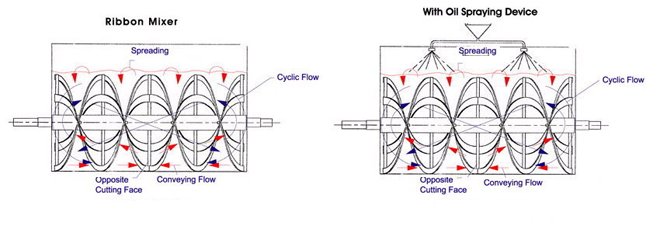
Ribbon mixing process
There are three main factors you should consider to get the correct agitator for your ribbon mixing machine:
- Shear – A high degree shear agitator will be ideal when you are dealing with the dense or viscous material. The opposite is true for the less dense materials.
- Friability – If the materials break easily, a gentle agitator, such as a paddle, will be the best.
- Mix time – The mixtime will determine whether your machine will need single or double agitators. Having two agitators on the same machine will greatly reduce the mixing time.
Which Are The Types Of Mixer Seals Used In Ribbon Mixing Machine?
Mixer seals are important in your ribbon mixing machine.
Their role is to keep the ingredients inside the mixer.
They also protect the movement of the shafts.
There are various types of mixer seals with the most common being;
- Air-Purged Seal
- Stuffing Boxes
- Lip-seals
- Single seals
How Many Types Of Discharge Gates For Ribbon Blender Mixers Are There?
Your choice of a specific type of discharge gate will depend on the discharge time and the discharge level (complete or partial) you need.
Below are the common discharge gates at your disposal:
Drop Bottom
This type of discharge gate permits immediate and complete discharge of the mixed materials.
Their instant release makes getting a tight seal difficult. Consequently, when using drop bottom discharge gates for powder applications, dust might escape into the air.
Pneumatic Slide Gate
Unlike the drop bottom gate, the pneumatic slide gate will allow only partial discharge of the product.
With these type of gates, you can regulate the amount of material being discharged.
Hence, you can easily measure, group into batches, and pack the final product.
Also, the regulatory nature of these gates means that they have tight seals to prevent the escape of any material.
Multiple Slide Gates
As the name suggests, your ribbon mixing machine will have more than one discharge gate. This will increase the discharge rate at the same time providing a tight seal.
How Can You Optimize A Ribbon Mixing Machine?
Optimization of a ribbon mixing machine starts right from purchase.
You ought to buy a ribbon mixer with the right design and features for your project.
Identifying the below parameters will help you in the optimization:
- Ingredients – Have a list of your ingredients and their bulk densities. This will help you in choosing the correct size and features. Specifically for solid ingredients, know their friability, adhesion, shear sensitivity, and particle size.
- Facility – You should know the space available in the facility. Avoid crowding out any auxiliary equipment that is relevant for your production. This will guide you in choosing the right dimensions for the ribbon mixing machine.
- Total production – How much you intend to produce will guide the decision on the capacity and the number of mixes you need.
- Mixing time – The mixing time will guide the cycle time. Knowing this will enable you to know the exact time to prepare the next batch to allow for continuous production.
- Weighing time – Now that you know the cycle time, the weighing time for the next batch of ingredients should be within the window available during a complete cycle. This will also allow for continuous production.
- Agitator design – Optimization means minimal energy use. You should not choose an agitator that is too heavy since it will require much power. Also, a wrong agitator will result in inhomogeneous mixing.
- The number of ribbon mixing machines – Sometimes, you won’t need a single large ribbon mixing machine but instead, you will need two mixers. An advantage of this is that the mixing process will continue even if one mixture is not operational.
- Coating – For materials that are heat and shear sensitive, coating of the contact surface will greatly help in the optimization. Such materials are prone to sticking on the surfaces. Consequently, reducing the mixture quality or even damaging the machine.
- Shear – You should you the appropriate shear for various materials. Some ingredients require gentle shear while others require vigorous shear. Knowing the correct shear will contribute to the quality of the final product.
- Discharge gate – Ensure you have the correct discharge gate depending on the cycle time and the type of ingredients.
- Horsepower – The correct horsepower or motor will make the mixing process efficient as the shaft and the agitators will function properly.
- Quality parts – Choosing a ribbon mixing machine with quality parts will reduce the maintenance cost. Also, it will increase the machine’s life span.
What Are The Advantages And Disadvantages Of Ribbon Mixer Machine?
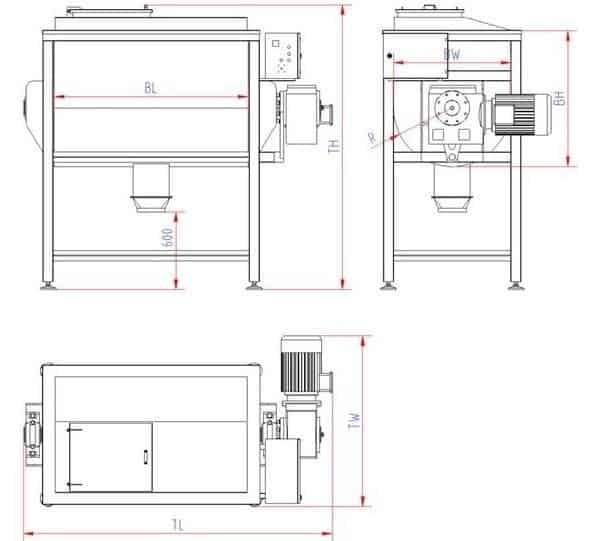 Ribbon mixer
Advantages
- The materials in the mixing chamber do not splatter or jump out when overloaded due to the availability of the lid.
- Easy to operate and maintain due to the design and construction material (steel)
- Various parts are customizable to meet your needs.
- Automation enables the machines to protect themselves from damage in case of overload.
- It can be used to mix both solid and viscous materials.
- Has minimal vibration, hence low noise.
Disadvantages
- Adjusting the ribbon speed may be difficult depending on the type of machine.
- Larger capacity machines can consume a larger amount of power.
- You can not click the ribbon mixing machine when it is operational.
When Should You Replace The Ribbons of Ribbon Mixer?
Ribbon mixers are designed to last throughout the machine’s lifetime. However, abrasive materials may make the ribbons wear out faster.
You should regularly check the ribbon’s thickness and clearance. If the ribbon appears to be growing thin, replace it before it breaks.
How Do You Determine The Right Motor Horsepower Of Ribbon Mixer Machine?
The sufficient horsepower required to operate a ribbon mixer machine depends on the machine’s capacity and the density of the ingredients.
Typically, an average mixer will require 10Hp per ton of the materials being mixed.
Selecting the right motor will guarantee that your mixer gets the right amount of horsepower, not too much or way too low. Your manufacturer will help you with this since the selection might be technical.
What Is Swept Volume of Ribbon Mixing Machine?
The swept volume is the area that the agitator occupies in the mixing chamber.
Which Are Some Of The Custom Ribbon Mixing Machine Options Available?
Some common parts of a ribbon mixing machine that can be optimized include:
- Capacity or Swept volume
- Size of the ribbon mixer
- Horse Power (HP)
- Discharge gates
- Finishes
- Motors
How Do You Determine Mix Time Of Batch Horizontal Ribbon Mixer Machine?
The mixing time of a batch horizontal ribbon mixer machine is equivalent to the cycle time, i.e. how the upstream and downstream process.
Also, the intended output will determine your machine’s mix time.
Notably, a machine with high-power motors will have a shorter mix time compared to those with medium or low-power motors.
What Are The Ribbon Mixer Maintenance Tips?
Correctly maintaining your ribbon mixer will ensure that it attains or surpasses its projected life span.
Below are some important maintenance practices:
- Check the seals – Ensure that the seals are not broken and are fully functional. Dysfunctional seals may result in to escape of materials but worse off interference with the shaft’s alignment.
- Lubrication – Most parts of the mixer are usually in motion. Thus, you should ensure they are constantly lubricated. The most important parts to consider are the areas around the reducer, the driver, and the shaft bearings.
- Check the discharge gates – Ensure that the limit switches that open and close the discharge gates are fully functional.
- Regularly monitor the drive system – A too tight or too loose belt will result to wearing out of bearings or damage of the sprocket, respectively.
- Inspect the electrical cords – Mostly, the machine’s electrical cords run openly on the floor. Regularly check that the cords are not damaged by accident.
- Monitor coefficient of variation – Annually, you can send samples of your final mixture to a lab to ensure that it is not under mixed or over mixed
Are There Ribbon Blender Mixers For Products Bulk Densities Over 35 lbs/cu.ft.?
Yes, heavier-duty ribbon blender mixers can handle products with bulk densities of over 35 lbs. /cu ft.
It is important to note that the standard ribbon blender mixers handle products with bulk densities of about 35lbs/cu ft.
What Are The Features Of Hygienic Ribbon Mixing Machine Design?
A hygienic ribbon mixing machine design should comply with GMP standards.
Below are some considerations outlined by the standards:
- Interior welds should be continuous and free from crevices and cracks.
- Agitators ought to be one piece with solid round bar construction.
- For ease of maintenance, shaft seals should have a split design. Also, they should be fully constructed with stainless steel approved by FDA.
How Do You Prevent Dust Explosions In Ribbon Mixer Machine?
You can ensure the following to prevent dust explosion in your ribbon mixer machine:
- To avoid any contact between the ribbon and the housing, the mixer and the tip of the paddle must have a large clearance between them.
- Ensure that the tip speed of the paddle is less than 1 m/s during loading or discharge.
- Ensure the bearing seals are pressurized.
Which Are The Safety Systems In Ribbon Mixing Machine?
The common safety system installed in ribbon mixing machines include:
- Speed Sensor – helps in checking the shaft’s speed and rotation.
- Temperature Sensors – These are located on the bearings. They help detect broken bearings by sensing any abnormal heat.
- Flowmeter – Helps in the regulation of the compressed air going to the bearing seal flush.
- Valve Position Sensor –Acts as a detector for whether the discharge valve is open or closed.
- Safety Locks –Ensures that the operator cannot open the machine’s access door when the machine is operational.
Can You Use Ribbon Mixing Machine For Both Wet And Dry Applications?
Although the ribbon mixing machine is commonly used for dry applications, it can also function efficiently in wet applications.
One major thing to note is that solids are added to the ribbon blender when it is not functional.
On the other hand, liquid ingredients are sprayed into the mixing chamber while the agitator is fully operational.
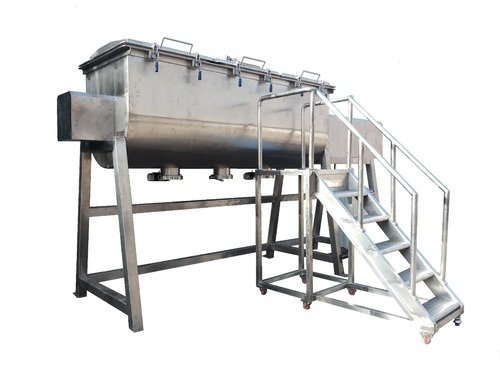
Ribbon blender
Which Material Do You Use To Construct Ribbon Mixing Machine?
Mostly, the contact parts of the ribbon mixing machine are constructed from FDA-approved stainless steel.
The outside parts can be made from low-grade steel and coated with paint.
How Do You Troubleshoot Common Issues With Ribbon Mixing Machine?
The table below highlights the major problems associated with ribbon mixing machines, their causes, and solutions.
| Problem | Cause(s) | Solution |
| Long Mixing Time | Overfilled mixer
Low mixing speed Incorrect filling sequence |
Reduce batch size
Increase mixing speed Load small ingredients in between majors |
| Blocked ribbon | High-density powder | Reduce batch size/density
During filling, start the mixer at low speed and allow it to run until discharge |
| Damaged/broken final product | Too much mixing speed
Too long mixing time |
Reduce the mixing speed
Reduce the mixing time |
Which Is The Best Between Chain/Belt Driven And Direct Drive Ribbon Mixing Machine?
Modern direct-drive powder ribbon blender machines, operated by gear motors, are recommended as opposed to the traditional chain/belt-driven mixer.
The recommendation is since the former has generally a better performance ad a low maintenance cost than the latter.
What Is The Difference Between Standard Duty And Heavy-Duty Ribbon Mixing Machine?
The immediate difference between the two is in their application. The standard-duty mixers will handle less dense products (about 35 lb/cu ft).
Conversely, the heavy-duty ribbon mixing machines will handle higher dense products (more than 35 lb/cu ft.)
Depending on your unique requirements and specifications, we offer a range of ribbon blender machines.
Contact us now for all your ribbon mixing machines.