
Date Seeds Crushing Machine and Fine Powder Processing Line
A two-stage process for hard roasted date seeds, combining controlled coarse crushing with ACM fine grinding.
YDCS Coarse Crusher + YDWF ACM Mill
Approximately 4 mm after coarse crushing
Approx. 200 mesh may be evaluated through testing
Dust collection box and YDLF air-cooled chiller
Quick Answer: What Machine Is Suitable for Grinding Date Seeds?
For roasted whole date seeds, a two-stage size-reduction process is generally more practical than feeding the complete seeds directly into a fine grinding machine.
The recommended process is:
Roasted Date Seeds → YDCS Series Coarse Crusher → Small Granules → YDWF Series ACM Mill → Fine Date Seed Powder
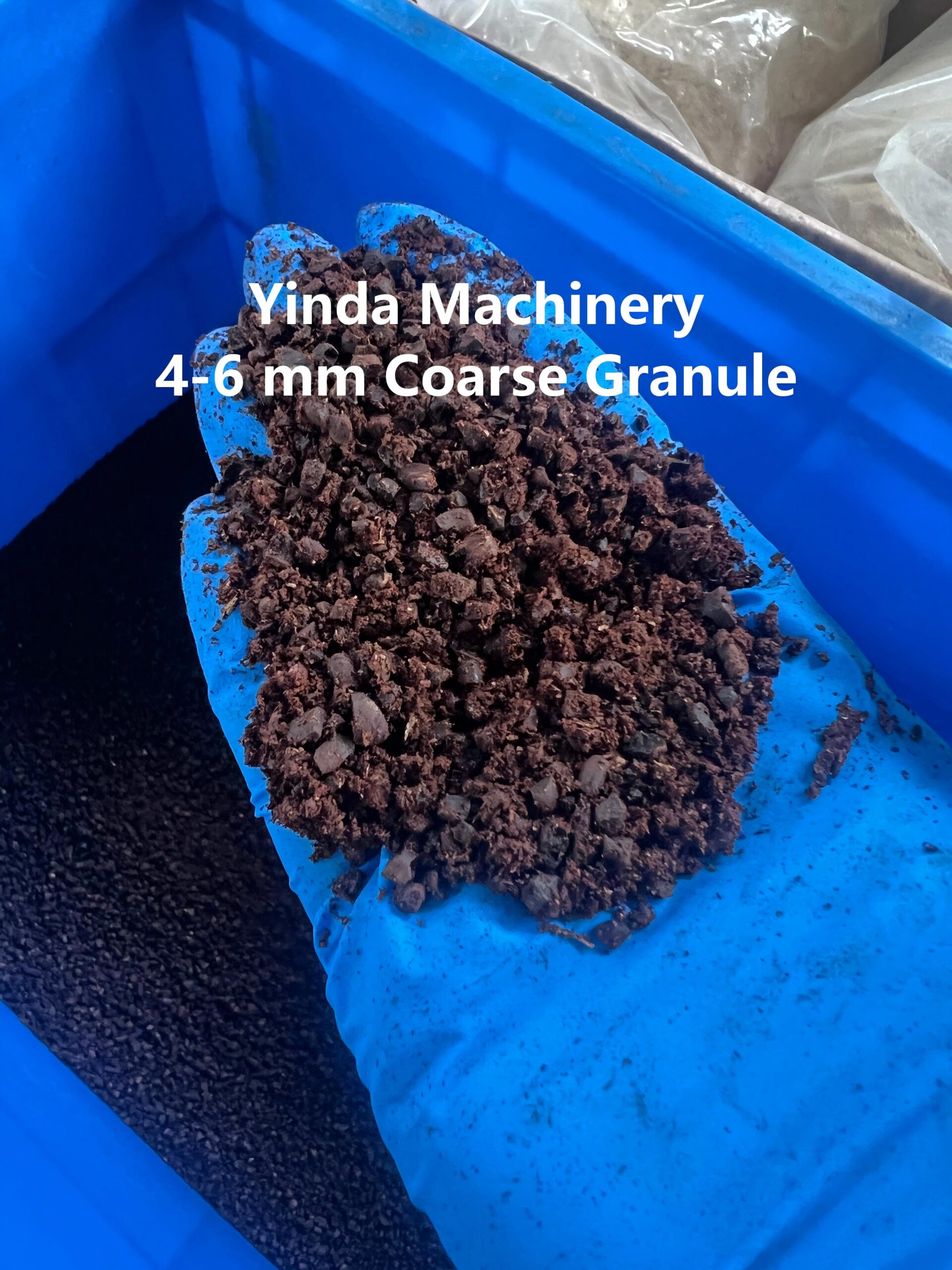
The YDCS series coarse crusher is used to reduce the hard whole seeds into smaller particles. In Yinda’s recent crushing test, roasted date seeds were processed into granules of approximately 4 mm.
If a finer and more uniform powder is required, the coarsely crushed material can then be processed by a YDWF series ACM mill. A dust collection system can be added to improve workshop cleanliness, while a YDLF series air-cooled chiller can be considered when temperature management and roasted-flavor protection are important.
Confirmed actual test result: approximately 4 mm after YDCS coarse crushing.
Recommended downstream solution: YDWF ACM mill for fine grinding.
Experience-based project target: approximately 200 mesh may be evaluated, but the actual fineness and capacity must be confirmed through material testing.
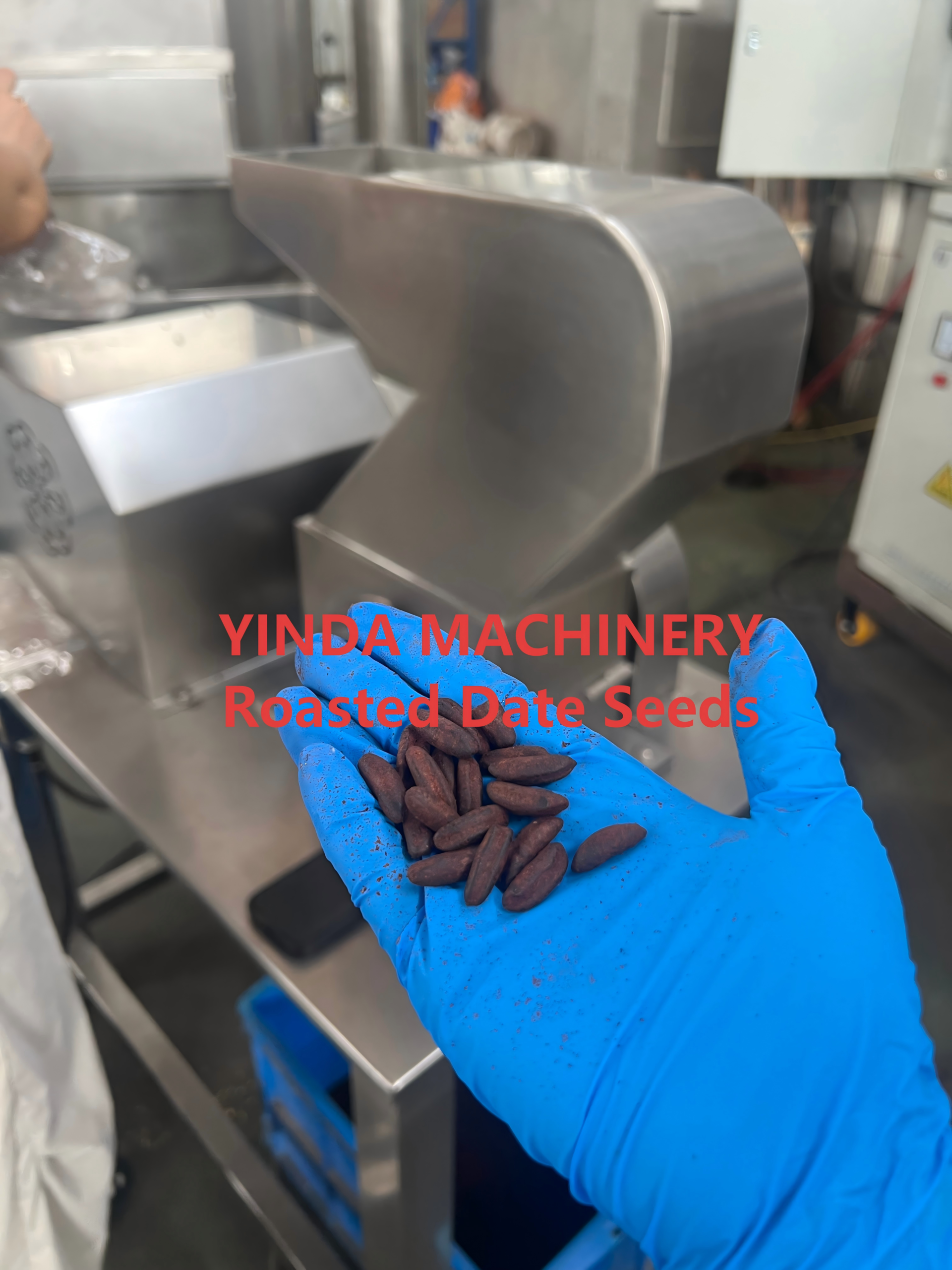
Watch the equipment or material test video
Material Characteristics of Date Seeds
Date seeds, also known as date pits or date kernels, are hard, dense and relatively difficult to reduce into fine powder.
Their grinding performance is influenced by several material characteristics.
1. Hard and Dense Structure
Whole date seeds are significantly harder than many dried fruits, leaves or ordinary food powders. Direct feeding into a fine grinding machine may cause unstable feeding and increase the impact load on the grinding components.
2. Roasting Condition
Roasting can change the hardness, brittleness, moisture and aroma of the seeds. Lightly roasted and deeply roasted date seeds may behave differently during crushing and fine grinding.
The roasting condition should therefore be confirmed before selecting the machine and estimating the production capacity.
3. Residual Moisture
Higher moisture may reduce crushing efficiency and increase the risk of material adhesion inside the machine.
The seeds should normally be sufficiently dry before entering the crushing and grinding stages. However, the acceptable moisture level should be evaluated according to the actual material and target fineness.
4. Natural Oil Content
Date seeds may contain a certain amount of natural oil. During high-speed fine grinding, the combination of oil and heat may affect powder flowability, collection efficiency and machine cleaning.
This is one reason why temperature management may become important when producing very fine powder.
5. Final Application
The appropriate particle size depends on how the finished powder will be used.
Potential applications may include:
- roasted date seed beverage formulations;
- coffee-style drink blends;
- food ingredient development;
- bakery and biscuit formulations;
- cereal and nutritional powder blends;
- extraction preparation;
- further food-additive research and formulation.
Whether the powder can legally be classified or marketed as a food additive must be confirmed according to the regulations of the target market.
Fine grinding reduces particle size, but it does not automatically make all components of date seeds water-soluble.
Recommended Date Seed Powder Process Flow
Cleaning and Inspection
↓
Roasting, if required
↓
YDCS Series Coarse Crusher
↓
Approximately 4-6 mm Intermediate Granules
↓
YDWF Series ACM Mill
↓
Cyclone Separation
↓
Pulse Dust Collection
↓
Fine Date Seed Powder Collection
Optional equipment may include:
- feeding hopper;
- magnetic separator;
- screw or vacuum conveying system;
- high-efficiency dust collection box;
- cyclone separator;
- pulse dust collector;
- rotary airlock;
- YDLF air-cooled chiller;
- vibrating sifter;
- powder collection bin;
- packing machine.
The complete configuration should be selected according to the production capacity, plant layout, cleanliness requirement and final powder specification.
Machine Selection for Date Seed Processing
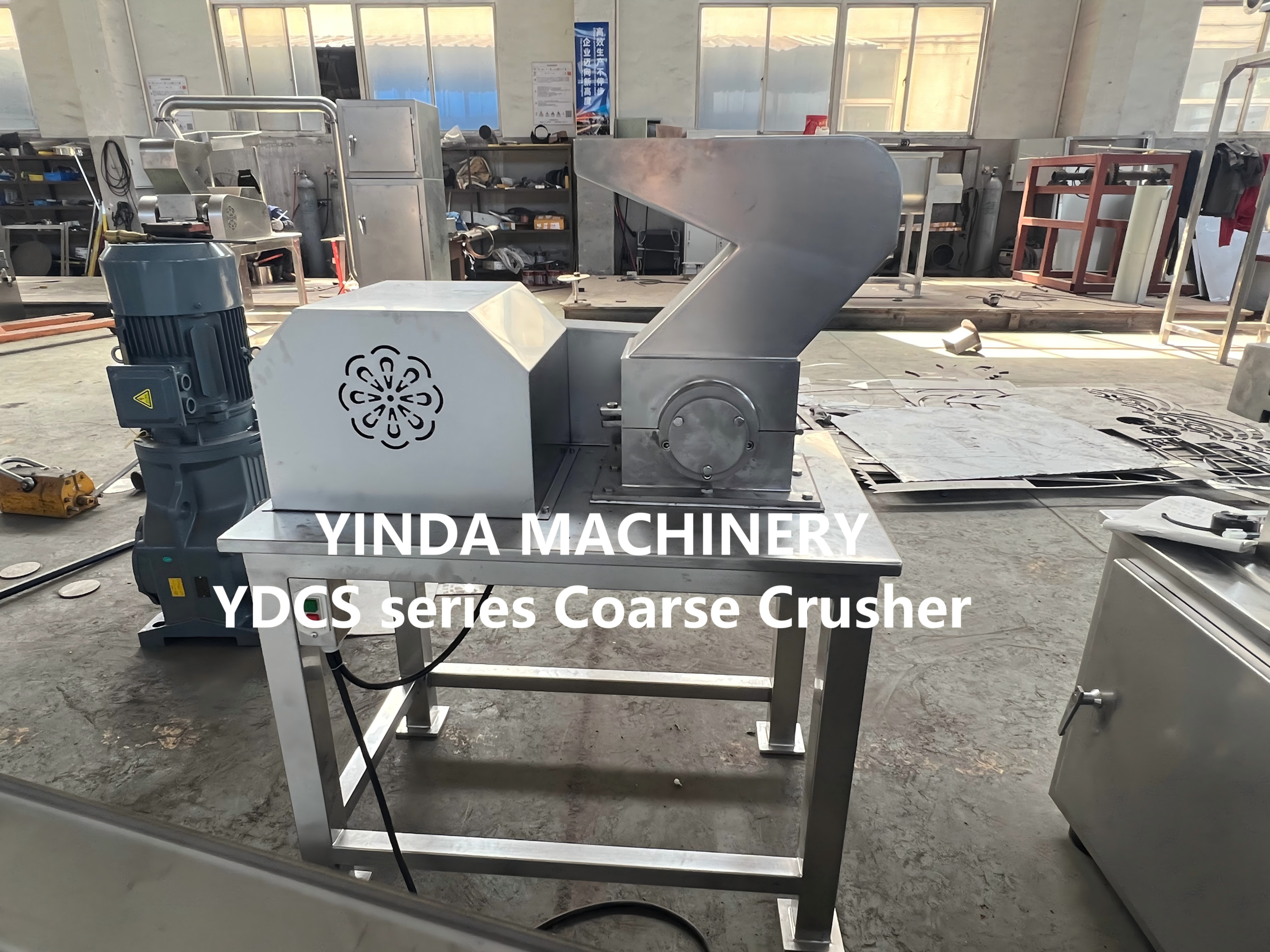
Stage 1: YDCS Series Coarse Crusher
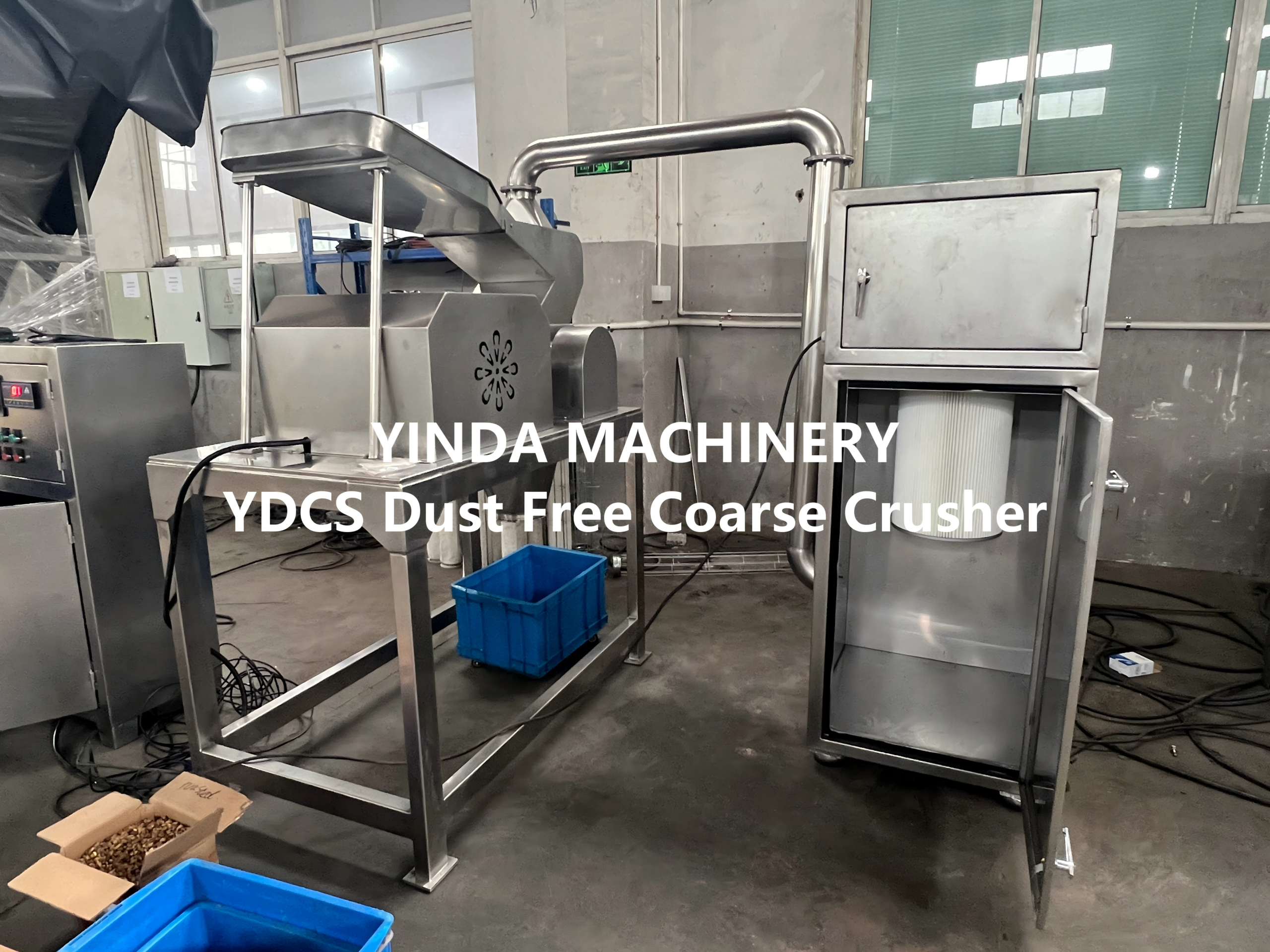
Our Yinda YDCS series coarse crusher is recommended for reducing whole roasted date seeds into smaller particles before fine grinding.
Actual Test Result
In the recent Yinda test:
- Material: roasted date seeds;
- Machine: YDCS series coarse crusher;
- Observed discharge size: approximately 4 mm;
- Test stage shown in the video: coarse crushing only.
This result applies to the tested material and test configuration. A different seed variety, roasting degree, moisture level or screen configuration may produce a different discharge condition.
Why Use the YDCS Coarse Crusher?
Pre-crushing provides a more suitable feeding size for the downstream ACM mill.
The main functions of this stage are:
- reducing the size of whole date seeds;
- improving feeding consistency;
- lowering the direct impact on the fine grinding system;
- supporting more stable continuous processing;
- reducing the risk of oversized material entering the ACM mill;
- simplifying downstream capacity control.
The coarse crusher is not intended to replace the ACM mill when the customer requires a fine and uniform powder.
Stage 2: YDWF Series ACM Mill
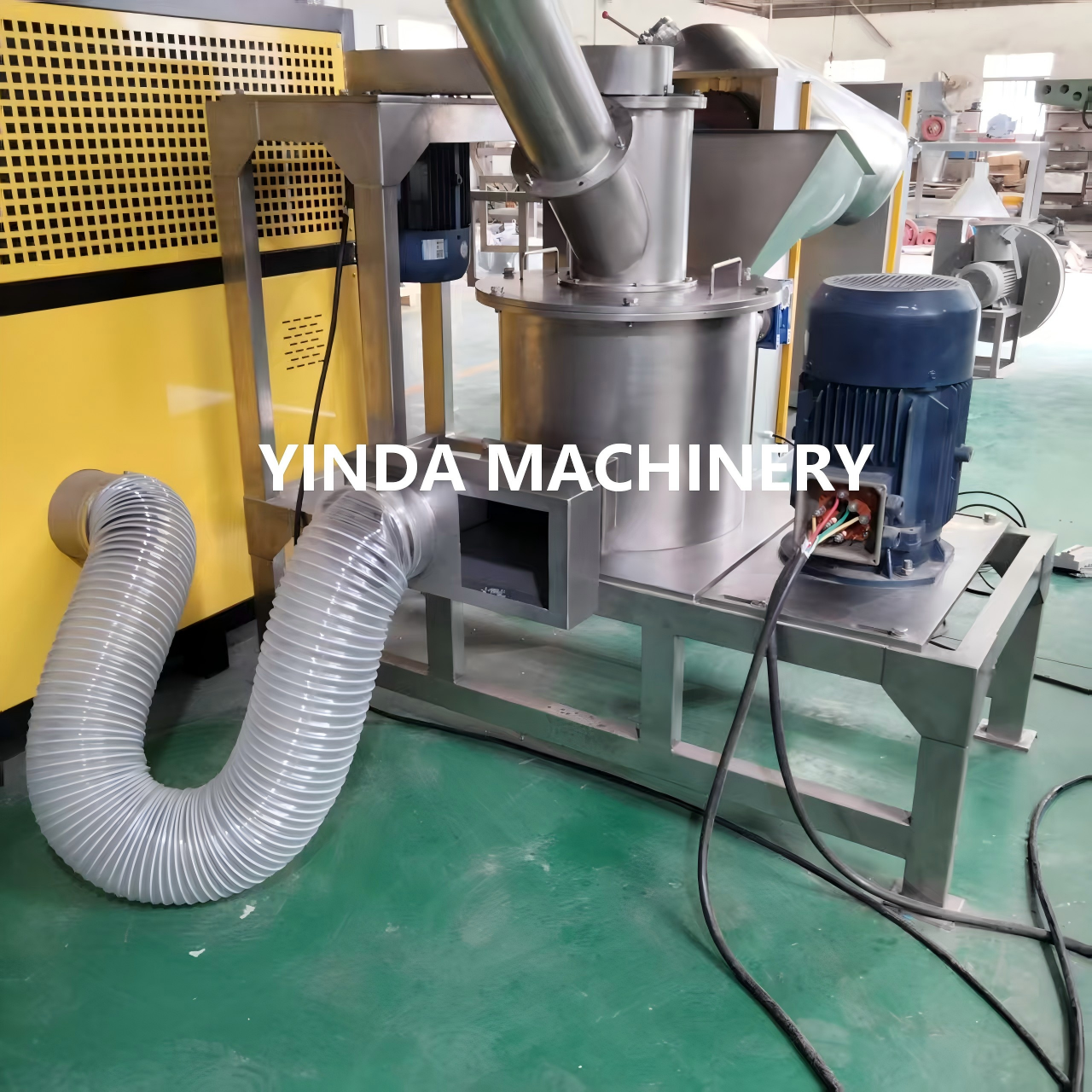
After coarse crushing, the date seed granules can be fed into our Yinda YDWF series ACM mill for further size reduction.
The ACM mill is more suitable when the customer requires:
- finer powder;
- more controlled particle-size distribution;
- continuous grinding and classification;
- integrated airflow conveying;
- reduced oversized particles in the finished product;
- a complete dust-controlled fine grinding system.
A target such as approximately 200 mesh can be considered as a project requirement. However, it should not be treated as a guaranteed result before testing.
The actual fineness and production capacity depend on:
- feeding particle size;
- roasting degree;
- material moisture;
- residual oil content;
- classifier speed;
- grinding rotor speed;
- airflow volume;
- system resistance;
- feeding rate;
- ambient temperature;
- required operating time.
工作原则
How Does the YDCS Coarse Crusher Work?
The date seeds enter the coarse crushing chamber through the feeding inlet.
Inside the chamber, rotating cutting components apply cutting, shearing and impact forces to the material. The broken particles pass through the selected screen or discharge structure after reaching a suitable size.
The screen configuration influences the approximate discharge size, but the actual particle distribution is also affected by the hardness, brittleness and feeding condition of the seeds.
The output from the coarse crusher is an intermediate material for downstream processing rather than a classified fine powder.
How Does the YDWF ACM Mill Work?
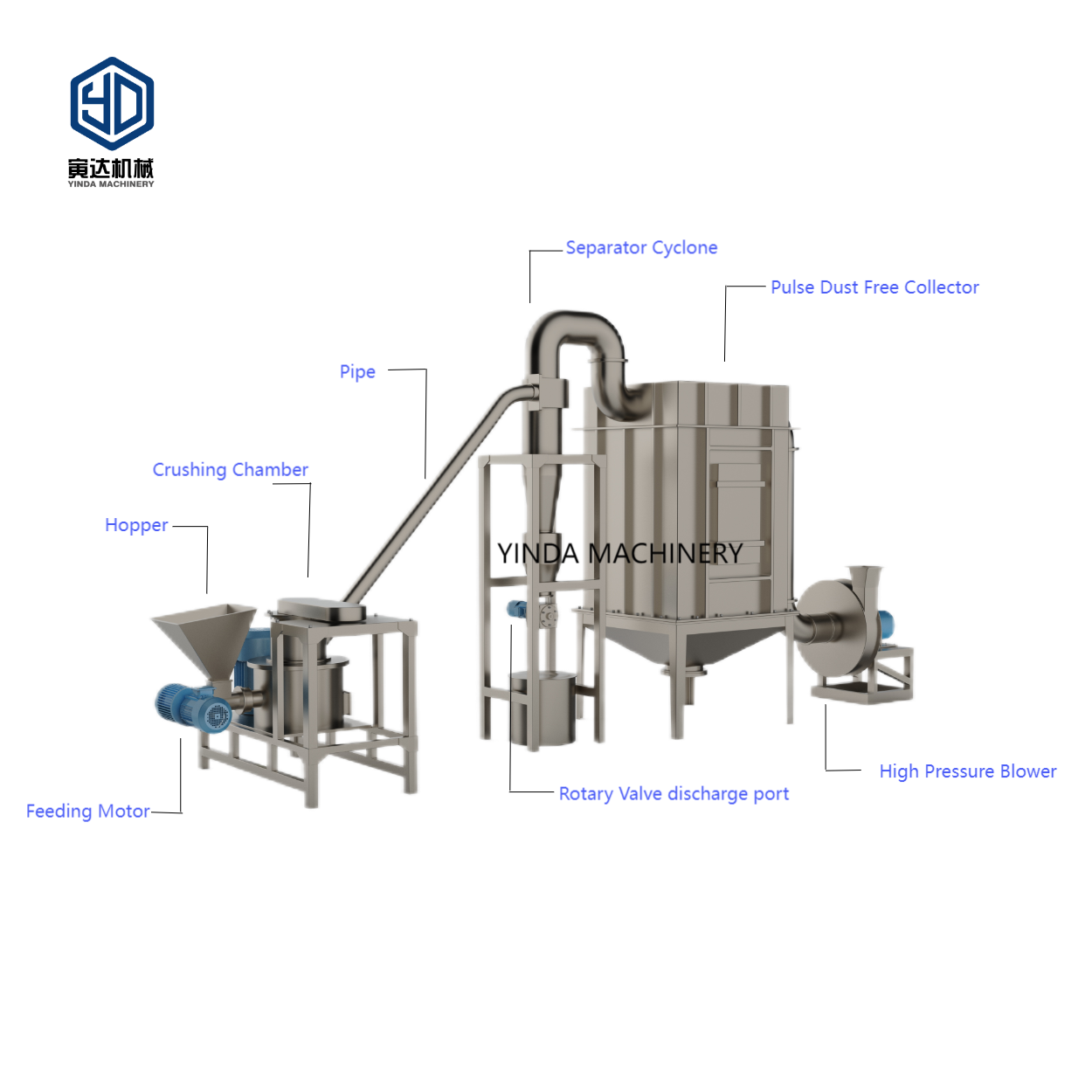
A complete ACM grinding system normally includes more than the main mill.
A typical system may contain:
- feeding device;
- ACM grinding chamber;
- dynamic classifier;
- cyclone separator;
- pulse dust collector;
- induced-draft fan;
- rotary airlock;
- control cabinet;
- powder collection container.
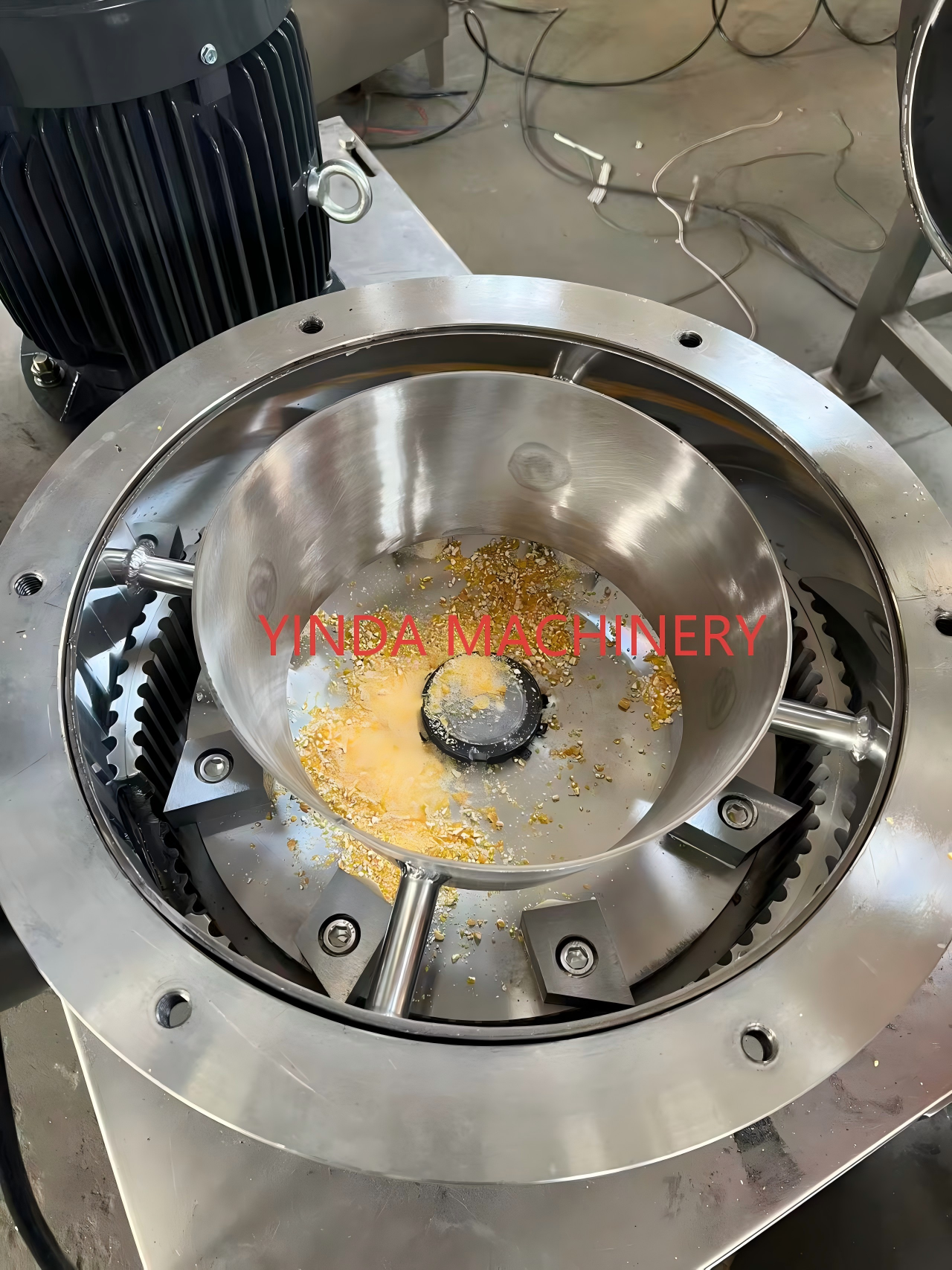
The pre-crushed date seed granules enter the grinding chamber and are reduced by the high-speed grinding components.
The airflow carries the ground particles toward the classifier wheel.
Particles that meet the required fineness can pass through the classifier and enter the collection system. Oversized particles are rejected by the classifier and remain inside the grinding zone for further size reduction.
This internal classification process allows the ACM mill to produce a finer and more controlled powder than a conventional coarse crusher.
The cyclone collects most of the powder carried by the airflow. The pulse dust collector captures finer particles that are not separated by the cyclone.
The required filter area and airflow should be calculated according to the system design rather than selected only according to the target mesh.
Configuration Options
Option 1: Standalone Coarse Crusher
A standalone YDCS coarse crusher may be suitable when:
- only coarse date seed granules are required;
- the production volume is relatively limited;
- the material generates little visible dust;
- the customer already has a central dust extraction system;
- the machine will be connected to existing downstream equipment.
This is the simpler configuration, but dust around the discharge point should still be evaluated during production.
Option 2: Coarse Crusher with High-Efficiency Dust Collection Box
When workshop cleanliness is more important, the coarse crusher can be connected to a high-efficiency dust collection box.
The dust collection system helps create negative pressure around the crushing and discharge sections and captures some of the airborne fine particles.
This configuration may be more suitable for:
- food-processing workshops;
- continuous production;
- enclosed production areas;
- materials that generate fine dust;
- customers requiring cleaner powder collection;
- production lines with higher housekeeping standards.
The dust collection capacity should be designed according to the actual air volume, piping length, discharge method and plant layout.
A dust collector cannot be selected only according to the motor power of the crusher.
Option 3: YDWF series ACM Mill with YDLF Air-Cooled Chiller
Fine grinding generates heat due to high-speed impact, airflow friction and continuous material circulation.
A YDLF series air-cooled chiller can be integrated into the system when the customer needs better temperature management.
For roasted date seeds, cooling may help reduce the risk of:
- excessive heat accumulation;
- aroma loss;
- powder sticking;
- reduced flowability;
- unstable powder collection;
- cleaning difficulties caused by oily deposits.
However, the chiller should not be described as guaranteeing a fixed discharge temperature or completely preserving the original flavor.
The actual powder temperature depends on:
- ambient temperature;
- material inlet temperature;
- feeding rate;
- grinding time;
- target fineness;
- equipment model;
- system airflow;
- chiller capacity;
- heat-transfer design.
A required discharge temperature should be treated as a test condition rather than a standard machine specification.
Option 4: SS304 or SS316L Product-Contact Parts
For general food powder processing, SS304 is commonly considered for product-contact parts.
SS316L may be requested when:
- the customer has a specific internal material standard;
- stronger corrosion resistance is required;
- the equipment is used in a pharmaceutical or special food application;
- a project specification explicitly requires SS316L.
The material scope should be confirmed clearly.
For example:
- product-contact parts;
- internal grinding chamber;
- feeding hopper;
- cyclone;
- powder pipes;
- collection bin;
- machine external covers;
- support frame.
“SS316L machine” should not be used as a general description unless the exact stainless-steel scope is defined.
Comparison Analysis
Single-Stage Grinding vs. Two-Stage Grinding
| Comparison Item | Direct Fine Grinding | YDCS + YDWF Two-Stage Process |
|---|---|---|
| Feeding material | Whole date seeds | Pre-crushed granules |
| Feeding stability | May be affected by seed size and hardness | More consistent feeding size |
| Impact on fine mill | Higher direct impact from whole seeds | Reduced initial particle size |
| Process control | More dependent on one machine | Coarse and fine stages controlled separately |
| Fine powder uniformity | Depends strongly on mill design | ACM classification supports more controlled fineness |
| Equipment investment | Potentially lower | Higher due to two processing stages |
| 应用 | Simpler or less demanding projects | Fine and more uniform powder production |
For hard roasted date seeds, the two-stage process is generally easier to control when fine powder is required.
This does not mean every project must use two machines. The final decision should depend on the feeding size, target fineness, capacity and test results.
Standalone Crusher vs. Dust-Free Crushing Design
| Comparison Item | Standalone YDCS | YDCS with Dust Collection Box |
|---|---|---|
| System structure | Simpler | More integrated |
| Initial cost | Lower | Higher |
| Installation space | Smaller | Larger |
| Dust control | Depends on operation and material | Improved local dust extraction |
| Cleaning management | More manual control may be required | Better suited to cleaner workshops |
| Recommended application | Small or existing systems | Food lines and continuous production |
The dust-free option should be selected according to actual workshop requirements rather than assumed to be mandatory for every project.
ACM Mill Without Chiller vs. ACM Mill with Chiller
| Comparison Item | Standard ACM System | ACM System with Chiller |
|---|---|---|
| System complexity | Lower | Higher |
| Investment | Lower | Higher |
| Heat management | Depends on airflow and operating conditions | Additional cooling support |
| Suitability | Moderate fineness or shorter operation | Fine grinding or longer continuous operation |
| Flavor protection | Not guaranteed | May reduce the risk of heat-related aroma loss |
| Product temperature | Depends on actual process | Still requires testing and verification |
The chiller is an optional process-control configuration. It is not automatically required for every date seed grinding project.
How to Select the Right Date Seeds Crushing Machine
The machine model should be selected from the complete process requirement rather than from the keyword “date seeds crushing machine” alone.
Customers should provide the following information.
Raw Material Information
- Are the date seeds raw, dried or roasted?
- What is the date variety or seed source?
- What is the approximate moisture content?
- Is the material brittle or relatively tough?
- Is there visible oil after crushing?
- Are foreign materials present?
Feeding Information
- What is the maximum feeding size?
- Are the date seeds complete or already broken?
- Will feeding be manual or automatic?
- Is continuous feeding required?
Final Product Requirement
- Is the target defined in millimeters, microns or mesh?
- Is a narrow particle-size distribution required?
- Is the powder used for beverages, extraction or blending?
- Is a vibrating sifter required after grinding?
- Is sedimentation in the beverage a concern?
Capacity Requirement
- What is the required hourly output?
- Is the capacity based on feeding quantity or collected qualified powder?
- How many hours will the line operate continuously?
- Is the target capacity required at the final qualified mesh?
Capacity should always be linked to the target fineness.
A machine may achieve a higher capacity at a coarser particle size and a lower capacity when producing a finer powder.
Temperature Requirement
- Is there a maximum acceptable powder temperature?
- What is the ambient workshop temperature?
- Is the material fed at room temperature?
- How long will the machine operate continuously?
- Is flavor retention a critical project requirement?
A requested temperature limit should be confirmed through testing under the required fineness and capacity.
Construction and Compliance
- Are contact parts required in SS304 or SS316L?
- Is a food-grade material certificate required?
- Is CE documentation required?
- What surface polishing standard is required?
- Are quick-disassembly parts required?
- What are the local voltage, frequency and phase?
Technical Data Classification
To avoid misunderstanding, technical information for a date seed processing project should be classified into three categories.
1. Actual Test Result
Information directly observed during a completed material test.
For the current date seed project:
- roasted date seeds were tested;
- a YDCS series coarse crusher was used;
- the observed output was approximately 4 mm;
- the available video shows the coarse-crushing stage.
2. Equipment Applicable Range
Information describing what the equipment is designed to do.
For example:
- YDCS is applicable to pre-crushing whole date seeds;
- YDWF ACM is applicable to fine grinding and dynamic classification;
- a dust collection box is applicable when cleaner crushing is required;
- a chiller is applicable when additional temperature management is required.
3. Experience-Based Reference
Information used for preliminary project discussion before testing.
For example:
- approximately 200 mesh may be considered as a target for fine date seed powder;
- a two-stage process may provide more stable feeding than direct fine grinding;
- a chiller may be beneficial for continuous fine grinding.
Frequently Asked Questions
Can a YDCS Coarse Crusher Produce Finished Date Seed Powder?
The YDCS coarse crusher is mainly used for initial size reduction.
It can produce small date seed granules, but it is not the preferred machine when the customer requires fine and uniformly classified powder.
For fine powder, a downstream machine such as the YDWF ACM mill should be considered.
What Particle Size Was Obtained in the Actual Date Seed Test?
In the current YDCS crushing test, the roasted date seeds were reduced to approximately 4 mm.
This is an actual coarse-crushing result from the tested material.
The common range for the YDCS series coarse crusher is around 2-20 mm, so result should not be interpreted as a universal output size for every date seed or every YDCS configuration.
Can the ACM Mill Produce 200-Mesh Date Seed Powder?
Approximately 200 mesh can be used as a preliminary project target.
However, the final fineness, qualified powder ratio and production capacity must be confirmed through an ACM grinding test.
The result will depend on the roasting degree, moisture, oil content, feeding size and system settings.
Is Roasting Required Before Date Seed Grinding?
Not every processing project uses the same pretreatment.
Roasting may be required for roasted beverage or coffee-style applications, but other applications may use dried or differently treated date seeds.
The machine selection and grinding performance may change according to the pretreatment method.
Can Date Seed Powder Be Used in Beverages?
Date seed powder may be developed for roasted beverage and blended drink applications.
However, fine grinding does not make the entire powder completely soluble.
The manufacturer should evaluate:
- dispersion;
- sedimentation;
- mouthfeel;
- suspension stability;
- filtration;
- extraction method;
- formulation compatibility.
The permitted application should also be checked against local food regulations.
Is a Dust Collector Necessary?
A dust collector is not automatically required for every project.
It should be considered when the material generates airborne particles, the equipment operates continuously or the customer has higher workshop-cleanliness requirements.
The correct dust collector must be selected according to actual airflow and system design.
Is a Chiller Necessary for Fine Date Seed Grinding?
A chiller is optional.
It may be useful when the powder is very fine, the operation is continuous or the customer is concerned about heat accumulation, aroma loss or powder sticking.
The need for cooling should be evaluated through material testing and process requirements.
Can Yinda Guarantee the Capacity Without Testing?
A reliable capacity cannot be confirmed from the material name alone.
Capacity is affected by:
- material hardness;
- moisture;
- oil content;
- feeding size;
- final mesh;
- qualified powder ratio;
- machine configuration;
- operating temperature.
A preliminary capacity range may be provided for equipment selection, but the project capacity should be confirmed through testing whenever the requirement is critical.
Can the Complete Line Be Designed as a Closed Dust-Controlled System?
Yes, the coarse crusher, ACM mill, cyclone, pulse dust collector and conveying equipment can be integrated into a more enclosed processing line.
The final design depends on:
- workshop layout;
- feeding method;
- discharge method;
- required automation level;
- cleaning procedure;
- local dust-control requirements;
- available installation height.
A layout drawing should be prepared after the process and machine models are confirmed.
Conclusion
For roasted whole date seeds, the YDCS series coarse crusher can be used as the first size-reduction stage.
The actual Yinda test showed that the roasted date seeds could be crushed into approximately 4 mm granules. This smaller and more consistent feeding size can support the downstream fine grinding process.
When customers require a finer and more uniform powder, the YDWF series ACM mill can be added after coarse crushing. A high-efficiency dust collection box can improve dust control at the coarse-crushing stage, while a YDLF series air-cooled chiller can support temperature management during fine grinding.
The recommended configuration is therefore:
YDCS Coarse Crusher + Optional Dust Collection Box + YDWF ACM Mill + Optional YDLF Chiller
The final machine model, capacity, fineness and temperature-control configuration should be selected according to the actual date seeds, target application and material test results.
Contact Yinda for a Date Seed Grinding Solution
Yinda Machinery can evaluate the material and recommend a suitable coarse crushing, fine grinding, dust collection and cooling configuration for the date seed powder processing line.
Yinda Machinery supports global customers with:
Material grinding tests before equipment selection
Customized processing solutions based on material characteristics and final application
Complete production line design and system integration
邮箱:dennie@yindamachinery.com
WhatsApp: +86-13914192807
Website: https://www.yindamachinery.com/
Get a Customized Powder Processing Solution
Please share your raw material, feeding size, target particle size, required capacity, moisture or oil content, heat sensitivity, voltage, cleaning requirements, and final application. Yinda Machinery will evaluate a suitable configuration.
Your Powder Processing Contact
Dennie Yuan | Powder Processing Solution Specialist
Email: dennie@yindamachinery.com
WhatsApp / WeChat: +86-13914192807
Website: 银达机械网