Bin Blender in the Pharmaceutical Industry: Why It Matters for Efficient Powder Mixing

Pharmaceutical Powder Mixing Solutions

Bin Blender in the Pharmaceutical Industry

Learn how a bin blender machine helps pharmaceutical manufacturers achieve uniform powder and granule mixing while reducing material handling, improving containment, simplifying changeovers, and supporting efficient production workflows.

Category: Pharmaceutical Powder Processing Equipment | Brand: Yinda Machinery

In pharmaceutical manufacturing, achieving a consistent mixture of powders and granules is essential for maintaining product quality. Active pharmaceutical ingredients (APIs), excipients, and other components must be distributed evenly throughout a batch to achieve the required formulation and performance.

This is where a bin blender becomes an important part of modern pharmaceutical processing. Designed to mix powders and granules inside a removable container, a bin blender can help manufacturers achieve uniform blending while reducing unnecessary material handling and improving production efficiency.

Equipment Type
搅拌机
Designed for dry powder and granule mixing inside a removable bin.
Main Benefit
Uniform Mixing
Controlled tumbling promotes repeated folding and redistribution of ingredients.
Yinda YDSH Range
400–3,000 L
Multiple total-volume options for different pharmaceutical batch requirements.
Operating Speed
5–15 RPM
Listed operating range for the YDSH Bin Blender series.

1. What Is a Bin Blender?

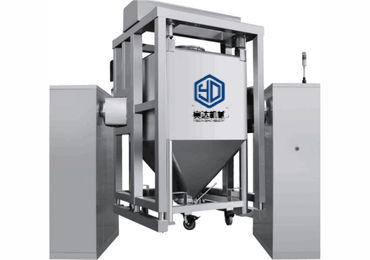
A bin blender is an industrial powder mixing machine that blends dry powders and granules inside a removable bin or Intermediate Bulk Container (IBC).

Instead of transferring material into and out of a permanent mixing vessel, the ingredients can be loaded into a dedicated bin. The bin is then securely connected to the blender and rotated at a controlled speed.

As the container rotates, the material inside tumbles and moves continuously. This creates repeated folding and redistribution of the powder, helping different ingredients become evenly distributed throughout the batch. After the mixing cycle is completed, the bin can be removed and transported to the next stage of production.

This combination of mixing and material handling is one of the main reasons bin blenders are widely considered for pharmaceutical, food, and chemical powder-processing applications.

2. Why Is a Bin Blender Important in Pharmaceutical Manufacturing?

Pharmaceutical formulations can contain ingredients with different particle sizes, densities, flow characteristics, and concentrations. Achieving a homogeneous mixture can therefore be challenging without appropriate mixing equipment.

A properly selected bin blender machine can help manufacturers achieve consistent blending while simplifying the overall production workflow.

Key Advantages

  • Uniform mixing of powders and granules
  • Reduced product transfers
  • Lower manual material handling requirements
  • Improved containment
  • Easier batch changeovers
  • Flexible production
  • Reduced risk of product loss during transfers
  • Compatibility with automated controls
  • Easier integration with downstream processing

For facilities that manufacture multiple formulations, these benefits can make bin blending particularly useful.

3. How Does a Bin Blender Machine Work?

The operating principle of a bin blender machine is based primarily on controlled tumbling.

  1. Required powders or granules are loaded into the blending bin according to the formulation and production procedure.
  2. The filled bin is positioned on the blender and securely locked into place.
  3. The machine begins rotating the container at a predetermined speed.
  4. As the bin rotates, the material continuously moves, tumbles, folds, and redistributes throughout the container.
  5. This movement encourages the different ingredients to interact and gradually produces a more homogeneous mixture.
Controllable Parameters: Rotation speed, mixing time, operating sequence, direction of movement, and safety functions can be controlled in modern systems.

Once the programmed mixing cycle has finished, the machine stops and the bin can be removed for further processing. Yinda’s Bin Blender systems, for example, use a centrally controlled system for setting operating parameters such as rotation speed and mixing time.

4. Reduced Material Handling

One of the biggest advantages of a bin blender is the reduction in unnecessary product transfers.

With some conventional mixing systems, material must be discharged from one vessel into another container before it can be transported to the next manufacturing stage.

Handling Time

Additional transfers can increase the time required to move material through production.

Product Loss

Every transfer can create opportunities for product loss.

Dust Generation

Reducing transfers can help limit dust-generating handling steps.

Contamination Points

Fewer product transfers can reduce potential contamination points.

Practical Benefit: The same container used for blending can potentially be transported to the next stage of production, simplifying the workflow and reducing the number of times operators need to handle the finished blend.

5. Contamination and Dust Control

Contamination control is a major concern in pharmaceutical manufacturing, particularly in facilities producing multiple formulations. Every time powder is exposed to the surrounding environment or transferred between containers, there can be additional opportunities for dust generation or cross-contamination.

A bin blender machine can help reduce these risks by keeping the product inside a dedicated container for a greater portion of the process. Appropriate equipment design, sealed connections, suitable product-contact surfaces, and controlled material handling can all contribute to a cleaner production environment.

However, the blender itself is only one part of contamination control. Manufacturers should also follow appropriate cleaning, validation, containment, and manufacturing procedures.

6. Flexible Batch Production

Pharmaceutical manufacturers often need to process different batch sizes. A machine designed for only one production volume may not provide enough flexibility for a facility with changing requirements.

Bin blender systems can be configured with different container capacities, allowing manufacturers to select an appropriate setup for their production needs.

Yinda YDSH Bin Blender Range

Yinda’s YDSH Bin Blender range includes models from 400 L to 3,000 L total volume, with maximum working volumes ranging from 320 L to 2,400 L. The listed operating speed is 5–15 RPM.

The correct capacity should always be selected according to the material characteristics, required batch size, filling level, mixing requirements, and production goals.

7. Easier Cleaning and Changeovers

Cleaning is another important consideration when selecting pharmaceutical mixing equipment. Residual powder from a previous batch must be removed before another product is processed, particularly when the same equipment is used for multiple formulations.

Removable-Bin Advantage: The removable-bin concept can simplify cleaning because the product-contact container can be separated from the main blender structure. Depending on the equipment design and the manufacturer’s validated procedures, bins can be cleaned and prepared separately.

This can help manufacturers reduce downtime during product changeovers.

What to Evaluate

  • Internal surface finish
  • Accessibility of product-contact areas
  • Bin design
  • Cleaning procedures
  • Cleaning validation requirements
  • Material compatibility
  • Cross-contamination controls

8. Automation and Process Control

Automation has become increasingly important in modern pharmaceutical manufacturing. Manual operation can introduce variations in mixing time, rotation speed, and other process parameters. Automated controls can help make the process more repeatable.

PLC-Based Controls

Support repeatable operation and control of process parameters.

Touchscreen HMI

Provides a centralized interface for operator control.

Recipe Management

Programmable recipes can help establish repeatable production cycles.

Batch Data Logging

Supports process monitoring and operator control.

Yinda’s current Bin Blender information lists options including PLC and touchscreen HMI controls, variable-frequency drives, programmable recipe management, batch data logging, and safety interlock systems.

9. Operator Safety

Pharmaceutical powders can require careful handling, particularly when they generate dust or require controlled containment. A bin blender can reduce some manual handling because the product remains within the blending container during the mixing process.

Common Safety Systems

  • Emergency stops
  • Safety interlocks
  • Position sensors
  • Guarding
  • Controlled machine access
  • Secure bin locking mechanisms

The specific safety features required will depend on the machine configuration, material being processed, and applicable production standards.

10. Why Choose Yinda Machinery for a Bin Blender Machine?

Choosing a manufacturer is just as important as choosing the right machine. Yinda Machinery specializes in powder and particle processing equipment and manufactures bin blenders for applications including pharmaceutical, food, and chemical powder processing.

Yinda’s current Bin Blender range is designed around removable bins, controlled mixing, and reduced cross-contamination during processing. Its YDSH series covers multiple production capacities, giving manufacturers options for different batch requirements. The company also states that it provides engineering support and customization according to customer requirements.

Key Considerations

  • Multiple Capacity Options: The YDSH series includes models ranging from 400 L to 3,000 L total capacity.
  • Controlled Mixing: Variable rotation speeds allow the blending process to be adjusted according to material characteristics and required process conditions.
  • Pharmaceutical Applications: Yinda positions its Bin Blender for dry powder mixing applications in pharmaceutical, food, and chemical industries.
  • Engineering Support: Yinda states that its engineering team works with customers to develop powder-processing solutions according to their requirements.

11. Quality and Compliance Considerations

When purchasing pharmaceutical powder-processing equipment, certification, materials, documentation, and compliance requirements should be considered as part of the project.

Yinda’s current product information references CE, ISO, and SGS certifications and pharmaceutical-oriented equipment configurations. Specific certification, material, documentation, and compliance requirements should be confirmed for each project before purchase.

Looking for the right bin blender for your pharmaceutical powder-processing line? Contact Yinda Machinery to discuss your material, batch size, capacity, and production requirements.

12. How to Choose the Right Bin Blender Machine

Before purchasing a bin blender machine, pharmaceutical manufacturers should evaluate several factors.

1. Material Characteristics

Consider particle size, bulk density, flowability, moisture content, and whether the material is fragile or sensitive to mechanical stress.

2. Required Batch Size

Determine the minimum and maximum batch quantities you expect to process. Choosing a machine that is too large or too small can affect production efficiency.

3. Mixing Uniformity

The blender should be capable of achieving the required blend uniformity for your particular formulation.

4. Cleaning Requirements

Consider how easily the bin and product-contact surfaces can be cleaned and whether the equipment supports your cleaning and validation procedures.

5. Containment

For pharmaceutical applications, evaluate how the equipment handles dust and how effectively it can minimize unnecessary product exposure.

6. Automation

Determine whether you need PLC controls, touchscreen operation, recipe management, variable-speed operation, data logging, or integration with other production equipment.

7. Downstream Processing

Consider where the blended material goes after mixing. A removable bin can be particularly advantageous when the same container can be moved directly to a downstream operation.

8. Technical Support

Choose a manufacturer that can provide technical guidance, documentation, spare parts, and after-sales support throughout the equipment’s operating life.

13. Bin Blender vs. Traditional Powder Blenders

A bin blender is not automatically the best solution for every powder-mixing application. Traditional equipment such as ribbon blenders, V blenders, and double-cone blenders can also be suitable depending on the material and process.

Key Advantage: The key advantage of a bin blender is its integration of mixing and material handling.

A Bin Blender Can Be Particularly Attractive When a Manufacturer Needs:

  • Closed-container processing
  • Flexible batch handling
  • Reduced material transfers
  • Efficient product changeovers
  • Multiple removable bins
  • Automated process control
  • Pharmaceutical-grade powder processing

The final selection should be based on actual material testing and process requirements rather than machine capacity alone.

Frequently Asked Questions

What is a bin blender used for in pharmaceutical manufacturing?

A bin blender is used to blend dry powders and granules inside a removable bin or IBC. It can help achieve uniform mixing while reducing product transfers and material handling.

How does a bin blender machine mix powders?

The filled bin is securely connected to the blender and rotated at a controlled speed. The material tumbles, folds, and redistributes throughout the container, promoting a more homogeneous mixture.

What capacities are available in Yinda’s YDSH Bin Blender range?

The source article states that Yinda’s YDSH range includes models from 400 L to 3,000 L total volume, with maximum working volumes ranging from 320 L to 2,400 L.

What should I consider when choosing a bin blender machine?

Consider material characteristics, batch size, required mixing uniformity, cleaning, containment, automation, downstream processing, and technical support.

Can a removable bin help with pharmaceutical changeovers?

It can simplify cleaning and preparation because the product-contact container can be separated from the main blender structure, subject to equipment design and validated procedures.

Why Choose Yinda Machinery for Pharmaceutical Powder Processing?

Yinda Machinery specializes in powder and particle processing equipment and manufactures bin blenders for pharmaceutical, food, and chemical powder-processing applications.

  • Multiple YDSH Bin Blender capacity options
  • Controlled mixing with variable rotation speeds
  • Pharmaceutical-oriented powder-processing applications
  • Engineering support and customization according to customer requirements
  • Options for automated process control
  • Focus on removable-bin processing and material handling efficiency
  • Technical support for powder-processing solutions

Conclusion

A bin blender can play an important role in modern pharmaceutical manufacturing by combining efficient dry powder mixing with a practical material-handling approach.

Its removable-container design can help reduce product transfers, simplify handling, support flexible batch production, and contribute to better containment and changeover procedures.

For pharmaceutical manufacturers, selecting the right bin blender machine requires careful consideration of material properties, batch size, blend uniformity, cleaning requirements, automation, containment, and downstream processing.

Yinda Machinery provides Bin Blender solutions for pharmaceutical, food, and chemical powder-processing applications, with multiple YDSH capacity options and configurable operating features.

Looking for a Bin Blender Machine for Your Production Line?

Whether you need a machine for pharmaceutical powders, food ingredients, chemicals, or other dry materials, Yinda Machinery can help you evaluate the appropriate configuration based on your application.

Send Yinda your material type, required capacity, batch size, and production requirements to receive a suitable bin blender recommendation and quotation.

Share The Post:
滚动到顶部

获取快速报价!

X