
Manual vs Automated Powder Processing Systems: How Manufacturers Reduce Labor Costs and Increase Productivity
In today’s manufacturing industry, food, pharmaceutical, chemical, spice, mineral, and nutraceutical producers face increasing pressure to improve efficiency, maintain product quality, and reduce operating costs.
Manual powder processing systems may be suitable for small-scale production, but as production volume grows and quality requirements become stricter, automated powder processing systems become a more practical solution for long-term factory growth.
Manual vs Automated Powder Processing
Reduce labor cost and improve productivity
Crushing, grinding, conveying, mixing, dust collection
Food, pharmaceutical, chemical, spice, nutraceutical
Upgrade Your Powder Processing Line
View Equipment Solutions
Why Powder Processing Automation Matters
For many years, manufacturers relied on manual powder processing systems. Operators manually loaded raw materials, transferred powders between machines, collected finished product, and cleaned dust after production.
However, as labor costs continue to rise and quality requirements become stricter, automated powder processing systems are becoming the preferred choice for modern factories.
At Yinda Machinery, we help customers improve powder processing operations through crushing, grinding, mixing, conveying, dust collection, and complete powder production line solutions.
Automation does not always mean replacing the whole factory at once. Many manufacturers start by automating one bottleneck stage, such as pre-crushing, fine grinding, powder conveying, mixing, or dust collection.

What Is a Manual Powder Processing System?
A manual powder processing system depends heavily on operators to perform most production activities. Workers are responsible for loading raw materials, feeding machines, collecting finished powder, transferring materials between processing stages, and cleaning equipment.
Typical Manual Production Process
- Raw materials are manually unloaded and transported to the production area.
- Workers manually feed materials into a crusher or grinder.
- Ground materials are collected in containers or bags.
- Operators manually transfer powders to mixing equipment.
- Mixed products are discharged and packaged manually.
Advantages of Manual Powder Processing Systems
- Lower initial investment
- Simple equipment configuration
- Easy installation and operation
- Flexible production scheduling
- Suitable for trial production and product development
Disadvantages of Manual Powder Processing Systems
What Is an Automated Powder Processing System?
An automated powder processing system integrates crushing, grinding, conveying, mixing, dust collection, and packaging into a continuous production line with minimal human intervention.
Instead of relying on workers to move materials between processing stages, automated systems allow materials to flow automatically through the entire production process.
Typical Automated Powder Processing Workflow
Why More Manufacturers Are Switching to Automation
How Yinda Machinery Transforms Manual Production into Automated Powder Processing
For most manufacturers, the real question is not only the difference between manual and automated systems. The real question is: how can an existing production process be transformed into a more efficient automated system?
The answer depends on material characteristics, production capacity, target particle size, and industry regulations. Yinda Machinery helps customers build customized powder processing solutions by selecting the right crushing, grinding, conveying, mixing, and dust collection equipment.
Step 1: Eliminating Manual Pre-Crushing with the YDCS Coarse Crusher
One common bottleneck in manual production is raw material preparation. In many factories, workers manually break large materials into smaller pieces before feeding them into a pulverizer.
This creates several problems:
- High labor requirements
- Inconsistent material size
- Reduced grinding efficiency
- Increased operator fatigue
- Lower production throughput
How the YDCS Coarse Crusher Solves the Problem
The YDCS Coarse Crusher is designed to process large raw materials before fine grinding. It is suitable for pharmaceutical, food, chemical, metallurgy, and construction industries.
Materials enter the crushing chamber through the feed hopper and are crushed by the combined action of rotating blades and fixed blades. The crushed material is automatically discharged by centrifugal force.
Key Benefits of the YDCS Coarse Crusher
- Suitable for hard, soft, fibrous, and sticky materials
- GMP-compliant stainless steel construction
- Continuous production capability
- Easy cleaning and maintenance
- Adjustable final particle size through screen replacement
- Optional dust collection system
| نموذج | YDCS-100 | YDCS-200 | YDCS-300 | YDCS-400 |
|---|---|---|---|---|
| Production Capacity kg/hr | 80-100 | 100-200 | 200-300 | 300-500 |
| Feeding Size mm | <80 | <100 | <100 | <100 |
| Discharge Size mm | 0.5-20 | 0.5-20 | 0.5-20 | 0.5-20 |
| Motor kW | 3 | 4 | 5.5 | 11 |
| Speed of Principal Axis r/min | 960 | 960 | 960 | 960 |
| Dimension mm | 650*500*1100 | 800*650*1250 | 900*700*1400 | 900*800*1440 |
| Weight kg | 280 | 350 | 450 | 550 |
Step 2: Automating the Fine Grinding Process
After coarse crushing, materials enter the fine grinding stage. This is where particle size, product quality, and production efficiency are determined.
Yinda Machinery offers different grinding solutions based on material characteristics and target fineness requirements.
YDWS Multifunctional Dust-Free Grinding Machine
The YDWS grinding system combines grinding and dust collection into one integrated solution.
Suitable materials: sugar, salt, rice, corn, ginger, turmeric, Chinese herbal medicines.
- Adjustable fineness from 20–120 mesh
- Dust-free operation
- GMP-compliant design
- Multiple grinding disc options
| نموذج | YDWS-30 | YDWS-40 | YDWS-60 | YDWS-80 | YDWS-100 |
|---|---|---|---|---|---|
| Capacity kg/h | 50-300 | 100-600 | 200-1200 | 400-2000 | 600-3000 |
| Speed r/min | 3800 | 3600 | 2600 | 2000 | 1600 |
| Input Size mm | ≤10 | ≤10 | ≤12 | ≤15 | ≤15 |
| Output Size mesh | 60-120 | 60-120 | 60-120 | 60-120 | 60-120 |
| Grinding Motor kW | 5.5 | 7.5 | 18.5 | 37 | 45 |
Watch YDWS Dust-Free Grinding Machine video
YDGS Spice Hammer Mill
The YDGS system is specifically designed for oily and fibrous materials such as chili, black pepper, cinnamon, cumin, cardamom, and garlic.
- Processes materials containing 10%-20% oil
- Maintains natural color and aroma
- Continuous production
| نموذج | YDGS-400 | YDGS-600 | YDGS-800 | YDGS-1000 |
|---|---|---|---|---|
| Capacity kg/h | 80-300 | 300-500 | 400-1000 | 800-1500 |
| Feeding Size mm | <20 | <20 | <20 | <20 |
| Particle Size | 20-100 | 20-100 | 20-100 | 20-100 |
| Grinding Motor kW | 22 | 22 | 37 | 45 |
| Dimension mm | 5400*1300*2700 | 6800*1320*2700 | 7800*1800*3200 | 8800*2000*3300 |
Watch YDGS Spice Hammer Mill video
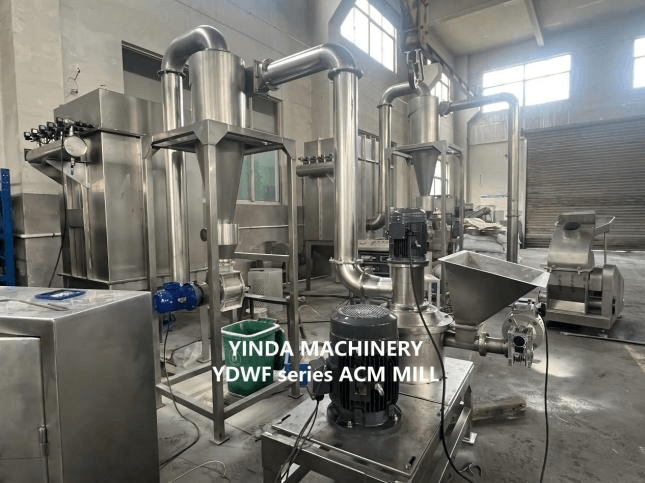
YDWF Superfine Pulverizer Air Classifier Mill
For ultrafine powder applications, the YDWF Air Classifier Mill provides advanced airflow classification technology.
- Screen-free classification
- Adjustable fineness from approximately 80–320 mesh
- Uniform particle size distribution
- Continuous automatic operation
| نموذج | YDWF-15 | YDWF-20 | (يدف -30) | (يدف -40) | YDWF-60 |
|---|---|---|---|---|---|
| Capacity kg/h | 30-100 | 40-200 | 60-300 | 80-500 | 100-600 |
| Speed r/min | 5800 | 3600 | 3600 | 2900 | 2300 |
| Feeding Size mm | ≤15 | ≤15 | ≤15 | ≤15 | ≤15 |
| Crushing Size mesh | 80-320 | 80-320 | 80-320 | 80-400 | 80-400 |
| Total Motor kW | 20 | 35 | 55 | 75 | 95 |
Step 3: Automating Powder Mixing Operations
After grinding, powder mixing is often the final critical processing step before packaging. Manual loading, transferring, timing, and discharging increase labor costs and may result in inconsistent mixing quality.
Automated mixing systems help manufacturers improve efficiency, reduce handling, and achieve consistent product quality.
خلاط على شكل حرف V.
Suitable for dry powders and granules in pharmaceutical, food, and chemical industries.
- High mixing uniformity
- Easy cleaning
- GMP-friendly design
- Small and medium batches
خلاط الشريط
Ideal for larger production volumes and continuous processing requirements.
- High mixing efficiency
- Suitable for powders and granules
- Large working capacity
- Optional heating, cooling, or vacuum systems
Three-Dimensional Mixer
Designed for applications requiring excellent mixing uniformity.
- Multi-directional mixing movement
- High loading efficiency
- Short mixing times
- Dust-free enclosed operation
By selecting the appropriate mixer, manufacturers can ensure consistent product quality while reducing production time and labor requirements.
Case Studies: From Manual Production to Automated Powder Processing
Case Study 1: Spice Manufacturer Upgrades from Manual to Automated Production
A spice processing company in Bangladesh was producing chili powder, black pepper powder, and seasoning blends using a largely manual process.
Main challenges:
- High labor costs
- Dust pollution in the workshop
- Inconsistent particle size
- Limited production capacity
Yinda solution:
- YDCS Coarse Crusher
- Vacuum Feeding System
- YDGS Spice Hammer Mill
- Pulse Dust Collection System
- خلاط الشريط
Results:
- Production capacity increased by more than 300%
- Labor requirements reduced by approximately 50%
- Product quality became more consistent
- Workshop cleanliness improved significantly
Case Study 2: Pharmaceutical Manufacturer Improves GMP Compliance
A pharmaceutical manufacturer needed to improve product consistency and upgrade its facility to meet stricter GMP standards.
Yinda supplied:
- YDCS Coarse Crusher
- YDWS Dust-Free Grinding Machine
- Automatic Conveying System
- خلاط على شكل حرف V.
- نظام جمع الغبار
Results:
- Improved GMP compliance
- Reduced contamination risks
- More consistent batch quality
- Lower operating costs
- Improved production efficiency
Frequently Asked Questions
Is automation suitable for small and medium-sized manufacturers?
Yes. Many manufacturers start with a single crusher, grinder, or mixer and gradually expand into a fully automated production line.
Which grinding machine is best for spices?
The YDGS Spice Hammer Mill is specifically designed for oily and fibrous spices such as chili, pepper, cinnamon, and cumin.
Which machine is suitable for ultrafine powder production?
The YDWF Air Classifier Mill is ideal for ultrafine powder applications and can achieve fineness from approximately 80 to 320 mesh.
Can Yinda Machinery provide complete turnkey solutions?
Yes. Yinda provides complete powder processing systems including crushing, grinding, conveying, mixing, dust collection, and automation integration.
Can Yinda equipment meet GMP requirements?
Yes. Most Yinda equipment is manufactured from stainless steel and designed according to GMP requirements, making it suitable for pharmaceutical, food, and chemical applications.
Conclusion: Choosing the Right Powder Processing System
Manual powder processing systems can still be suitable for small-scale production and product development. However, as production volumes increase, labor costs rise, and quality requirements become stricter, automation becomes an increasingly valuable investment.
Automated powder processing systems help manufacturers improve efficiency, reduce labor requirements, maintain product consistency, and support long-term growth.
Whether you need coarse crushing, fine grinding, ultrafine pulverizing, powder mixing, dust collection, or a complete turnkey production line, Yinda Machinery can provide a customized solution tailored to your materials and production goals.
Ready to Upgrade Your Powder Processing Line?
Yinda Machinery’s engineering team can help evaluate your current production process and recommend the most suitable equipment and automation solution.
- Manual-to-automated production line upgrade
- Coarse crushing, fine grinding, ultrafine pulverizing, and powder mixing solutions
- Automatic conveying and dust collection system integration
- Food, pharmaceutical, chemical, spice, and nutraceutical applications
- Customized system design based on materials, capacity, and target particle size
Please share your material type, current process, required capacity, target particle size, factory layout, and automation goal. Yinda will recommend a suitable powder processing solution.
Your Trusted Powder Processing Expert
Dennie | Powder Processing Solution Specialist
With over 15 years of industry experience, we assist global manufacturers in optimizing grinding, mixing, and powder handling systems for reliable production.
Email: dennie@yindamachinery.com
WhatsApp: +86-13914192807
Website: https://www.yindamachinery.com/